The century between 1350 and 1453 was the extended dying of the medieval Roman state. The Empire that the Andronikan civil wars and the plague had reduced was progressively confined by the Ottoman expansion to a enclave comprising Constantinople, the Peloponnese (the Despotate of the Morea), Thessalonica until its 1430 fall, and a scattering of Aegean islands. The appeals to the Latin West produced false dawns — the Council of Florence of 1438–39, the Crusade of Varna of 1444 — but no military relief. The Ottoman siege of Constantinople of 1453 — fifty-four days of bombardment by cannon, followed by the storming of the walls on the 29th of May — produced the end of the millennium-and-a-quarter Empire and the transition of the city to the Ottoman capital.
The Ottoman frontier
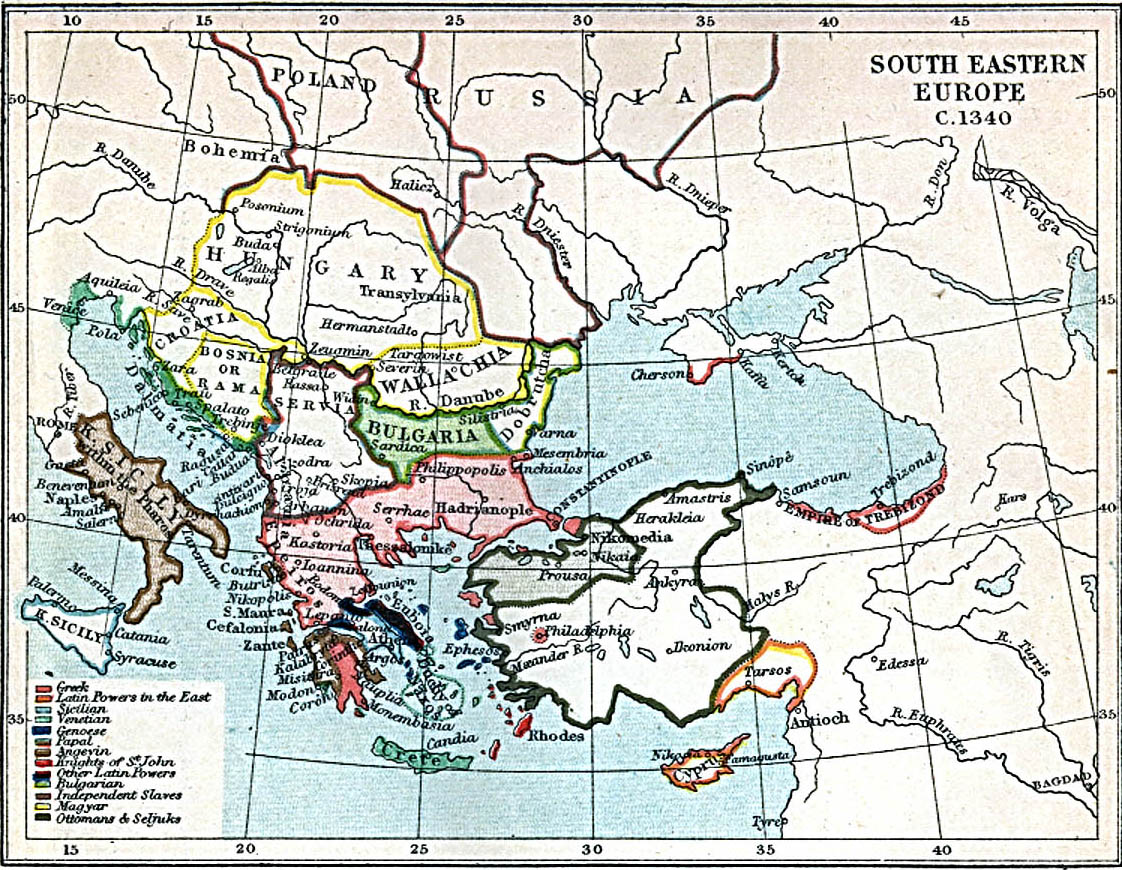
The Ottoman state — originating as a frontier ghazi principality on the Byzantine north-western Anatolian frontier under Osman I (c. 1299–c. 1326) — expanded through the fourteenth century at the expense of the declining Empire and the competing Anatolian beyliks. The Ottoman crossing of the Dardanelles into European territory in 1352 — as auxiliaries to John VI Kantakouzenos in the Byzantine civil war, but without subsequent withdrawal — produced the Ottoman foothold at Gallipoli that would expand into the conquest of the Thracian and Bulgarian territories. By the reign of Murad I (1362–1389) the Ottoman capital had been moved across the Bosphorus to Adrianople (Edirne), Bulgaria had been subjugated, and the Ottoman authority extended across portions of the Balkan peninsula.
The battle of Kosovo Polje in June 1389 — between the Ottoman army under Murad I and the Serbian-led coalition under Tsar Lazar — produced the Ottoman victory that eliminated the Serbian state as a independent power. The subsequent extension of the Ottoman frontier through Bulgaria and portions of Greece progressively reduced the Empire to its coastal and insular residue. The siege of Constantinople of 1394–1402 by Bayezid I — enough to reduce the city to famine — was raised by the Mongol intervention of Timur, whose defeat of Bayezid at the battle of Ankara in July 1402 produced the Ottoman interregnum of 1402–1413 and a Byzantine reprieve of approximately twenty years.

The Council of Florence
The diplomatic intervention by which the Empire most attempted to obtain Latin assistance was the submission to the Roman papacy through the Council of Florence in 1438–39. The council — convened at Ferrara in 1438, moved to Florence in 1439 — was attended by the Emperor John VIII Palaiologos, the Patriarch Joseph II, the Greek metropolitans, and a delegation of scholars. The doctrinal negotiations of the seven months of discussion produced Greek concessions on the filioque (the Latin addition to the Nicene Creed), on the primacy of the Roman papacy, on the doctrine of purgatory, and on liturgical matters. The Union of Florence was signed on the 6th of July 1439 by the Greek delegation, with the exception of Mark of Ephesus.
I would rather see the turban of the Turk in the midst of the City than the Latin mitre. — attributed to Loukas Notaras, Megaduke of Constantinople, on the eve of the 1453 siege
The reception of the Union at Constantinople was hostile. The popular Greek-Orthodox sentiment regarded the Union as the betrayal of the Orthodox tradition; the famous remark attributed to the Megaduke Loukas Notaras captured the popular position. The promised Latin military assistance was limited: the Crusade of Varna of 1444, organised by John Hunyadi and Władysław III of Poland, was defeated by the Ottomans under Murad II at the battle of Varna in November 1444. The subsequent smaller Crusade of 1448 was similarly defeated. By 1450 the Latin willingness to mount relief expeditions had ceased.
Mehmed II's preparation
The Ottoman Sultan Mehmed II (1444–46, 1451–81), who succeeded his father Murad II in February 1451 at the age of nineteen, conceived from the start of his reign the project of the conquest of Constantinople. The preparation through 1451–53 comprised:
- The Rumeli Hisarı fortress (1452). Built on the European side of the Bosphorus to close the maritime supply route from the Black Sea.
- A siege army of c. 80,000 combatants, recruited and trained through the winter and spring of 1452–53.
- The siege artillery train of Orban. The Hungarian cannon-founder cast the Basilica cannon — bore of approximately twenty-seven inches, projectile weight of approximately six hundred pounds — and a battery of supporting bombards.
- A naval force of c. 120 galleys for the Marmara and Bosphorus approaches.
The defensive resources of the besieged city were limited. The defending force comprised approximately seven thousand combatants — four to five thousand Greek troops, two thousand Latin volunteers (substantially Genoese under Giovanni Giustiniani Longo, Venetians, Catalans, and various other Latin contingents). The population of the city was approximately fifty thousand — down from the half-million of the twelfth century. The walls — the Theodosian land walls of the fifth century, maintained — were the principal defensive resource.
The siege of 1453
The Ottoman siege opened on the 6th of April 1453. The bombardment of the Theodosian walls by the Ottoman artillery — the first siege in military history in which gunpowder artillery played the principal role — produced damage to the outer wall over the subsequent fifty-three days. The Roman defence under the Emperor Constantine XI Palaiologos (1449–1453) and the Genoese commander Giovanni Giustiniani Longo repaired the damage each night, repulsed Ottoman assaults on the 18th of April, the 7th of May and the 12th of May, and maintained the impossible defensive position through the fifty-three days. The Ottoman naval transfer of galleys overland into the Golden Horn in the night of 21–22 April, circumventing the chain across the harbour mouth, extended the siege perimeter to the harbour walls.
The 29th of May
The final Ottoman assault began at approximately 1:00 a.m. on the Tuesday morning of the 29th of May 1453. The first wave of irregular troops (the bashibazouks) was repulsed; the second wave of regular Anatolian troops was repulsed; the third wave of Janissaries broke through at the Mesoteichion sector after the wounding of Giustiniani and his withdrawal from the defensive line. The subsequent collapse of the defence was rapid. The Emperor Constantine XI — last seen leading a cavalry charge into the breach near the Saint Romanos Gate — was killed in the fighting; his body was never identified. The Ottoman troops entered the city through the breach and through subsequent breaches in the harbour walls; the city was given over to the customary three-day sack.
Mehmed II entered the city on the afternoon of the 29th of May. The first action was the conversion of the Hagia Sophia into a mosque — the Aya Sofya Camii, which it would remain until 1934 (when it became a museum) and again from 2020 to the present. The subsequent organisation of the post-conquest Ottoman administration of the city was the subject of the subsequent decade; the repopulation of the city, the restoration of the commercial life, the accommodation of the surviving Greek-Orthodox population under the Patriarchate of Constantinople in its new constitutional position as the recognised representative of the Orthodox millet within the Ottoman state, were the achievements of Mehmed II's subsequent reign.
The last Roman successor — the Empire of Trebizond — fell to Ottoman conquest in 1461. The Despotate of the Morea fell in 1460. The Roman Empire — the state continuously administered, however briefly interrupted by the Latin occupation of 1204–61, from the Augustan settlement of 27 BC to the walls of Theodosius in May 1453 — ceased to exist. The subsequent Roman afterlife — in the Ottoman institutional continuity, in the Russian "Third Rome" doctrine, in the Greek diaspora and the modern Greek state — is the subject of the final chapter.
End of Chapter IX