Foreword
What was Byzantium,
really?
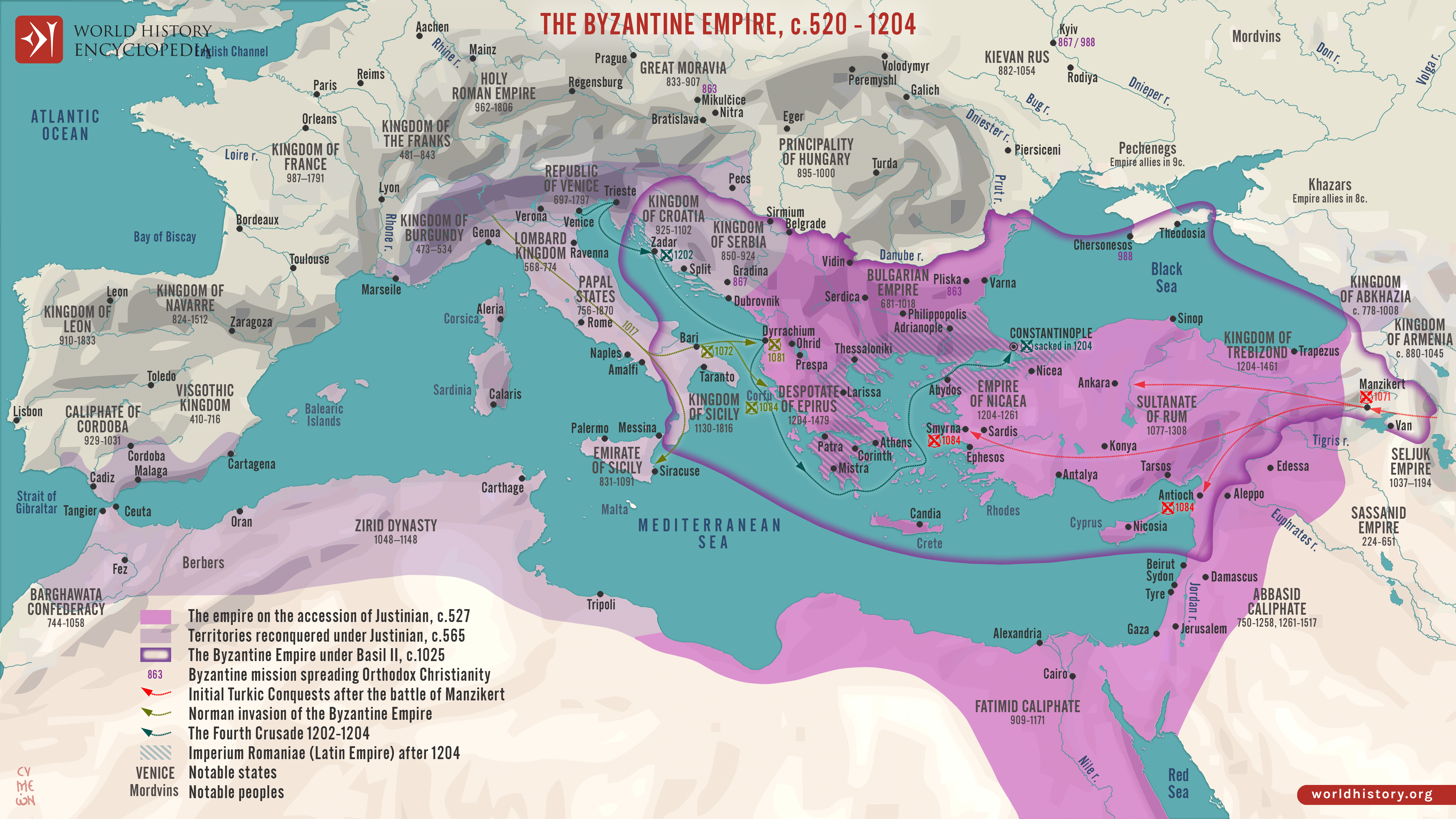
The Roman Empire after Constantine moved its capital from Italy to the Bosporus. The Byzantines themselves did not use the word "Byzantine" — they called themselves Romaioi, "Romans". The label "Byzantine" was invented by the German historian Hieronymus Wolf in 1557 to distinguish the medieval Greek-speaking empire from the classical Latin-speaking one; it has stuck because it is useful.
The eleven centuries this volume covers contain too many transformations to be summarised easily. The early-Byzantine period (roughly 330–610) is still recognisably the late Roman Empire of Constantine and Justinian: Latin in administration, Christian in religion, Mediterranean in outlook, with substantial Roman institutional continuity. The middle-Byzantine period (610–1204) is the proper Byzantine empire: Greek-speaking, Orthodox-Christian, defined territorially by the loss of the Levant and Egypt to the Arab caliphates and politically by the Iconoclasm controversy, the conversion of the Slavs, the schism with the Latin Church (1054), and the Macedonian and Komnenian dynasties' attempted military recoveries. The late-Byzantine period (1204–1453) is the rump empire that limped along after the Latin sack of Constantinople in the Fourth Crusade, restored under the Palaiologoi after 1261 but never to the eleventh-century territorial extent, finally extinguished by the Ottoman conquest of 1453.
The volume also acknowledges, in its opening chapters, that Volume IX (the Roman Empire) covers the same chronological span up to 1453. This is intentional: the Roman and Byzantine volumes describe the same continuous state from two different vantage points. The Roman volume tracks the Latin-pagan-classical Mediterranean empire from Augustus to its eventual extinction in the East; the Byzantine volume tracks the same empire's eastern continuation as a Greek-speaking Orthodox Christian medieval state. Readers can read either volume independently; readers who read both will see why historians have argued, for five centuries, about exactly when "Rome" became "Byzantium" — there is no single answer.
We then visit the surviving Byzantine world. Istanbul (the Hagia Sophia, the cisterns, the walls). Ravenna (the early Justinianic mosaics). Thessaloniki. Mount Athos. The Mistras ruins in the Peloponnese. Cappadocia's underground churches. The Caucasus monasteries of Sumela and Bagrati. The Sicilian Byzantine sites of Cefalù and Monreale.