The Palaiologan dynasty that took possession of the restored Empire in July 1261 ruled at Constantinople for one hundred and ninety-two years — the longest dynastic continuity of any Roman imperial house — until the last Palaiologos, Constantine XI, fell in the Ottoman storming of the walls on the 29th of May 1453. The dynasty's history is the long story of a cultural-religious revival pursued under the conditions of continuous territorial loss, diplomatic isolation, fiscal collapse, and recurrent civil war. The first ninety years — the reigns of Michael VIII (1259/61–1282), Andronikos II (1282–1328), and the successor regimes through approximately 1350 — produced the Palaiologan Renaissance, a flourishing of theological, philosophical and artistic production that the subsequent fall of the Empire to the Ottomans would disseminate to the Italian Renaissance and into the broader European cultural inheritance.
Michael VIII's reconstruction
Michael VIII Palaiologos (1259/61–1282) was the architect of the restored Empire's institutional and diplomatic system. The restored state inherited structural problems: the financial exhaustion of the Nicaean regime by the recovery effort, the physical degradation of the city of Constantinople from the Latin occupation and the intervening half-century of neglect, the fragmented territorial situation (the successor states of Epirus and Trebizond refused submission to the restored Empire and remained independent for the subsequent two centuries), and the continuing threat from the Latin powers that had not accepted the loss of the Latin Empire.
The diplomatic intervention by which Michael VIII most neutralised the Latin threat was the Union of Lyon in 1274 — the submission of the Greek Orthodox Church to the doctrinal and constitutional authority of the Roman papacy, in exchange for Papal political support against the Angevin Sicilian programme of reconquest of Constantinople. The Union was imposed on the Greek ecclesiastical establishment by the imperial coercion (dismissals, imprisonments, confiscations) and produced subsequent political-religious resistance — sufficient for the subsequent emperor Andronikos II to repudiate the Union in 1282 immediately on Michael's death. The diplomatic benefit was, however, substantial: the 1282 Sicilian Vespers (the popular Sicilian revolt against the Angevin rule) and the consequent collapse of the Angevin project for Constantinople were produced by Michael's diplomatic and financial support of the Aragonese intervention.
The cultural revival
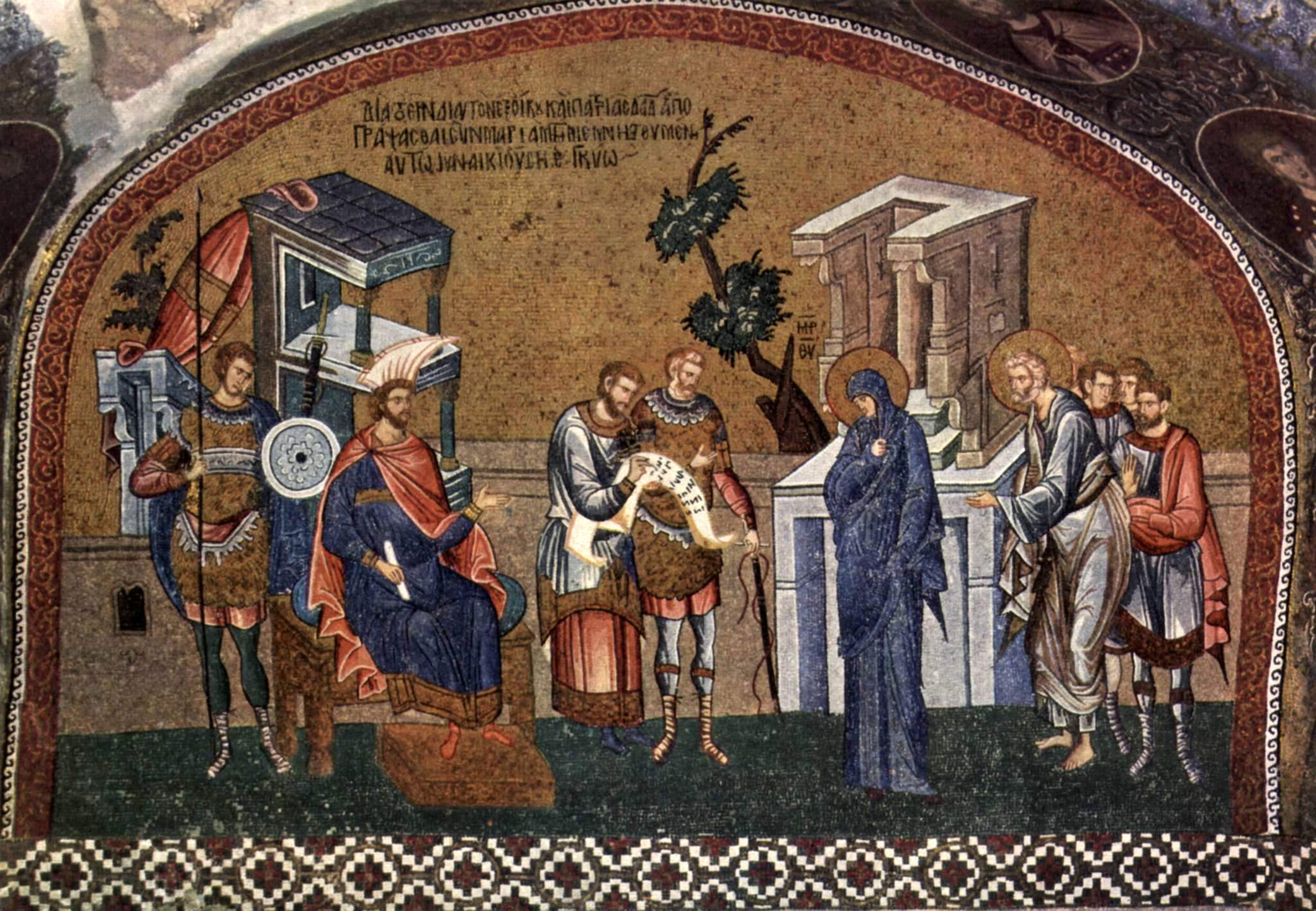
The Palaiologan cultural revival — produced under the sponsorship of Michael VIII and flowering under Andronikos II — produced achievements across disciplines. The intellectual figures of the period included: Theodore Metochites (1270–1332), the polymath and founder of the Chora monastery's mosaic decoration that has survived to the present; Maximos Planudes (1260–1310), the classical scholar and translator from Latin and Persian; Nikephoros Gregoras (1295–1360), the historian and theologian; Manuel Moschopoulos (c. 1265–1316), the grammarian and editor of classical texts. The Palaiologan production of manuscripts of classical Greek and patristic literature — preserved at libraries across the Italian peninsula in the fifteenth-century diaspora — would shape the Italian Renaissance encounter with the Greek tradition.

The Hesychast controversy
The doctrinal controversy of the period was the Hesychast dispute of the 1330s and 1340s. The Hesychast tradition — a monastic prayer practice that had developed at the Athonite monasteries from the twelfth century — involved the repetition of the Jesus Prayer ("Lord Jesus Christ, son of God, have mercy on me") combined with bodily disciplines, with the claimed result of direct experiential apprehension of the divine light. The Calabrian-born scholar Barlaam of Calabria attacked the Hesychast practice from a scholastic-Aristotelian perspective; the defence was undertaken by Gregory Palamas (1296–1359), an Athonite monk and subsequent Archbishop of Thessalonica.
The doctrinal dispute — settled in favour of the Hesychast tradition by the Councils of Constantinople of 1341, 1347 and 1351 — produced the Palamite doctrine of the distinction between the divine essence (substantially unknowable and unparticipable) and the divine energies (substantially knowable and participable through the Hesychast prayer practice). The doctrine has remained the fundamental theological-mystical framework of Eastern Orthodox spirituality from the 1351 settlement to the present.
The Andronikan civil wars
The first major civil war of the Palaiologan period was the Andronikan civil war of 1321–1328 between Andronikos II and his grandson Andronikos III. The war was prosecuted intermittently over seven years across the European provinces of the Empire and destabilised the imperial administration. The result — Andronikos III's victory in 1328 and Andronikos II's deposition and subsequent monastic retirement — produced a reign (Andronikos III, 1328–1341) that was active in military and administrative reform but limited in its achievements by the accumulated decay of the preceding decades.
The second civil war and the Black Death
The second civil war of 1341–1347 — between the regency for John V Palaiologos under Anna of Savoy and the usurpation of John VI Kantakouzenos — produced catastrophic damage to the Empire. The Kantakouzenist reliance on Turkish auxiliaries (Aydinid and Ottoman troops, brought across the Bosphorus to fight the imperial forces in the Balkans) established the Ottoman military presence in the European territories from which it would not withdraw; the financial exhaustion of the imperial treasury was substantial; the physical degradation of Constantinople by the absence of any maintenance was substantial. The 1347 settlement — under which John VI assumed the senior emperor's position with John V as junior — produced a Empire that was smaller, poorer, and more dependent on the Turkish neighbours than it had been at the start of the civil war.
The 1347 arrival of the Black Death in the Mediterranean basin — through the Genoese trade routes from the Crimea — produced additional demographic and economic catastrophe in the weakened Empire. The mortality rates of approximately thirty to fifty per cent across the urban populations of Constantinople, Thessalonica and the Aegean islands eliminated the demographic basis on which the military and fiscal recovery of the Empire might have been based. The post-1350 Empire would never recover from the combined demographic, economic and military exhaustion of the Andronikan civil wars and the plague.
The subsequent century — the period from 1350 to the fall of Constantinople in 1453 — is the subject of chapter IX.
End of Chapter VIII