The Byzantine Empire is a label invented by sixteenth-century German humanists to distinguish the medieval Greek-speaking Christian polity ruled from Constantinople from the classical Latin-speaking pagan polity ruled from Rome. The people who lived in it called themselves Romaioi (Romans) and called their state Basileia ton Romaion (the Empire of the Romans) from beginning to end. The continuity, as a constitutional fact, is unbroken. The 11th of May 330 — the date Constantine inaugurated his new capital on the Bosphorus — is the convenient terminus a quo of the eastern Roman Empire that we have come to call Byzantine; the 29th of May 1453 — the date Constantinople fell to Mehmed II — is the terminus ad quem. Between the two dates, eleven hundred and twenty-three years.
The third-century crisis and the tetrarchy
The substantive reorganisation of the Roman state in the late third century — the administrative reforms of Diocletian (284–305), the establishment of the Tetrarchy with two senior Augusti and two junior Caesars, the multiplication of provinces from approximately fifty to a hundred, the new mobile field armies (comitatenses) distinct from the frontier garrisons (limitanei), the regulated coinage, the indictional taxation cycle — created the institutional template that the Constantinian foundation took over and to which the eastern Empire would substantially adhere for centuries. Constantine's own contribution to that template was the substantive promotion of Christianity from a persecuted minority faith to a tolerated and progressively privileged one (the Edict of Milan, 313), the convocation of the first ecumenical council at Nicaea (325), and the choice of Byzantium-on-the-Bosphorus as the site of a new imperial capital.
The site and the foundation
The strategic case for the Bosphorus site was overdetermined. The location commanded the Black Sea trade through the narrow strait, the Mediterranean trade through the Sea of Marmara, and the land routes between Asia Minor and the Balkans. The defensive geography — a triangular peninsula bounded on three sides by water, with only a relatively short western land approach to fortify — made the site substantially more defensible than Rome. The administrative case was the increasing weight of the eastern provinces in the imperial economy, and the proximity to the Persian frontier and the Danube. The political case was that a new capital, founded by Constantine and free of the senatorial-republican traditions of Rome, would give the post-Diocletian autocratic system an unambiguous symbolic centre.
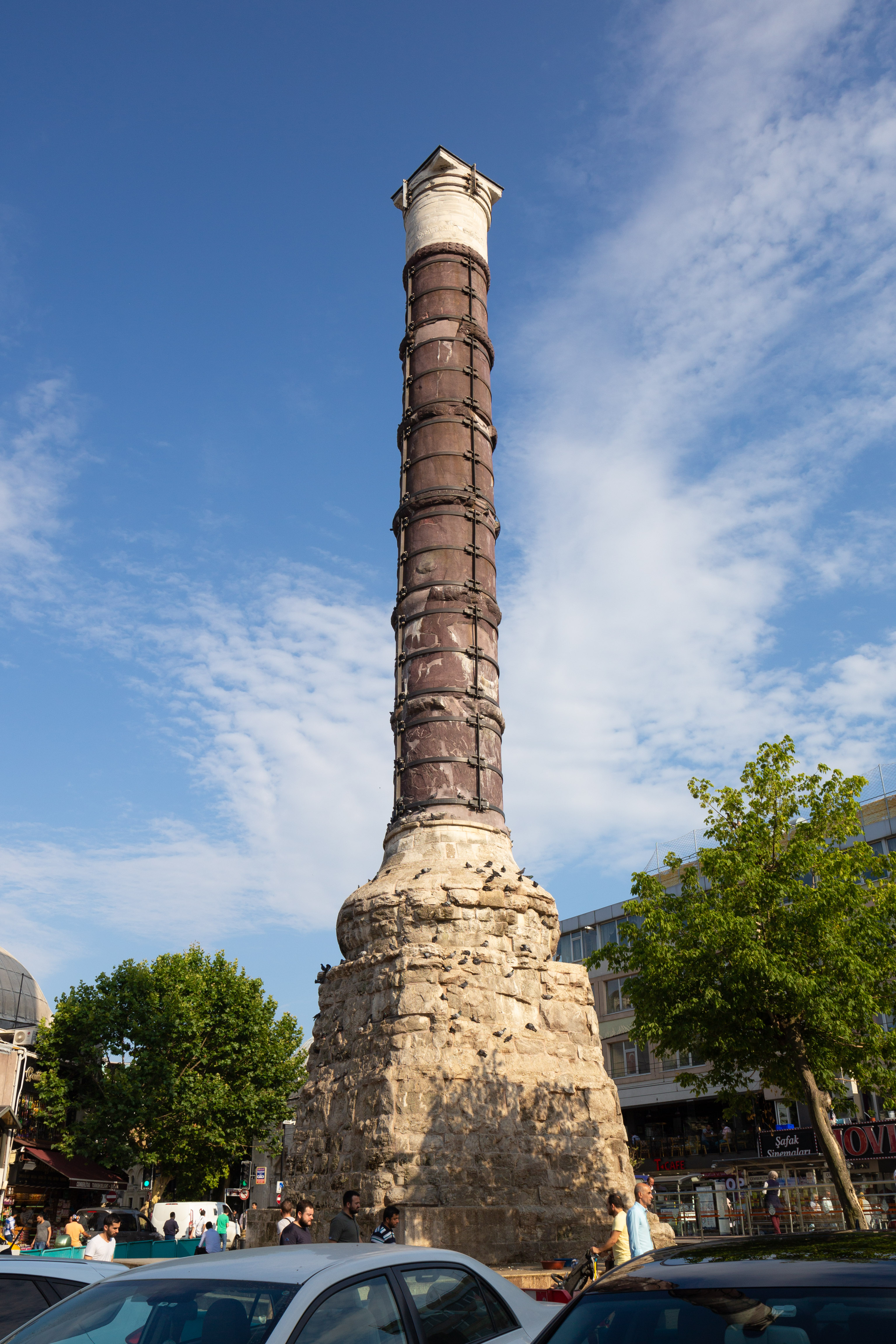
The foundation ceremonies of 11 May 330 inaugurated a city that had been substantially under construction since 324 — the year of Constantine's victory over Licinius at Chrysopolis (the Asian shore of the Bosphorus, directly opposite the new capital). The new walls extended the old Byzantium's circuit westward to enclose approximately five times the previous area; the Mese (the principal east-west thoroughfare) ran from the Augusteion (the central public square at the eastern tip of the peninsula) through the Forum of Constantine to the Capitolium and the western gates. The Hippodrome, the imperial palace complex, the senate house, the new churches (including the first Hagia Sophia, the first Hagia Irene, and the Church of the Holy Apostles), and the substantial residential and commercial quarters were established within a single generation.

The Christian establishment
The Christianisation of the imperial state from Constantine through Theodosius (379–395) is the substantive fact that distinguishes the post-330 polity from its classical Roman predecessor. Constantine's own commitments — the legalisation of Christianity, the substantial imperial patronage of new churches and clergy, the convocation of the Nicene council and the imperial enforcement of its homoousion creed against the Arian alternative, the personal baptism (on his deathbed in 337) by the Arian bishop Eusebius of Nicomedia — were both substantive and pragmatic. The succeeding emperors — with the brief Julianic interruption of 361–363 — progressively extended the establishment: Constantius II (337–361) supported a moderate Arianism; Theodosius I (379–395) made Nicene Christianity the official faith by the Edict of Thessalonica (380), prohibited public pagan worship across the Empire (391), and convened the Council of Constantinople (381) that produced the substantially final form of the Christian creed.
The institutional architecture of the imperial church — the pentarchy of patriarchates (Rome, Constantinople, Alexandria, Antioch, Jerusalem), the metropolitan structure of provincial bishoprics, the ecumenical councils as the legislative body of doctrinal definition, the imperial patronage of monasticism (which expanded substantially in the late fourth and fifth centuries on Egyptian and Cappadocian models), the imperial role in episcopal elections and disciplinary matters — was substantially in place by 395. The doctrinal disputes of the next two centuries (Christology, the natures of Christ, the substantial questions of homoousios, Nestorianism, monophysitism, monotheletism) would substantively divide the eastern from the western Christianity and produce the permanent estrangement of the Syrian, Egyptian and Armenian churches from the imperial orthodoxy.
The division of the Empire
The administrative division of the Empire on Theodosius's death in January 395 — Arcadius receiving the East with capital at Constantinople, Honorius receiving the West with capital at Milan and later Ravenna — was not novel in the substantive sense (Diocletian's tetrarchy had divided administrative responsibilities, and subsequent imperial co-rulerships had been the norm), but it was the last division. The eastern and western halves of the Roman Empire after 395 were administratively distinct, financially distinct, and progressively diverged in their political and military trajectories. The western Empire's substantial decay through the fifth century — the loss of Britain (410), Gaul (progressively to the Franks, Visigoths and Burgundians), Spain (to the Visigoths), North Africa (to the Vandals, 429–439), Italy itself (to the Ostrogoths after Odoacer's 476 deposition of Romulus Augustulus) — produced the conventional terminus of the western Roman Empire. The eastern Empire continued.
The reasons for the eastern survival have been substantially argued about. The standard historiographical inventory comprises: the greater wealth of the eastern provinces (Egypt, Syria, Asia Minor) as compared with the western (Italy, Gaul, Spain, North Africa); the greater defensibility of Constantinople as a capital, as against Rome or Ravenna; the greater institutional continuity of the eastern administration; the smaller demographic and military pressure on the eastern frontier (the Persian wars were less continuous than the western barbarian incursions); the better imperial succession (the eastern dynasties were on the whole more stable); the relative absence of the religious civil war that destabilised the western Empire (the eastern Empire absorbed its Arian-Nicene dispute under Theodosius; the western had Arian Germanic settlers within the imperial frontier). The combination of factors was sufficient to maintain the eastern Empire as a substantively functioning state through the fifth century while the western Empire dissolved.
The fifth-century reconstitution
The fifth-century eastern Empire's institutional consolidation — through the reigns of Arcadius (395–408), Theodosius II (408–450), Marcian (450–457), Leo I (457–474), Zeno (474–491) and Anastasius I (491–518) — produced the institutional template that Justinian inherited. The substantial reforms of the period: the construction of the Theodosian Walls (built 408–413, extended after the 447 earthquake), which would defend the city for the next thousand years; the Theodosian Code (438), the first comprehensive imperial codification of law; the establishment of the University of Constantinople (425) under Theodosius II; the reform of imperial fiscal administration under Anastasius I (which produced a surplus of substantial proportions by the early sixth century); the substantive Christianisation of public ceremony and law.
The eastern Empire entered the sixth century with a defended capital, a working bureaucracy, a fiscal surplus, an emerging Christian institutional Orthodoxy, and a continuing constitutional identification with the Roman state. The first sustained attempt to use those resources to reconquer the lost western provinces — Justinian's reign of 527–565 — is the subject of chapter II.
End of Chapter I