The sack of Constantinople by the Latin army of the Fourth Crusade on the 12th and 13th of April 1204 was the moment at which the eastern Empire ceased, for fifty-seven years, to exist as a unified state. The Latin Empire of Constantinople that replaced it from 1204 to 1261 was a Western European feudal entity superimposed on a Greek-Orthodox population; the three successor Roman states — Nicaea in western Anatolia, Trebizond on the Pontic coast, and Epirus in north-western Greece — preserved the Roman institutional and confessional identity through the half-century. The Nicaean recovery of Constantinople in July 1261 restored the unified Empire, but on reduced foundations from which the recovery would never be complete.
The Crusade's diversion
The Crusade was originally intended for the recovery of Jerusalem from the Ayyubid Sultanate of Egypt, by an amphibious operation against the Nile delta. The financing — through the Republic of Venice, which had contracted in 1201 to provide ships and provisions for a Crusader army of thirty-three thousand fighting men in exchange for eighty-five thousand silver marks — was the mechanism of the subsequent diversion. The Crusader army that assembled at Venice in 1202 numbered approximately one-third of the contracted strength, leaving the Crusaders with a debt to Venice that they were unable to pay.
The Venetian solution was the commutation of the debt against the assistance of the Crusader army in Venetian commercial and political projects. The Doge Enrico Dandolo — by then approximately ninety years old and blind — proposed the Crusader assault on the Adriatic port of Zara (modern Zadar, then under Hungarian rule), which the Crusaders executed in November 1202 over Papal objection (Pope Innocent III excommunicated the entire Crusader force).
The second diversion — to Constantinople — was proposed by the young Byzantine prince Alexios IV Angelos, son of the deposed and blinded emperor Isaac II Angelos (whose brother Alexios III had usurped the throne in 1195). Alexios IV offered the Crusaders two hundred thousand silver marks, provisions, ten thousand Roman troops to accompany them to Egypt, and the submission of the Roman Church to Rome, in exchange for Crusader assistance in restoring his father and himself to the throne. The Crusader leadership accepted the offer over dissent from a minority. The Crusader fleet arrived off Constantinople in late June 1203.
The first siege of 1203
The first Crusader siege of Constantinople (July 1203) produced the restoration of Alexios IV and his blind father Isaac II as co-emperors after the flight of Alexios III. The new regime was, however, unable to deliver on promises: the two hundred thousand silver marks were unavailable, the popular Roman hostility to the Latin presence and to the submission of the Roman Church was substantial, and the Crusader force encamped at Galata across the Golden Horn was unwilling to depart without payment. The January 1204 coup of Alexios V Mourtzouphlos against Alexios IV (substantially strangled in February), and the repudiation of the Crusader treaty, produced the second siege.
The sack of April 1204
The second siege opened in late March 1204. The Crusader assault on the Bosphorus walls of the city on the 9th of April was repulsed; the second assault on the 12th of April broke through the sea walls near the Petrion Gate. By the evening of the 12th the Crusader force was within the city; the three-day sack that followed on the 12th, 13th and 14th of April 1204 produced the destruction of portions of the monumental city. The looting of the Hagia Sophia — including the silver iconostasis, the Holy Vessels, and the relics — and the destruction or removal of pieces of imperial art and library eliminated approximately a thousand years of accumulated Roman cultural patrimony. The four bronze horses of the Constantinopolitan Hippodrome subsequently relocated to the west front of San Marco at Venice; the Holy Crown of Thorns subsequently sold to Saint Louis IX of France and housed at the Sainte-Chapelle in Paris; other relics dispersed across Latin Christendom.
The human cost — the assessment of the modern historiography is approximately two thousand civilian deaths in the three-day sack, with larger numbers of sexual assault and expropriation of property — was smaller than the popular tradition has preserved. The cultural-religious cost was substantial. The breach of the Greek-Latin Christian fellowship that the Fourth Crusade represented was the point of no return in the estrangement between the Orthodox and Catholic confessions; the Orthodox liturgical commemoration of the sack continues to be observed in some communities to the present.

The Latin Empire
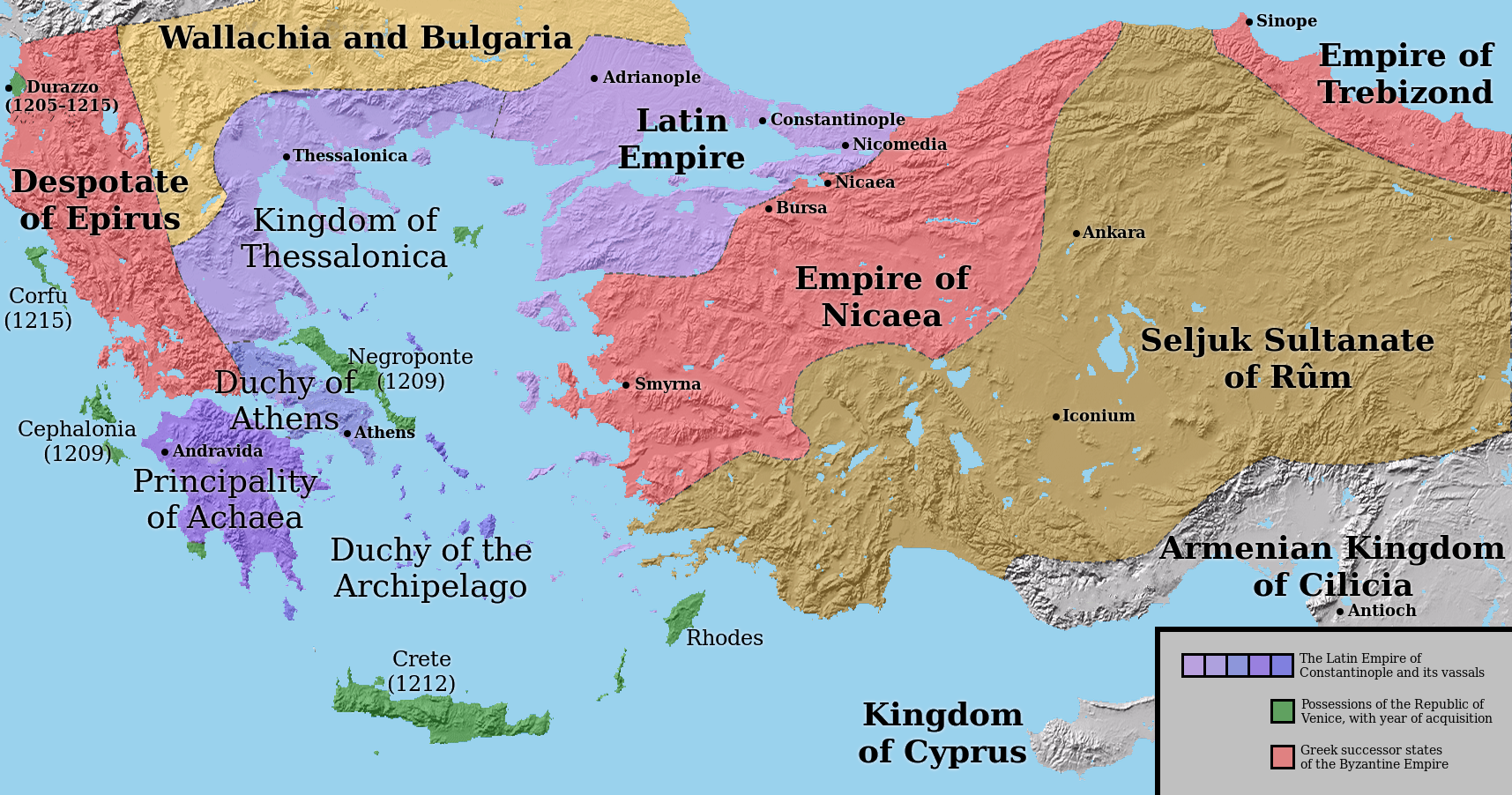
The Latin Empire of Constantinople that emerged from the sack was organised on the feudal pattern of contemporary western Christendom. The first Latin emperor, Baldwin I of Flanders, was elected by a committee of Crusader and Venetian electors in May 1204; the partition treaty (the Partitio Romaniae) distributed the provinces of the Empire among the Crusader leaders and the Venetians. The Venetian share — approximately three-eighths, comprising portions of the Aegean islands, the Ionian islands, Crete, the commercial quarters of Constantinople — established the Venetian maritime empire that would persist for parts to the sixteenth century. The Crusader share produced feudal principalities of variable durability: the Principality of Achaia (the Peloponnese, persisting to 1432), the Duchy of Athens (persisting to 1456), the Kingdom of Thessalonica (rapidly destroyed in 1224).
The Latin Empire itself was insolvent and indefensible. The subsequent fifty-seven years saw progressive territorial loss to the Roman successor states and to the Bulgarian kingdom under Tsar Kaloyan and his successors. The last Latin emperor Baldwin II (1228–1261) financed the regime by selling relics, by mortgaging the Crown of Thorns, and by loans from the Venetians.
The successor states
The three Roman successor states — Nicaea, Trebizond, and Epirus — preserved the institutional and confessional continuity of the Roman state through the half-century of the Latin occupation.
The Empire of Nicaea, established by Theodore I Laskaris in 1204 at the old Bithynian city of Nicaea, was the principal successor. Under Theodore I (1204–22), John III Vatatzes (1222–54), and Theodore II Laskaris (1254–58), the Nicaean state expanded across western Anatolia, the Aegean islands, and a portion of the European hinterland of Constantinople. The Nicaean military and fiscal organisation developed a professional army, a agricultural and commercial economy, and a intellectual revival under the scholarly emperors. The Nicaean ecclesiastical organisation — with the patriarchate in exile at Nicaea — preserved the Orthodox confessional structure.
The Empire of Trebizond, established by the Komnenos family branch under Alexios I of Trebizond in 1204, comprised the Pontic coast from Sinope to the Caucasus; it persisted as an independent state until its Ottoman conquest in 1461 — eight years after the fall of Constantinople.
The Despotate of Epirus, established by Michael I Komnenos Doukas in 1205, comprised the north-western Greek mainland and portions of the Adriatic coast; it competed with Nicaea for the title of legitimate Roman successor through the 1220s, lost the Battle of Klokotnitsa to the Bulgarians in 1230, and persisted as a regional principality through the fourteenth century.
The recovery of 1261
The Nicaean recovery of Constantinople on the 25th of July 1261 was produced by the chance opportunity that the Nicaean general Alexios Strategopoulos exploited. The small Nicaean force, dispatched on a reconnaissance mission, discovered that the Latin garrison and the Venetian fleet were both absent from the city (engaged in operations elsewhere) and that the city walls were undermanned. The coup-de-main entered the city by a undefended postern gate; Latin Emperor Baldwin II fled to Italy; the Latin Patriarch fled with him. The Nicaean emperor Michael VIII Palaiologos, who had usurped the Nicaean throne from the young John IV Laskaris in 1259, entered Constantinople on the 15th of August 1261 and was crowned at the Hagia Sophia. The restored Empire — the subject of chapter VIII — would never recover the position of the pre-1204 state.
End of Chapter VII