The two centuries between the accession of Basil I in 867 and the death of Theodora in 1056 are the cultural and political high-water mark of the medieval eastern Empire. The Macedonian dynasty — so called because Basil's Armenian ancestors had been settled in the Macedonian theme — produced territorial reconquests in the Balkans, Syria and the Anatolian plateau; the conversion of the Slavic peoples (the Bulgarians, the Serbs, the Rus) to Orthodox Christianity under the cultural sponsorship of the imperial church; a literary and artistic revival that the historiographical tradition has labelled the Macedonian Renaissance; and a codification of imperial administrative law and ceremony under the scholar-emperor Constantine VII Porphyrogennetos. The decline of the dynasty after 1025 — and the collapse of the eastern frontier at Manzikert in 1071 — would set the conditions for the Komnenian restoration of chapter VI.
Basil I and the dynastic foundation
The founder of the dynasty, Basil I (867–886), came to the throne by the expedient of having murdered his immediate predecessor and adoptive father Michael III in September 867. The means of his rise — from Armenian peasant origins in the Macedonian theme, through service as a wrestler-groom to the chamberlain Theophilitzes, through favour with Michael III, through the elimination of his rival Bardas Phokas the elder in 866 — were Byzantine in their substance. The achievement of his reign was the consolidation of the dynasty: the military operations against the Paulician heretics of eastern Anatolia (the destruction of Tephrike in 872), the extension of the southern Italian holdings (the recovery of Bari in 876, the re-establishment of the theme of Longobardia), and the production of an heir, Leo VI, whose intellectual abilities would distinguish him from his largely-illiterate father.
Leo VI the Wise
Leo VI (886–912), known by his cognomen "the Wise" for his intellectual and literary attainments, was the architect of the Macedonian intellectual revival. The codification of imperial law under his auspices — the Basilika, a Greek-language redaction of the Justinianic Code in sixty books — produced the legal corpus that would govern the Empire for the next five and a half centuries. The expansion of the imperial administrative-ceremonial codification — including the Taktika (a military manual) and the Book of the Eparch (a regulatory code for the Constantinopolitan trade guilds) — produced the administrative texts that the modern historiography has exploited.
The scandal of Leo's reign was the succession crisis produced by his four marriages and the canonical question of whether his fourth marriage (to Zoe Karbonopsina, the mother of the eventual Constantine VII) was permissible under canon law. The Tetragamy Affair of 906–907 produced a conflict between the emperor and the patriarchate, the deposition of the Patriarch Nicholas Mystikos, the imperial-ecclesiastical confrontation, and the eventual compromise (after Leo's death) under which the marriage was recognised as canonical for the purpose of the succession but substantively irregular for the purpose of canon law.
Constantine VII Porphyrogennetos
Constantine VII Porphyrogennetos (913–959 in nominal reign, 945–959 in personal rule) was the scholar-emperor of the dynasty. The cognomen — "born in the purple", from the porphyry-walled birth chamber of the imperial palace — distinguished him as the legitimate dynastic heir. The intellectual programme of his reign produced a corpus of administrative-historical-ceremonial texts: De Administrando Imperio (a confidential briefing to his son Romanos II on the political and ethnographic situation of the Empire's neighbours), De Ceremoniis (a encyclopaedic compilation of imperial ceremonial), De Thematibus (a geographical-administrative description of the imperial provinces). The cultural-administrative documentation that the modern historiography has exploited is largely the work of Constantine VII's circle.
The Bulgarian wars
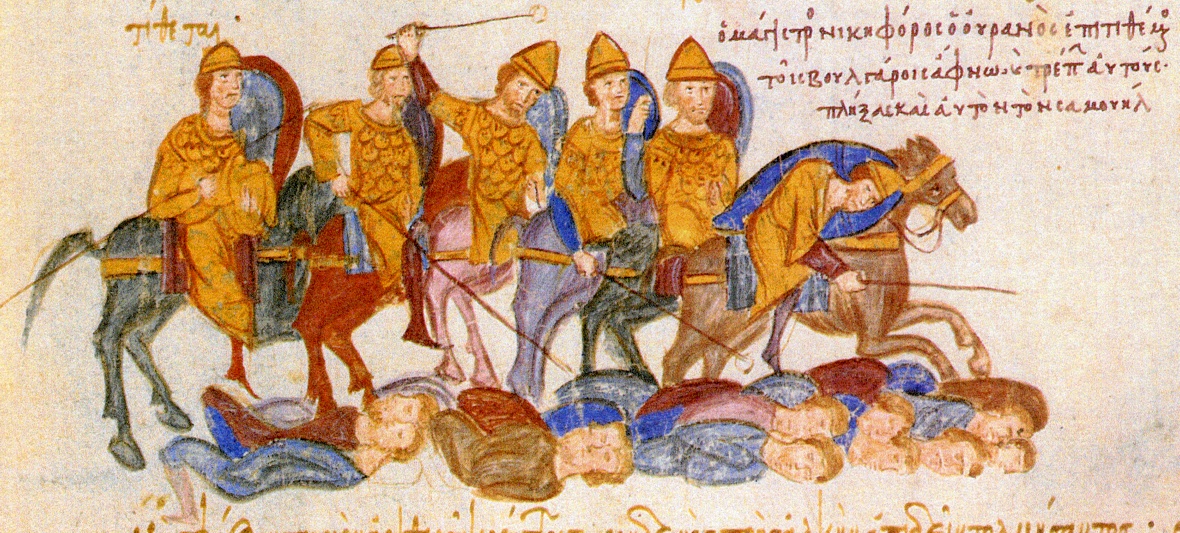
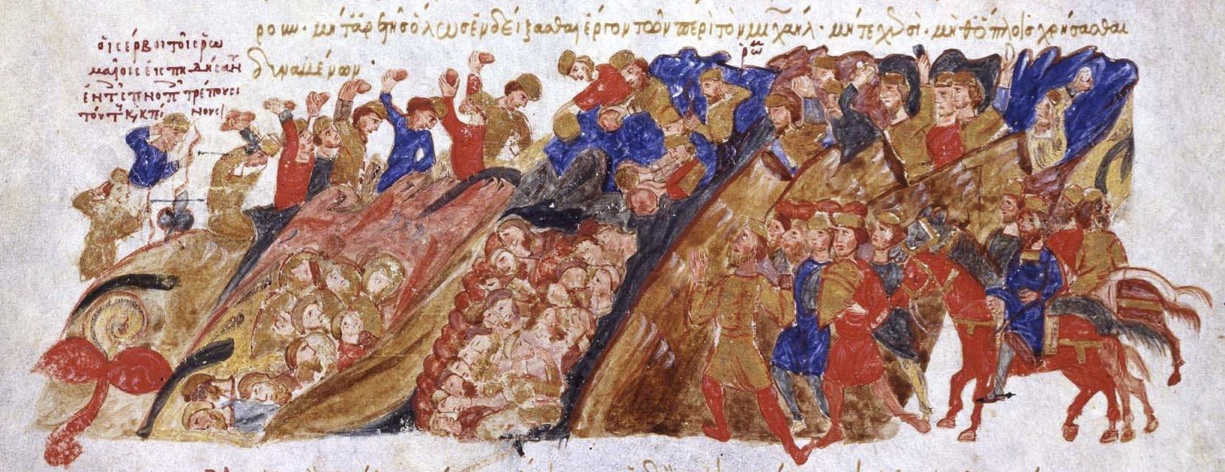
The military conflict of the late ninth and tenth centuries was the long series of wars with the Bulgarian state under Symeon I (893–927) and his successors. The Bulgarian threat — under Symeon, who had been educated at Constantinople and who pursued a ambition of converting the Bulgarian state into a substantively-Roman empire under Bulgarian dynastic rule — produced Roman military defeats at Achelous (917) and Katasyrtai (917). The Roman recovery in the late tenth century under Nikephoros II Phokas (963–969), John I Tzimiskes (969–976) and especially Basil II (976–1025) progressively destroyed the Bulgarian state. The culminating campaign of Basil II's reign — the conquest of the entire Bulgarian state by 1018, including the blinding of fifteen thousand Bulgarian captives after the battle of Kleidion in July 1014 (for which Basil acquired the sobriquet Boulgaroktonos, "Bulgar-slayer") — produced the restoration of the Empire's Danube frontier for the first time in three hundred years.

The eastern reconquests
The military reconquest in the east was prosecuted by a sequence of military commanders: John Kourkouas in the 920s and 930s (reconquest of Melitene 934, Theodosiopolis 949, and extension into Mesopotamia), Nikephoros Phokas as commander before his accession in 963 and as emperor afterwards (recovery of Crete in 961, Cyprus in 965, Antioch in 969), John I Tzimiskes (campaigns in the Levant and the upper Tigris, 974–975), and Basil II (extension into Armenia and northern Mesopotamia, 985–1021). By Basil II's death in 1025 the imperial eastern frontier had been restored to the line of the Euphrates and the Caucasus, the reconquest of Antioch had produced a Christian capital in the Levant, and Cilicia and northern Syria were integrated into the imperial administrative system.
The conversion of the Slavs
The religious-cultural achievement of the period was the conversion of the Slavic peoples to Orthodox Christianity. The Cyrillo-Methodian mission to Great Moravia in 863 — the dispatch by the Patriarch Photios of two scholar-monks, Constantine (Cyril) and Methodius, to translate the liturgical and scriptural texts into a new Slavic alphabet (the Glagolitic, subsequently developed into the Cyrillic) — produced the linguistic-cultural foundation for the subsequent Christianisation of the Bulgarians (864), the Serbs (mid-ninth century), and the Rus (the conversion of Vladimir of Kiev in 988, on the occasion of his marriage to Basil II's sister Anna). The result was the Orthodox Slavic religious-cultural sphere that the modern Orthodox church continues to occupy.
The post-Basil II collapse
The dynastic and political collapse of the dynasty after the death of Basil II in December 1025 was produced by the absence of dynastic continuity. Basil II had been unmarried; his successor Constantine VIII (1025–28), his brother and co-emperor, was in age but incompetent in administration; his three daughters (Eudokia, Zoe, Theodora) were the dynastic carriers, but the successive marriages of Zoe (to Romanos III Argyros, Michael IV the Paphlagonian, and Constantine IX Monomachos) and the reign of Theodora (1055–56) were insufficient to sustain the Macedonian institutional structure.
The neglect of the Anatolian frontier, the weakening of the thematic military system through the conversion of soldiers' lands into estates of the dynatoi (the landed magnates), the demobilisation of the Armenian principalities in the east (which had served as a buffer against the emerging Seljuk Turk threat), and the fiscal exhaustion produced by the wars of Basil II's reign, produced the conditions under which the Empire would be unable to resist the Seljuk advance of the 1060s and 1070s. The catastrophe at Manzikert in August 1071 is the prologue to the next chapter.
End of Chapter V