The Third Punic War of 149–146 BC was the deliberate Roman destruction of a Carthaginian state that had ceased to be a military or political threat. The three-year siege of the city, the systematic destruction of the population and physical infrastructure, and the conversion of the Carthaginian territory into the Roman province of Africa, ended the six-and-a-half-century history of the Phoenician colony at the Tunisian coast. The Roman political-cultural decision to conduct the destruction was driven by domestic Roman political dynamics rather than by any credible Carthaginian military threat.
The half-century of recovery
The half-century between the 201 BC peace and the 149 BC outbreak of the Third War was a period of Carthaginian economic recovery and political restoration. The Carthaginian state, confined to a territory of approximately 25,000 square kilometres on the North African coast, reorganised its economy on a agricultural-commercial basis: the agricultural production of olive oil, wine, wheat and figs from the Cape Bon and Medjerda valley farms; the commercial intermediation between the Italian-Roman markets and the trans-Saharan trade routes that delivered gold, ivory and enslaved persons from the African interior; the production of textiles, dyestuffs, pottery and small manufactured goods for the Mediterranean trade.
The population of the city by 150 BC has been estimated at approximately 200,000 to 400,000 — larger than the pre-Hannibalic-War population. The annual indemnity payments to Rome were completed ahead of schedule (the original 50-year schedule was completed in approximately 40 years), demonstrating the economic recovery. The Roman political-diplomatic supervision of the Carthaginian state — through the Senate's requirement of Roman permission for Carthaginian military action — was deployed by Masinissa's Numidian kingdom to conduct annexations of Carthaginian-claimed territory. The Carthaginian appeals to Rome for arbitration of the Numidian encroachments were consistently decided in Masinissa's favour through the 170s and 160s BC.
Cato the Elder
The political-rhetorical campaign for the Roman destruction of Carthage was conducted by Marcus Porcius Cato (Cato the Elder, 234–149 BC), the senior senator of the conservative faction. The famous Catonian peroration — "ceterum censeo Carthaginem esse delendam", "and besides, I think that Carthage ought to be destroyed" — appended to every speech Cato delivered in the Senate from approximately 153 BC, regardless of the subject matter, became the principal slogan of the political programme. Cato had visited Carthage in 153 BC on a diplomatic mission concerning the Numidian encroachments and returned impressed by the economic recovery that he observed; his assessment was that the Carthaginian economic and demographic recovery had proceeded to a point at which a future Carthaginian military challenge was possible, and that the proper Roman policy was the preemptive destruction.
The Senate's political division on the issue ran between the Catonian destruction faction and the Scipionic conciliation faction (substantially led by Publius Cornelius Scipio Nasica Corculum, the son-in-law of the elder Scipio Africanus), which argued that the Carthaginian threat was exaggerated, that the city served the useful purpose of maintaining Roman political-military discipline through the fear of an external rival, and that the destruction would produce domestic Roman political-moral consequences that would outweigh the military benefit. The Catonian faction won the debate by approximately 151 BC.
The 149 BC ultimatum
The occasion for the declaration of war was the Carthaginian armed response to the Numidian encroachments of 151 BC. The Carthaginian deployment of military forces against Masinissa was a technical violation of the 201 BC peace terms, which had forbidden military operations within Africa without Roman permission. The Roman Senate accepted the Catonian recommendation that the violation be treated as a casus belli. The Roman declaration of war was issued in spring 149 BC.
The Carthaginian diplomatic response was compliance: the Carthaginian Senate offered complete surrender of all military forces, all weapons, all hostages, and all naval forces. The Roman demands escalated in successive stages: the surrender of 300 hostages (substantially complied with); the surrender of all military weapons and naval forces (substantially complied with — approximately 200,000 weapons and 2,000 siege engines turned over); finally, the demand that the population relocate to a new site at least 10 miles from the sea (substantially the deliberate ultimatum, calibrated to be unacceptable to a commercial city dependent on maritime trade). The Carthaginian rejection of the relocation demand commenced the war.
The siege
The siege of Carthage from 149 BC to 146 BC was conducted by successive Roman commanders. The first phase of 149–148 BC under the consuls Manius Manilius and Lucius Calpurnius Piso was unsuccessful — the Roman forces were unable to breach the massive fortifications of the city and suffered casualties from Carthaginian sallies. The reorganisation of the Roman command under Publius Cornelius Scipio Aemilianus (the adopted grandson of the elder Scipio Africanus, subsequently Scipio Aemilianus Africanus the Younger) in 147 BC restored Roman military discipline and commenced the decisive operations.
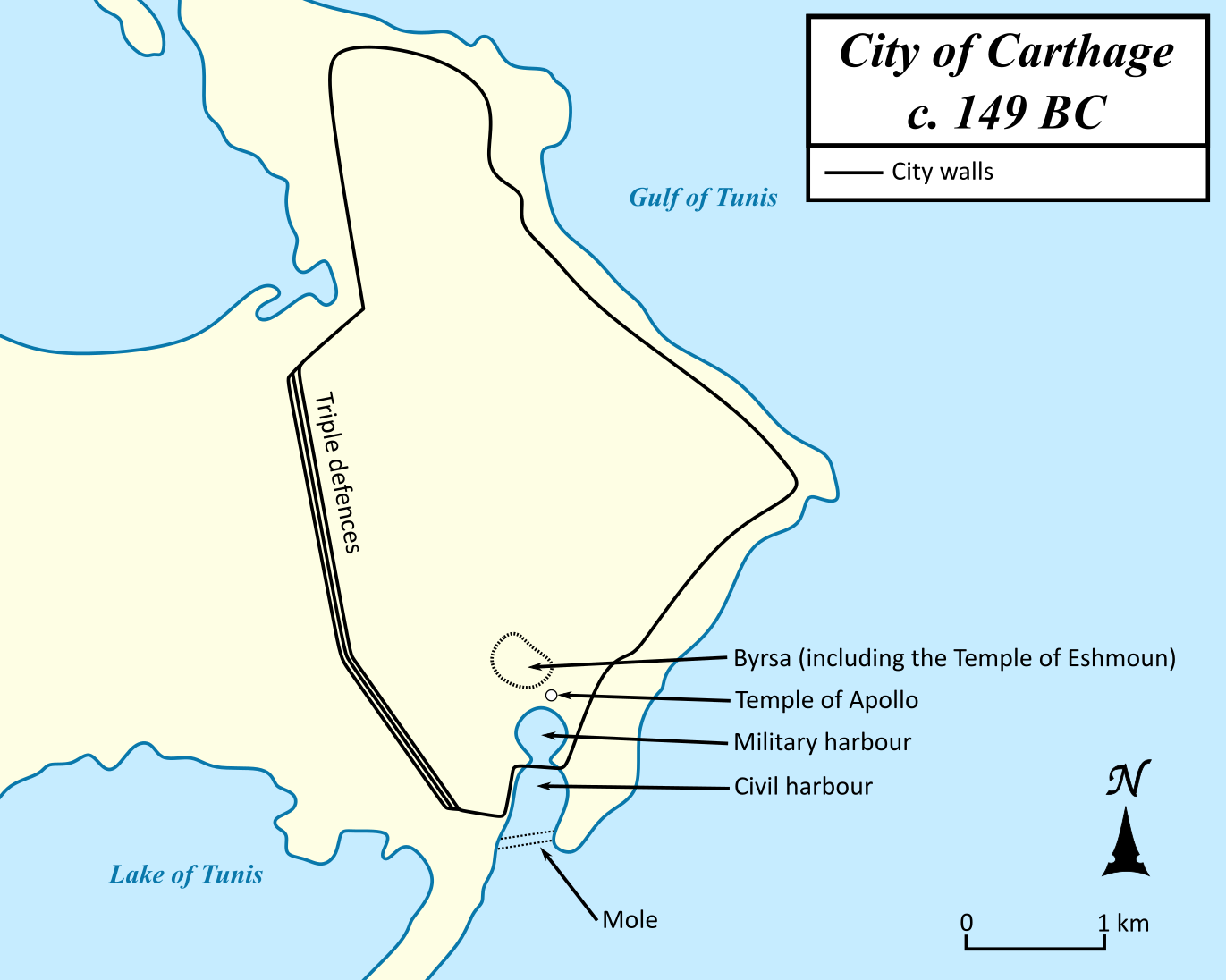
The Scipionic approach was the systematic reduction of the Carthaginian defensive position through three principal operations: the construction of a blocking mole across the harbour mouth, cutting off maritime supply; the reduction of the outer fortifications of the city through systematic siege engineering; and the systematic destruction of the Carthaginian field force at the battle of Nepheris in winter 147–146 BC. By spring 146 BC the city was isolated, famine-weakened, and militarily exhausted.

The destruction
The final assault on Carthage commenced in late spring 146 BC and proceeded across six days of street-by-street fighting through the densely-built Punic city. The Roman forces advanced from the harbour district up the slopes of the Byrsa hill toward the central citadel. The Carthaginian defence was conducted house by house, with civilian populations fighting alongside the reduced military forces. The Punic commander Hasdrubal surrendered to the Romans at the conclusion of the fighting; his wife, seeing him surrender from the roof of the Temple of Eshmun, cursed him and threw herself and her children into the flames of the burning temple.
The population at the fall of the city has been estimated at approximately 50,000 survivors out of a pre-siege population of perhaps 200,000 to 400,000. The 50,000 survivors were enslaved en masse. The city itself was systematically destroyed by Roman engineering — buildings demolished, walls levelled, the site formally cursed by the Roman religious authorities, with the famous tradition (substantially probably literary rather than historical) that salt was scattered across the site to prevent future cultivation. The Carthaginian territory was converted into the new Roman province of Africa Proconsularis.
The Phoenician colony on the Tunisian coast — six hundred and sixty-eight years after the traditional 814 BC foundation by Elissa — ceased to exist. The subsequent history of the site through the Roman, Vandal, Byzantine, Arab and modern periods is the subject of the final chapter.
End of Chapter IX