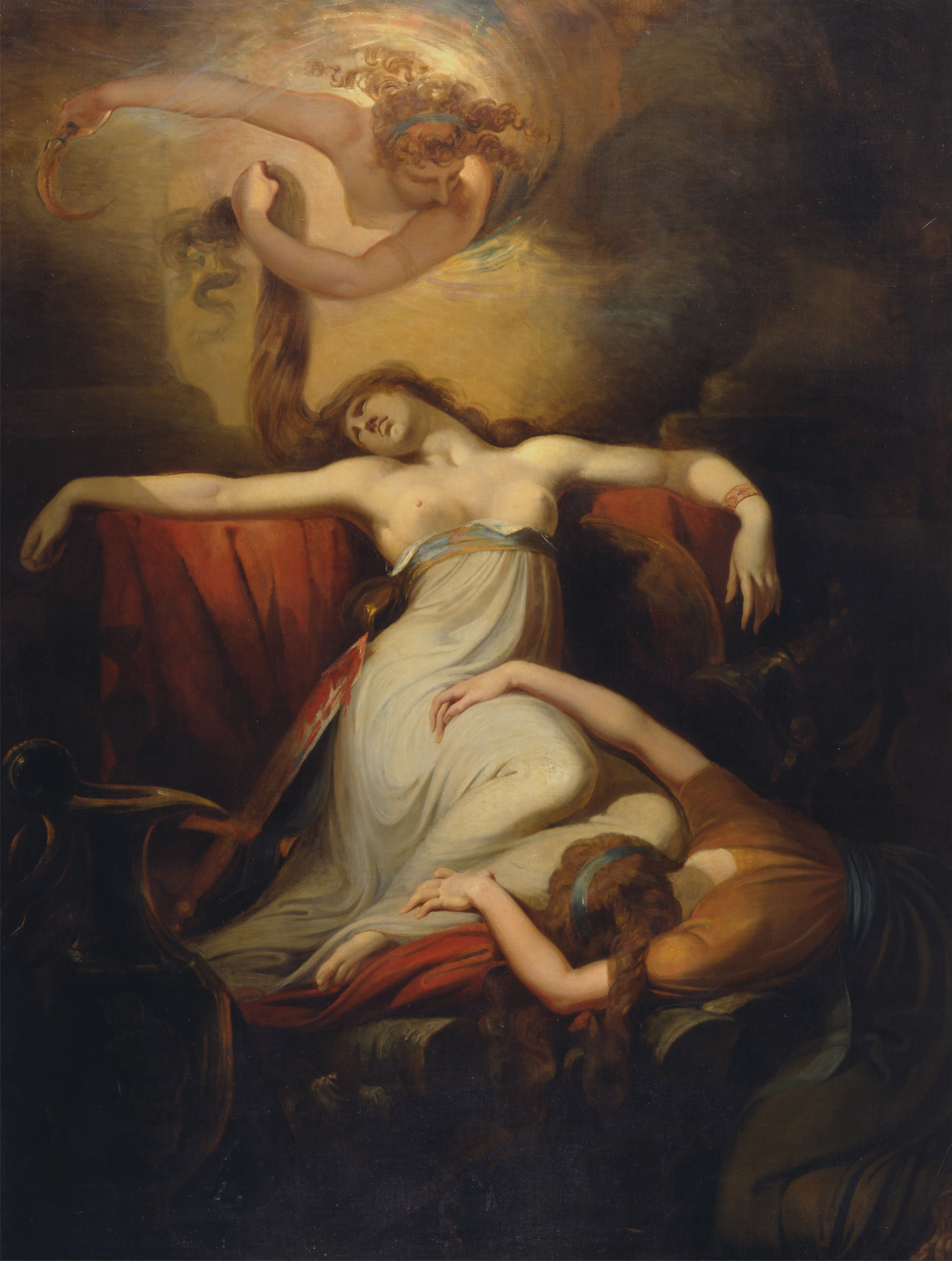
The traditional foundation date of Carthage is 814 BC. The traditional foundation story has Elissa — a Tyrian princess of the royal house, called Dido in the Latin tradition — flee her brother Pygmalion of Tyre after he has murdered her husband Acherbas, the high priest of Melqart, for his wealth. Sailing west with a party of supporters, she reaches the Tunisian coast and negotiates with the local Berber king Iarbas for as much land as an oxhide will cover. The hide is cut into thin strips and laid out as a long thread enclosing the hill that becomes the citadel of the new city — the Byrsa, from the Greek word for an oxhide. The story is preserved in Latin form in the Aeneid of Virgil, in a different version in the historian Justin's epitome of the now-lost work of Pompeius Trogus, and in fragments of Timaeus of Tauromenium. Whether any of it happened is doubtful. What the archaeology shows is that a Phoenician settlement was established on the Byrsa hill in approximately the late ninth or early eighth century BC, and that it grew rapidly through the eighth and seventh centuries into a major commercial city.
The foundation legend
The Elissa-Dido legend is preserved most fully in the Aeneid, Book I and Book IV, where it becomes the principal episode of Aeneas's journey from Troy to Italy and the mythological explanation for the subsequent enmity of Rome and Carthage. The Virgilian elaboration — Dido's love for Aeneas, his abandonment of her at the divine command, her suicide on the funeral pyre and the curse she pronounces on his descendants — is a late-republican Latin literary construction that is unlikely to bear much relationship to the early Carthaginian tradition. The earlier Greek and Phoenician versions of the foundation, preserved in Justin and Timaeus, share the elements of the Tyrian royal princess, the flight from a usurping brother, the negotiation with the local king, and the oxhide bargain; they differ on Aeneas, whose involvement is a Roman literary addition.
The historical kernel of the foundation tradition, if any, has been the subject of substantial scholarly argument. The most credited reconstruction is that the colony was founded by Tyrian settlers in approximately the period assigned by tradition (the radiocarbon dating of the earliest occupation levels at Carthage clusters around 810–760 BC, broadly consistent with the 814 BC date); that the colony was founded by a political-religious leader of unusual stature, the memory of whom was preserved in the figure of Elissa; and that the unusually large early settlement reflects an exodus from Tyre during the political-religious turmoil of the late ninth century BC rather than the gradual accretion characteristic of most Phoenician colonies.
The Byrsa
The Byrsa hill — the citadel of the city, approximately 60 metres high and overlooking the Gulf of Tunis — is the central archaeological site of Punic Carthage. Excavations conducted from the 1970s onwards under French, German, Italian and Tunisian direction have produced a detailed stratigraphic record of the city from the eighth century BC through to its 146 BC destruction. The earliest occupation levels comprise modest single-storey dwellings of mud-brick on stone foundations, with circular stone-built granaries and small workshops; the population of the late eighth century BC is estimated at approximately 6,000 inhabitants on the basis of the excavated residential area.
By the seventh century BC the city had expanded substantially beyond the original Byrsa hill into the plain below; the population was probably 20,000 to 30,000. The harbour district — the famous double harbour of the Punic city, with a rectangular commercial basin and a circular military basin to its north — was constructed in stages from the fifth century BC onwards, though earlier and simpler harbour works existed from the original foundation. The city wall, which by Hellenistic times enclosed approximately three hundred hectares, was extended in successive phases as the population grew.

The Tophet
The most controversial single feature of the Punic-Carthaginian archaeology is the Tophet — a religious precinct in the south of the city, on the Salammbo lagoon, in which thousands of small urns were buried containing the cremated remains of infants and very young children. The Tophet was in continuous use from the eighth century BC to the 146 BC destruction. The archaeology has produced approximately 20,000 urns from the principal Tophet excavated, with approximately 60% containing infant bones and 40% containing animal bones (typically lambs or kids). The carved stelae erected over the urns frequently bear inscriptions to the gods Tanit (the principal Carthaginian goddess, equivalent to Astarte) and Baal Hammon, with formulae such as "to the lady Tanit and lord Baal Hammon, this is the vow [mlk] which X dedicated".
The interpretation of the Tophet has been argued about for over a century. The Greek and Roman literary tradition — particularly Diodorus Siculus, Quintus Curtius and Tertullian — described Carthaginian religious practice as including the deliberate sacrifice of infants to Baal Hammon, particularly in moments of civic emergency (Diodorus reports a mass sacrifice of approximately 500 children during the 310 BC siege by Agathocles of Syracuse). One school of modern scholarship has accepted this description as essentially accurate, identifying the Tophet as a site of religious child sacrifice. An alternative school has held that the Tophet was a cemetery for infants who died of natural causes — perhaps with a religious-vow component — and that the Greco-Roman literary tradition of Punic infant sacrifice is hostile propaganda.
The most recent scholarship — particularly the work of Patricia Smith, Lawrence Stager and others through the 2000s and 2010s, drawing on isotopic and osteological analysis of the Tophet bones — has substantially supported the sacrifice interpretation, on the basis that (a) the age distribution of the buried infants is concentrated in the perinatal period, consistent with deliberate selection for sacrifice; (b) the inscriptions on the stelae use vocabulary consistent with formal religious dedications; and (c) the practice has parallels in the religious systems of the Levantine homeland (the biblical references to child sacrifice to Moloch are widely understood as references to the same religious complex). The volume of Tophet burials — averaging perhaps 100 per year across six centuries — implies a religious institution of substantial cultural importance.
Government and society
The political institutions of Carthage in the early period followed the Tyrian mother-city's pattern: a hereditary monarchy, with a council of elders (the adirim) advising the king on principal matters. As the city grew through the eighth and seventh centuries BC the monarchy was progressively constrained and eventually replaced by an oligarchic-republican system, comprising the council of elders (which grew into a body of approximately three hundred members drawn from the principal mercantile-aristocratic families); two annually-elected chief magistrates known as shofets or suffetes (cognate with the Hebrew shofet, "judge"); a popular assembly (the ‘am) with limited powers; and a tribunal of one hundred and four members drawn from the council to oversee the conduct of generals and magistrates. The transition from monarchy to oligarchic-republic was probably complete by the late seventh century BC. The Carthaginian constitution was admired in the Greek philosophical tradition — Aristotle's Politics II.11 includes a substantial favourable analysis of it, comparing it to the Spartan and Cretan constitutions — and was regarded as one of the principal stable mixed constitutions of the Greek-Mediterranean world.
The commercial expansion
Through the seventh and sixth centuries BC the Carthaginian commercial reach expanded substantially. The principal trade routes ran: north-west across the Tyrrhenian Sea to the Etruscan cities of central Italy (Caere, Tarquinia), to Sardinia and Corsica; due west to the Iberian coast and Gadir/Gades, the principal source of Iberian silver; further west into the Atlantic to the Moroccan coast at Lixus and to the periphera (the African Atlantic coast south of Morocco); north to Sicily and the western Sicilian cities of Motya, Solunto and Panormus (Palermo); east along the North African coast to Leptis Magna, Sabratha and Cyrenaica. The trade goods comprised: Iberian silver and copper, in exchange for which Carthaginian merchants delivered manufactured goods and Mediterranean agricultural staples; Sardinian copper and obsidian; Atlantic tin; African ivory and gold from the trans-Saharan caravan trade; and a great quantity of intermediated trade in olive oil, wine, cereals, dyed textiles, slaves, and luxury goods.
By 600 BC Carthage had become the principal Phoenician commercial centre in the western Mediterranean, with a population probably in excess of 50,000 and a commercial network that extended from the Atlantic to the Aegean. The territorial empire that would emerge from this commercial network in the sixth and fifth centuries BC, and the long competition with the Greek cities of Sicily and southern Italy, are the subject of chapter III.
End of Chapter II