The Roman invasion of Africa in 204 BC under the proconsul Publius Cornelius Scipio (subsequently Scipio Africanus, after his victory at Zama) completed the Roman strategic envelopment of the Carthaginian war effort. The campaign of 204–202 BC produced the recall of Hannibal from Italy, the decisive battle of Zama in October 202 BC, and the peace of 201 BC that terminated the Carthaginian status as a principal Mediterranean power. The subsequent five decades — from 201 BC to the outbreak of the Third Punic War in 149 BC — saw the Carthaginian state reduced to a regional power confined to the North African coast, with the principal political institutions restored but the economic recovery constrained by the Roman war indemnity and the Roman political-diplomatic supervision.
The African expedition
The Scipionic strategic conception was the Italian-style invasion of Africa that the First Punic War's Regulus expedition had attempted and failed. Scipio's preparation — a period of three years from his appointment as proconsul of Sicily in 205 BC to the landing at Utica in 204 BC — included: the assembly of a expeditionary force of approximately 35,000 Roman and allied troops; the diplomatic preparation through contacts with the Numidian princes Masinissa and Syphax (the principal allies of the Carthaginian state in Africa, whose defections would condition the campaign); the assembly of a supply system through Sicily; and the training of the Roman forces in the tactical methods that Scipio had developed in the Iberian campaigns.
The landing at Utica in summer 204 BC was uncontested. The subsequent campaign of 204–203 BC was principally conducted as siege operations against the Carthaginian-allied city of Utica and as campaigns against the field forces of the Carthaginian general Hasdrubal Gisco and the Numidian king Syphax. The principal engagements — the Battle of the Great Plains in spring 203 BC, in which Scipio defeated the combined Punic and Numidian field forces, and the subsequent capture of Syphax himself — eliminated the principal Carthaginian field forces in Africa. The Carthaginian Senate requested an armistice in summer 203 BC and recalled Hannibal from Italy.
The recall of Hannibal
Hannibal's recall from Italy was conducted under difficult conditions. The Carthaginian field force in southern Italy by 203 BC numbered approximately 24,000 veterans of fifteen years' campaigning, who were transported to Africa in late 203 BC via a naval movement that evaded the Roman blockade. Hannibal landed at Leptis Minor in winter 203–202 BC, proceeded to Hadrumetum, and reorganised the Carthaginian field force for the coming engagement.
The Carthaginian field army that Hannibal assembled in summer 202 BC for the engagement with Scipio numbered approximately 50,000 troops: the 24,000 veteran Italian troops as the principal infantry corps; Libyo-Phoenician and Carthaginian-citizen contingents; mercenary forces (Gauls, Iberians, Macedonians); approximately 4,000 cavalry; and approximately 80 elephants. The principal Carthaginian weakness was the absence of Numidian cavalry — Syphax had been captured, and Masinissa had defected to the Roman side and was commanding the Numidian cavalry on the Roman wing.
Zama
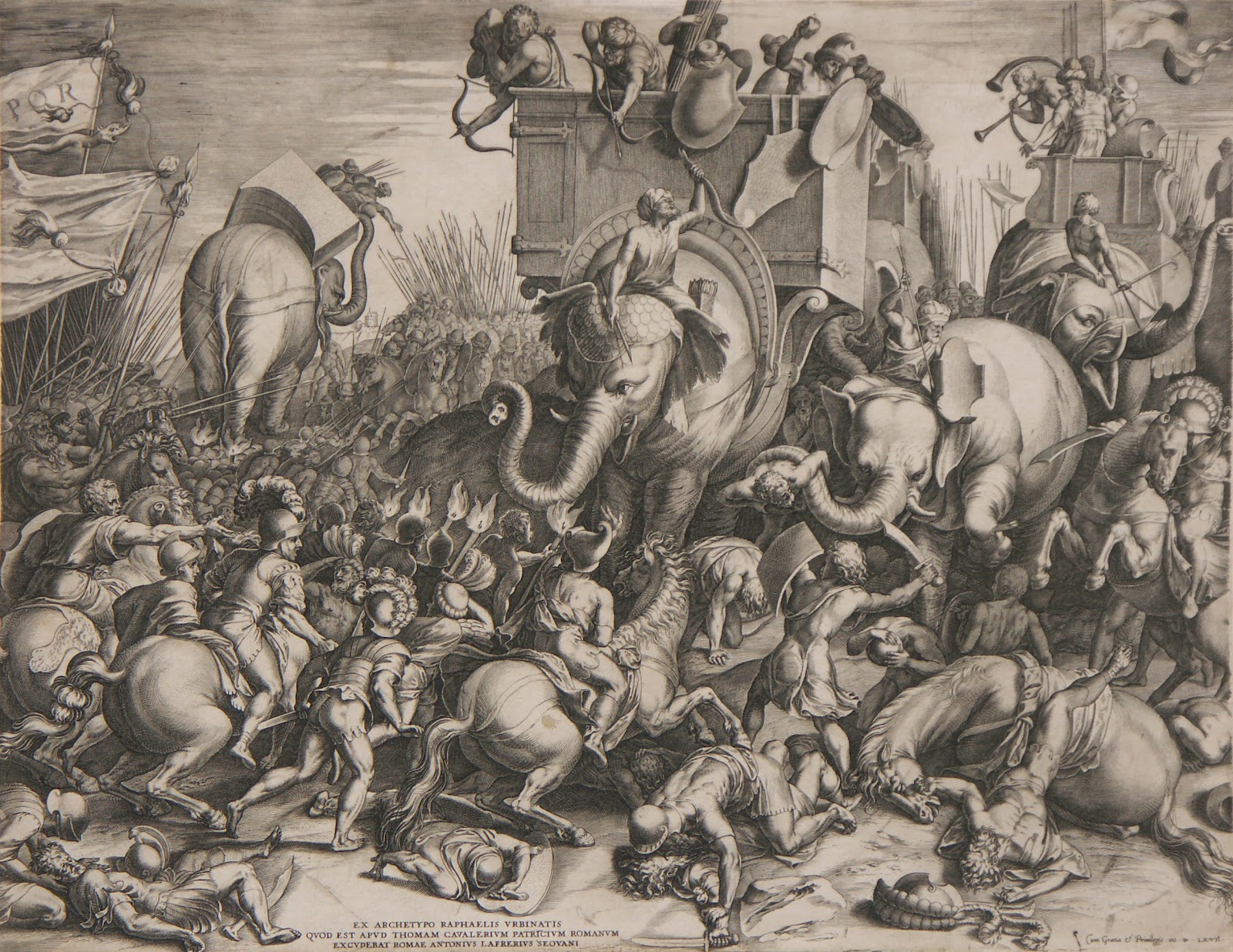
The Battle of Zama on the 19th of October 202 BC was the decisive engagement of the war. The location has been the subject of historical-geographical argument — Zama itself is a location approximately 80 miles south-west of Carthage, but the battle was probably fought at a location somewhat closer to the coast. The Roman force comprised approximately 30,000 infantry and approximately 6,000 cavalry (the Roman cavalry was reinforced by the Numidian contingents under Masinissa); the Carthaginian force comprised approximately 45,000 infantry, 4,000 cavalry and 80 elephants.
The tactical course of the battle has been reconstructed from the accounts of Polybius and Livy. The Carthaginian opening — a elephant charge against the Roman centre — was defeated by the Roman tactical innovation of gaps in the infantry line, through which the charging elephants were channelled and killed by javelin volleys. The subsequent cavalry engagements on the wings produced the defeat of the Carthaginian cavalry by the superior Roman-Numidian cavalry. The central infantry engagement was fought as the Roman and Carthaginian heavy infantry engaged in frontal combat; the decisive moment was the return of the Roman cavalry to the battlefield after the pursuit of the defeated Carthaginian cavalry, the subsequent envelopment of the Carthaginian infantry rear, and the collapse of the Carthaginian position.
The Carthaginian casualties were approximately 20,000 killed and 15,000 captured. The Roman casualties were approximately 1,500 killed and 4,000 wounded. Hannibal himself escaped the battlefield with a small escort and reached Hadrumetum.
The peace of 201 BC
The peace negotiations of late 202 BC and early 201 BC were conducted between Scipio and a Carthaginian delegation including Hannibal himself. The peace terms imposed by the Roman Senate were substantial: the Carthaginian state would surrender all overseas territories (the Iberian holdings, the Sardinian and Sicilian holdings already lost, the Atlantic and Mediterranean island holdings); would maintain only a small naval force of 10 vessels; would pay an indemnity of 10,000 talents of silver over 50 years; would conduct no war outside Africa without Roman permission; would conduct no war within Africa against Roman allies (principally the Numidian kingdom of Masinissa); would return all Roman prisoners and Roman-allied subjects without ransom; and would recognise the Numidian kingdom under Masinissa as a Roman-allied sovereign state with territorial sovereignty over portions of the previously Carthaginian territory.

Hannibal as suffete
The post-war Carthaginian state was governed by Hannibal in person as elected suffete in 196 BC — a remarkable political development, given the conventional post-defeat political pattern of blaming the defeated commander. Hannibal's suffete year (196 BC) produced administrative reforms that reformed the corrupt Carthaginian fiscal administration of the 200s BC, restored the Carthaginian fiscal position, and permitted the payment of the Roman war indemnity from regular revenues rather than from extraordinary property assessments.
The Carthaginian aristocratic-conservative faction (substantially associated with the Hanno family of political opposition to the Barcid programme) resented Hannibal's fiscal reforms and appealed to Rome for intervention. The Roman Senate's 195 BC ultimatum demanding the surrender of Hannibal produced his flight from Carthage in late 195 BC — first to Tyre, then to the Seleucid court of Antiochus III at Ephesus.
Hannibal in exile
Hannibal's subsequent two decades of exile in the eastern Mediterranean were spent in successive Hellenistic royal services. He advised Antiochus III in the Roman-Seleucid war of 192–188 BC; advised the Armenian king Artaxias I; served the Bithynian king Prusias I in the Bithynian war against the Pergamene kingdom in the late 180s BC. The Roman diplomatic pressure on the successive Hellenistic kings for the surrender of Hannibal eventually produced his suicide at Libyssa in Bithynia in 183 BC — through the taking of poison from a ring that he had carried through his exile — at the age of approximately 64.
The subsequent half-century of the Carthaginian state — the period from 200 BC to the outbreak of the Third Punic War in 149 BC — was characterised by the gradual economic recovery, the completion of the war indemnity payments, the Numidian-Roman pressure on the Carthaginian territory, and the Roman political faction (substantially led by Cato the Elder) that argued for the final destruction of the state. The Third Punic War is the subject of chapter IX.
End of Chapter VIII