Foreword
What was Carthage,
really?
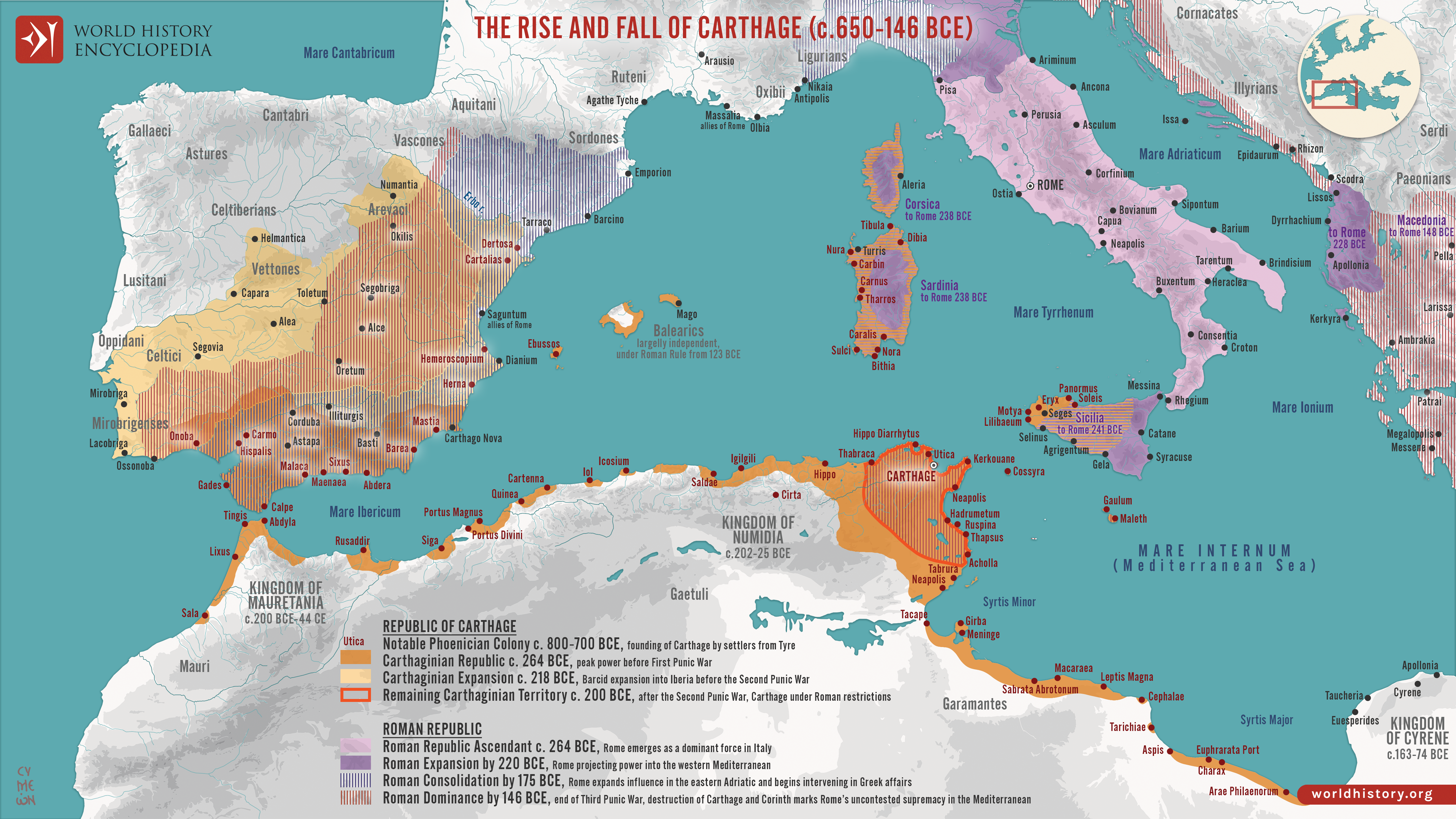
A Phoenician colony that outgrew its mother-city. Tyre, on the coast of modern Lebanon, sent out colonists across the Mediterranean from the ninth century BC onward — Cadiz, Mogador, Malta, Motya, Ibiza, Tharros — partly to trade for tin and silver and partly to escape Assyrian and later Babylonian pressure on the Levantine coast. Of these colonies, one outgrew Tyre itself.
Carthage — Phoenician Qart-Hadasht, "new city" — was founded on a peninsula in the Gulf of Tunis traditionally in 814 BC. The traditional founding-legend places it under a Tyrian princess called Elissa, who tricked the local Berber king Iarbas into selling her as much land "as could be covered by an oxhide" and then cut the hide into thin strips to enclose the Byrsa hill, the highest point of the future city. The legend is colourful and not contemporary; the archaeology shows substantial Phoenician material at Carthage from the eighth century BC, more or less consistent with the literary date. By the sixth century BC the city was the dominant Phoenician settlement in the west and had begun to develop a political identity separate from Tyre — particularly after Tyre's submission to Nebuchadnezzar in 573 BC and to Cyrus in 539. From then on, Carthage was on its own.
The Carthaginian state that resulted had a constitution that the Greek philosophers — Aristotle in Politics II.11 — admired: two annually elected suffetes (judges) sharing executive authority, a senate of three hundred elder citizens, and a popular assembly that could rule on matters where the suffetes and senate disagreed. The economy was thalassocratic — trade in metals, slaves, dye, salted fish, grain — and a state navy substantial enough to enforce trade monopolies in the western Mediterranean. The army, characteristically, was largely mercenary: Iberian, Numidian, Gallic, Greek, Libyan, with a small Carthaginian officer corps and the famous war elephants imported from the Atlas mountains and the upper Niger.
The volume traces three arcs. The trading-empire arc, from the eighth-century foundation to roughly 264 BC. The Punic-wars arc, three contests with Rome between 264 and 146 BC — Hamilcar Barca, Hannibal, Hasdrubal, Hannibal again, Scipio, and finally Scipio Aemilianus. And the afterlife arc: Roman Africa Proconsularis, the rebuilt Roman Carthage, Augustine's Hippo, the Vandal and Byzantine periods, and the modern archaeological recovery of the Punic city. Then we go to the ground itself — Byrsa hill, the Cothon harbour, the Tophet sanctuary, the Punic ports, the Antonine baths, and the Bardo Museum in Tunis where most of what survives is now kept.