The city that the Romans destroyed in 146 BC was a colony of Tyre. To understand Carthage requires beginning with the Tyrian mother-city — a small island fortress on the coast of the Levant whose merchants, between roughly 1200 BC and 600 BC, established the principal commercial network of the ancient Mediterranean and produced the colonial system from which Carthage emerged. The Phoenician civilisation that Tyre led was a coastal-mercantile rather than a land-imperial one, and the cities of the home country — Tyre, Sidon, Byblos, Arwad — never combined into a unified polity. Their colonial offshoots in the western Mediterranean, of which Carthage would become the principal, did the same.
The Phoenicians
The Phoenicians are an exonym applied by the Greeks to the Semitic-speaking inhabitants of the coast of modern Lebanon, Syria and northern Israel — a region the Phoenicians themselves called Canaan and whose inhabitants called themselves Canaanites (in cuneiform sources Kinahna, in their own inscriptions kn'n). The name Phoinix is conventionally derived from the Greek word for the purple dye that the cities of the Levantine coast manufactured from the murex sea-snail and exported across the Mediterranean. Whether the term originally referred to the dye, to the people who made it, or to the colour of their skin under the Mediterranean sun, has been argued; the dye-export interpretation is the most credited.
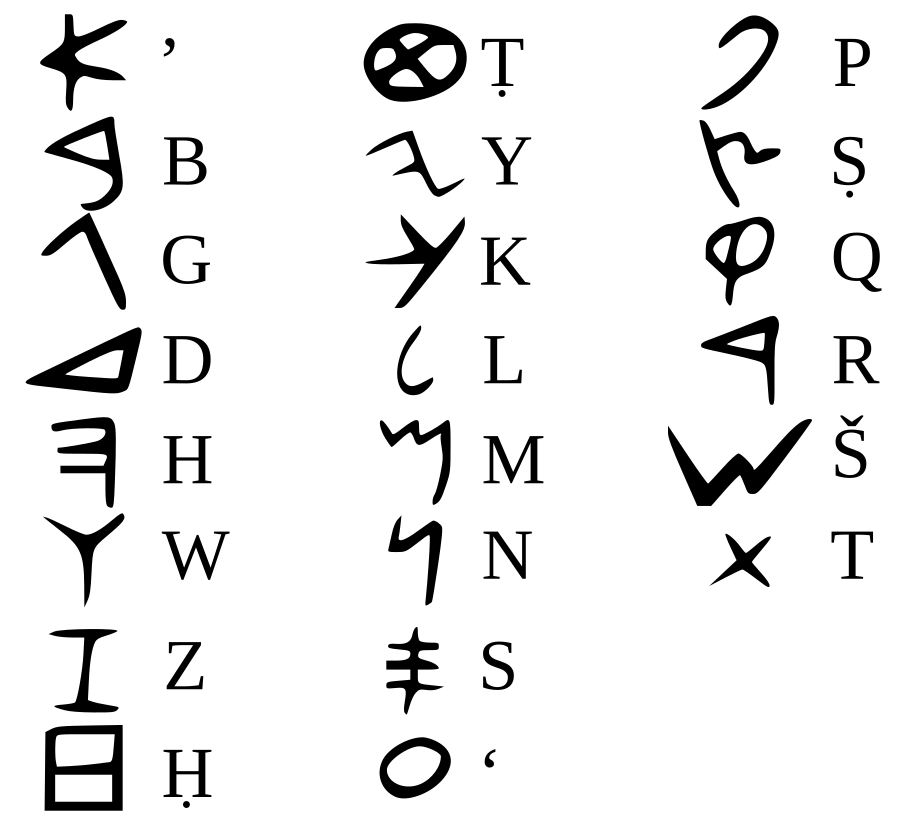
The Phoenician language was Northwest Semitic, closely related to Hebrew and Aramaic. The Phoenician alphabet — twenty-two consonantal signs, with no vowels written — was developed at Byblos in the eleventh century BC and is the direct ancestor of the Greek, Latin, Cyrillic, Aramaic, Hebrew and Arabic alphabets; the script the reader is reading at this moment descends from the Phoenician alphabet through the Greek and Latin intermediation. The Phoenician religion was a Canaanite polytheism with principal cults of Baal (the storm-god), Astarte (the goddess of love and war), Eshmun (the healer), and Melqart (the city-god of Tyre, associated with the Greek Heracles and the Roman Hercules). The civic-political system was a mercantile oligarchy in which kings ruled by the consent of a council of merchant-aristocratic families.
The Bronze Age background
The Phoenician cities had existed as Canaanite urban centres since the third millennium BC and had been engaged in long-distance trade — particularly the export of cedar wood from the Lebanon range to Egypt, attested in the Egyptian Old Kingdom records — for two thousand years before they emerged as the principal Mediterranean commercial power. The pivotal period was the Late Bronze Age collapse of approximately 1200 BC, in which the Mycenaean palace civilisations of mainland Greece, the Hittite Empire of central Anatolia, the New Kingdom Egyptian empire (substantially weakened), and the Ugaritic kingdom on the northern Syrian coast were all destroyed or substantially reduced by a combination of internal economic-political crisis and the migrations of the so-called Sea Peoples. The Phoenician cities survived this collapse intact — Tyre, Sidon and Byblos were the principal coastal cities not destroyed in the upheaval — and emerged in the post-collapse period of the eleventh and tenth centuries BC as the principal organised commercial power in the eastern Mediterranean.
Tyre under Hiram
The pivotal moment in the rise of Tyre to commercial pre-eminence was the reign of King Hiram I (c. 980–947 BC), a contemporary of David and Solomon of Israel. Hiram's reign is documented in three principal sources: the Tyrian annals quoted in fragments by the first-century-AD Jewish historian Josephus, the biblical accounts of Solomon's relationship with Tyre (1 Kings 5, 1 Kings 9, 2 Chronicles 2), and the archaeological evidence of construction at the island city. Hiram extended the island of Tyre by reclaiming the channel between the original island and an adjacent rock; built two harbours — the Sidonian harbour on the north side, oriented toward the Phoenician home country, and the Egyptian harbour on the south side, oriented toward the Egyptian and African trade; and constructed the great temple of Melqart and the royal palace.
The economic basis of Tyrian prosperity under Hiram and his successors comprised: the export of Lebanese cedar wood (in demand for shipbuilding and for monumental construction across the eastern Mediterranean); the production and export of purple-dyed textiles, glass, and metalwork; the long-distance carrying trade in metals (silver from Iberia, tin from the Atlantic coast of Iberia or possibly from Cornwall, copper from Cyprus, gold from Egypt and the African interior); and the eventual establishment of colonial trading posts along the principal Mediterranean routes.

The colonial system
The Phoenician — predominantly Tyrian — colonial movement extended westward across the Mediterranean from approximately the tenth century BC. The motivation was principally commercial: the establishment of trading posts at intervals along the principal routes to provide harbours, water, and exchange points with the local populations. The principal commodities pursued were the metals of the western Mediterranean — Iberian silver, Sardinian copper and lead, the metals of the British Isles via the Atlantic-Iberian route — for which the Phoenicians provided in exchange the manufactured goods of the Levantine cities and the staples of eastern Mediterranean agriculture.
The principal Tyrian colonies established in the ninth and eighth centuries BC include: Utica on the North African coast (founded c. 1100 BC according to tradition; the archaeology suggests a date in the ninth century BC); Gadir/Gades (modern Cadiz, on the south-western Iberian coast, founded c. 1100 BC according to tradition); Lixus on the Atlantic Moroccan coast; Motya on the western coast of Sicily; Nora and Tharros on Sardinia; Carthage itself, on the Tunisian coast (traditional foundation date 814 BC). The colonies were initially small trading posts — perhaps a few hundred settlers each — with substantial connection to the home city for the supply of trade goods, the dispatch of personnel, and the religious-ceremonial functions.
The political relationship between the home city and the colonies was looser than the equivalent Greek colonial system: there was no formal civic constitution requiring the colonies to maintain particular relations with Tyre, and as the colonies grew over the eighth and seventh centuries BC they developed their own administrative and political institutions. The principal continuing ties were religious (the annual sending of tribute to the great Temple of Melqart at Tyre) and commercial (the participation of colonial traders in the broader Tyrian commercial network).
The home-city decline
The principal Phoenician cities of the home country — Tyre, Sidon and Byblos — were progressively reduced through the late eighth, seventh and sixth centuries BC under the pressure of the major Near Eastern empires. The Neo-Assyrian Empire under Tiglath-Pileser III (744–727 BC), Sargon II (722–705 BC) and Sennacherib (705–681 BC) extracted tribute from the Phoenician cities and intermittently took direct control of them. The Neo-Babylonian Empire under Nebuchadnezzar II (605–562 BC) besieged Tyre for thirteen years from 587 to 574 BC — the only Phoenician city to resist Assyrian and Babylonian incorporation through sustained military defence — and ultimately produced its formal subjugation though Tyre retained its civic institutions and its commercial network. The subsequent Persian conquest under Cyrus the Great in 539 BC made the Phoenician cities tributary parts of the Achaemenid Empire; Alexander the Great's siege of Tyre in 332 BC — seven months, including the construction of a causeway from the mainland that converted the island city into a peninsula — produced the final destruction of Tyrian civic independence.
By 814 BC — the traditional foundation date of Carthage — the Tyrian home city was already under the increasing pressure that would terminate its civic independence five centuries later. The colony at the modern Tunisian coast that Tyrians founded at this date would, within three centuries, surpass the mother-city in commercial reach, civic population and political importance. The foundation legend, the archaeology of the early settlement, and the question of the Tophet are the subject of chapter II.
End of Chapter I