After the 29th of May 1453, no living person held the office of Roman emperor as a direct institutional inheritance. The continuous line was broken. But the prestige of the Roman name was such that four distinct claims to inherited Romanness were made by surviving political and religious institutions in the following century, and each lasted long enough to matter to the political history of its region. This final chapter sketches the four claims, the cultural inheritances that survived all four, and the answer to the question this volume began with: where Rome can still be found.
The Russian claim
The most ambitious post-1453 succession claim was made from Moscow. The Russian grand prince Ivan III (1462–1505) married Sophia Palaiologina, niece of the last Byzantine emperor Constantine XI, in 1472. Sophia had grown up in Rome under papal protection; her marriage to Ivan was diplomatically arranged by Pope Paul II in the hope of converting Russia to the Catholic obedience. The conversion did not happen, but Ivan adopted the Byzantine double-headed eagle as the symbol of his state (it is still the symbol of the Russian Federation) and the Byzantine title Tsar (Caesar) was used in correspondence. His grandson Ivan IV (Ivan the Terrible, 1547–1584) took the title formally in 1547 as part of his coronation.
The theological correlate of the Russian claim was articulated in a letter of around 1510 by the monk Filofei (Philotheos) of Pskov, addressed to Grand Prince Vasily III, which contains the famous formula: "Two Romes have fallen. The third stands. A fourth there shall not be." The first Rome had fallen to the heresy of papal supremacy in 1054; the second (Constantinople) had fallen to the Ottomans in 1453; the third was Moscow, and would not fall. The doctrine of the Third Rome was never adopted as official Russian policy but was widely diffused in Russian Orthodox ecclesiastical culture and is still invoked in some Russian nationalist circles. The Russian imperial title was held continuously from 1547 to 1917, when the last Tsar Nicholas II abdicated; some Russian Orthodox traditionalists have dated the formal end of the Roman empire to that abdication.
The Ottoman claim
Mehmed II himself, immediately after taking Constantinople, took the Roman imperial title in his diplomatic correspondence: Kayser-i Rum, Caesar of Rome. The claim was reasoned: Mehmed had taken the city by the sword and had assumed sovereignty over its inhabitants; he was the new lord of the Roman territory and people, and was therefore their emperor. The claim was recognised by the patriarch of Constantinople (whom Mehmed re-installed as head of the Orthodox millet) and was diplomatically used in dealings with Western powers and with the Russian state. The Ottoman court continued to use the title intermittently into the seventeenth century, when the language of pan-Islamic caliphate became more central to Ottoman self-description.
The substantive correlate of the Ottoman claim was demographic. The Greek-speaking Orthodox population of the eastern empire — the Romaioi — remained the dominant urban population of Constantinople and many other cities for several more centuries. The Ottoman state administered them through the Orthodox patriarchate. Modern Greek population statistics for the Ottoman territories in the nineteenth century — perhaps two and a half million Greek-speakers in Anatolia at 1900, perhaps one and a half million in Constantinople — were the demographic Rump of the eastern empire. The Greek-Turkish population exchange of 1923, ordered by the Treaty of Lausanne, ended this Roman demographic presence in Anatolia. About 1.2 million Greek-speakers were transferred to Greece. The Roman empire ended, in a quiet demographic sense, in the railway transports of 1923.
The Holy Roman claim
The third claim, much older than the others, was the Frankish-German Holy Roman Empire, founded when Charlemagne was crowned by Pope Leo III in Saint Peter's Basilica on Christmas Day 800. The Holy Roman Empire claimed to be the continuation of the western Roman empire, restored to legitimacy by papal coronation. The claim was, throughout the Middle Ages, contested by the eastern empire (whose response to the 800 coronation was diplomatically frosty for several decades). The German Holy Roman Empire survived in some institutional form until 1806, when Francis II of Austria formally dissolved it under Napoleonic pressure. Voltaire's famous quip — that it was "neither holy, nor Roman, nor an empire" — captures the standard modern Western view. The institutional claim was, however, real: the Holy Roman Emperors used Roman titles, employed Roman law, and considered themselves the direct heirs of Charlemagne and (through him) of Augustus.
The papal claim
The fourth claim is the Roman Catholic Church itself. The bishopric of Rome continued, in unbroken succession, throughout the post-Roman period; the pope inherited many of the urban-administrative functions of the imperial office in the city of Rome from late antiquity onward. The papal claim to be the heir of Rome is not a claim to political dynastic succession (though the Papal States of 754-1870 were a substantial Italian temporal sovereignty), but a claim to institutional and spiritual continuity. The Latin language is still the official language of the Catholic Church. The legal code that governs the Catholic Church (the Code of Canon Law) is a Roman-law-derived system. The college of cardinals — the senior advisers of the pope — preserves, in attenuated form, the structure of the Roman senate. The papal court ceremonies preserve, in modified form, the ceremonies of the late-Roman imperial court at Constantinople. The continuity is real and is consciously maintained.
Where Rome can still be found
The institutional inheritances of the Roman empire are, by any honest assessment, more substantial than those of any other former state. The Romance languages — French, Italian, Spanish, Portuguese, Romanian, Catalan, Occitan, Sardinian, and a dozen smaller varieties — are spoken as native languages by perhaps a billion people; they are direct descendants of the Latin that Augustus's soldiers and tax collectors carried into the western provinces. The Latin alphabet, in its slightly modified Roman-imperial form, is the most widely used writing system in the world. The Greek alphabet, in its slightly modified Byzantine form, is the official script of one modern country and the inheritance of the Cyrillic alphabet used by another dozen. The Roman calendar — the months named after Roman gods and emperors, the seven-day week — is the standard time-reckoning system on every continent. The Roman law — the civil-law tradition inherited from Justinian's Corpus Iuris Civilis — is the legal system of around 150 countries. The Roman road network is preserved, with surprisingly little alteration of route, in the modern road system of much of western and southern Europe; the M1 in southern England, the Watling Street of Roman Britain, the Via Appia in Italy, the Via Egnatia in northern Greece, the road from Lisbon to Mérida, all of these are Roman engineering projects still in use. The standard urban grid pattern of the central districts of Barcelona, Florence, and many smaller Italian and French cities preserves the Roman castra plan. The water-supply systems of medieval Italian cities continued, in many cases, to use Roman aqueducts; the Pont du Gard in France is a Roman aqueduct that supplied Nîmes from the first century until the ninth.

The classical literary inheritance — Virgil, Horace, Cicero, Ovid, Tacitus, Livy, Suetonius, Plutarch — has been continuously read in the West for two thousand years. It is read in the original language by perhaps fifty thousand specialists worldwide; it is read in translation by considerably larger numbers. The eastern empire's literary inheritance — Procopius, Anna Komnena, Psellos, the immense Byzantine theological and hagiographic literature — is, by contrast, very little read outside specialist circles, and is one of the projects to which a serious general reader could profitably turn.
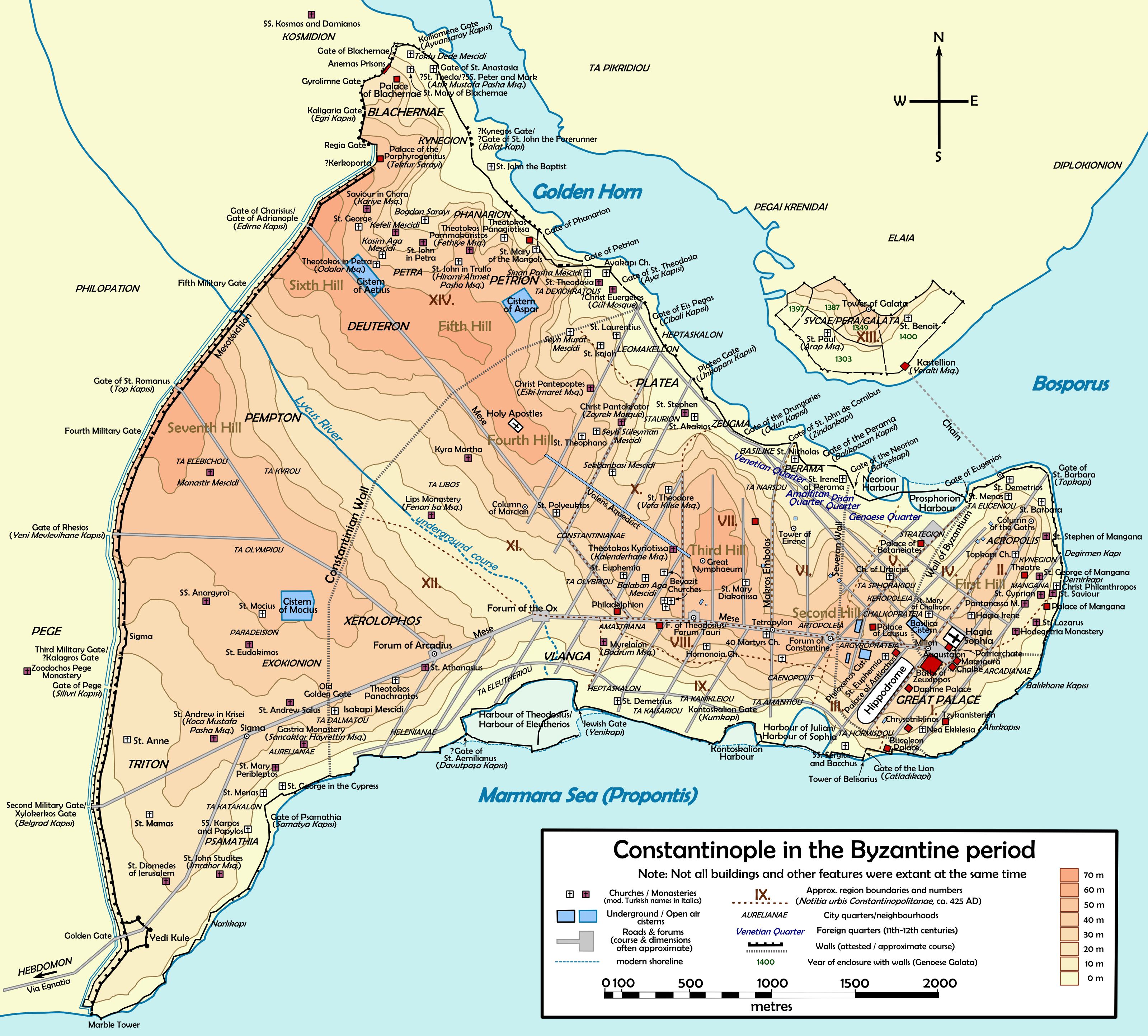
Constantinople is, by any account, the principal physical place where the empire can still be felt. Hagia Sophia is still standing (since 2020, again a working mosque, but visitable in its non-prayer hours). The Theodosian Walls are largely preserved; one can still walk most of their length. The Hippodrome is an open square (the Sultanahmet Meydanı, which keeps its Roman shape and several of its Roman monuments — the Walled Obelisk, the Serpent Column, the Egyptian Obelisk of Theodosius). The Basilica Cistern still works. The submarine archaeology of the Yenikapı excavations preserves the wrecks of Byzantine merchant ships of the fourth to eleventh centuries.
Rome itself is, by contrast, an excellent guide to what the city was; less of a guide to what the empire was. The empire was, in its centre, never in Rome after Diocletian. The empire was on the Rhine and the Danube, in Alexandria and Antioch, in Trier and Mérida and Carthage and Ephesus. The travel section of this volume describes twenty places where the empire's physical presence is still visible. Most of them are not Rome. But Rome remains, for any general reader, the principal pilgrimage destination of any volume of Lost Lands, and it deserves the four days it will take. The four days are described in the travel guide that follows.
"While stands the Coliseum, Rome shall stand. When falls the Coliseum, Rome shall fall. And when Rome falls, the world." — Bede, the Venerable, eighth century; as paraphrased by Byron
End of Chapter X · End of Volume IX