The four centuries between the death of Basil II in 1025 and the Ottoman conquest of Constantinople in 1453 are usually presented as the empire's long decline. They were. The territorial losses were continuous, the diplomatic position was almost never recoverable, and the institutional sophistication of the Macedonian-period state was, by the fifteenth century, gone. But the decline was uneven, and was punctuated by genuine recoveries — under the Komnenoi in the late eleventh and twelfth centuries, briefly under the Palaiologoi at the start of the fourteenth — that need to be understood on their own terms. The empire fell in 1453, but it fell after having repeatedly almost not fallen.

Manzikert and the loss of Anatolia
The first catastrophe was the battle of Manzikert on the 26th of August 1071, in eastern Anatolia, in which the army of the eastern emperor Romanos IV Diogenes was defeated by the Seljuk Turkish sultan Alp Arslan. The military casualties were relatively modest; the political consequences were enormous. Romanos was captured (Alp Arslan released him after a brief and famously courteous captivity), but a court faction at Constantinople — under the influence of the Doukas family — refused to recognise his return and deposed him; the resulting civil war kept the imperial army occupied for the next five years. While the Romans fought each other, Turkish tribal groups under loose Seljuk authority moved into the Anatolian plateau. By 1080 most of the interior of Asia Minor — the agricultural and demographic heart of the empire, source of most of its tax revenue and most of its soldiers — was under Turkic occupation. The economic and military base of the empire was permanently halved.
The Komnenian recovery (1081–1185) under Alexios I, John II, and Manuel I clawed back the coastal regions of western Anatolia, restored the diplomatic position of the empire, and produced a substantial intellectual revival; but it never re-established control of the central plateau, and after Manuel I's death in 1180 the dynasty collapsed in civil war and the new Angelos dynasty (1185-1204) was unable to defend the empire from internal disintegration. The Latin crusader states of Syria and Palestine, established after the First Crusade of 1096-1099 (a Crusade originally launched in response to Alexios I's appeal to the West for military assistance), became a permanent and complicated presence in the empire's strategic environment.
The Fourth Crusade
The single most catastrophic event in the eastern empire's history before 1453 was the Fourth Crusade of 1202–1204. A crusading force originally intended for Egypt, financed by the Republic of Venice, was diverted (under a long sequence of fiscal and political pressures, the details of which fill a substantial literature) first to attack the Christian city of Zara on the Adriatic, and then to Constantinople itself in support of a Byzantine pretender. The pretender was installed and quickly deposed. The crusaders, finding themselves unpaid and unprotected, took the city by storm on the 13th of April 1204 and sacked it for three days with a thoroughness that contemporary western observers found shameful and contemporary eastern observers found apocalyptic.
The damage was severe and largely permanent. The accumulated treasure of nine hundred years of imperial collecting was looted; the major works of classical sculpture in the city were melted down for their bronze; the relics of the Passion (Crown of Thorns, fragments of the True Cross, the holy lance) were exported to western churches (the Crown of Thorns ended up at Notre-Dame in Paris, where it remained until the 2019 fire). The four bronze horses now in St Mark's in Venice were taken from the Hippodrome. The crusaders set up a Latin Empire (1204-1261), partitioning the conquered territory among themselves; three Byzantine successor states emerged in the parts they had not occupied — the Empire of Nicaea (in north-western Anatolia), the Empire of Trebizond (on the Black Sea coast), and the Despotate of Epirus (in western Greece) — each claiming to be the legitimate Roman empire-in-exile.
The Palaiologan recovery
The empire of Nicaea, under the Laskaris dynasty and then the Palaiologos dynasty, slowly recovered most of the lost territory. Constantinople was retaken by the forces of the Nicaean emperor Michael VIII Palaiologos on the 25th of July 1261 — by surprise, almost without resistance, while most of the Latin garrison was away on campaign. Michael entered the city in triumph on the 15th of August and was crowned in Hagia Sophia. The Latin Empire had lasted fifty-seven years; the Palaiologan dynasty he founded would rule the restored empire until 1453.
The restored empire was, however, a much smaller state. The Latin sack had destroyed its fiscal base; the Italian maritime republics — Venice, Genoa, and Pisa — had taken over the long-distance trade that had once produced most of the empire's customs revenue; the army had to be rebuilt, mostly from mercenaries the state could not afford. The Anatolian frontier remained porous, and from the late 1200s a new Turkic confederation under the Osman family (the Ottomans) began to expand from a small frontier emirate in north-western Anatolia. By 1326 the Ottomans had taken Bursa; by 1354 they had crossed into Europe by capturing the fortress of Gallipoli; by 1389 they had defeated the Serbs at Kosovo and absorbed most of the Balkans. The empire by 1400 was reduced to Constantinople itself, parts of Thrace, the Despotate of Morea in the southern Peloponnese, and a few Aegean islands.
The siege and fall of Constantinople
The last act took place under the reign of the last emperor, Constantine XI Palaiologos (1449–1453), and the young Ottoman sultan Mehmed II (r. 1444-1446, 1451-1481). Mehmed succeeded to the Ottoman throne in 1451 with the explicit intention of taking Constantinople — a project his father Murad II had postponed. He spent the winter of 1451-2 building the great fortress of Rumeli Hisarı on the European bank of the Bosphorus, just north of the city, to control the strait. He commissioned the Hungarian gun-founder Urban to cast the largest siege artillery in history, including a 27-foot bombard capable of throwing a 600-pound stone projectile. The Ottoman army assembled in early April 1453 numbered perhaps eighty thousand men. The defenders of Constantinople — Constantine XI's own troops, Italian volunteer reinforcements from Venice and Genoa, the Genoese commander Giovanni Giustiniani Longo with seven hundred professional soldiers — numbered perhaps seven thousand. The walls of the city, built by Theodosius II in 413 and continuously maintained, had withstood twenty-three previous sieges. They were the most formidable urban defences in the medieval world.
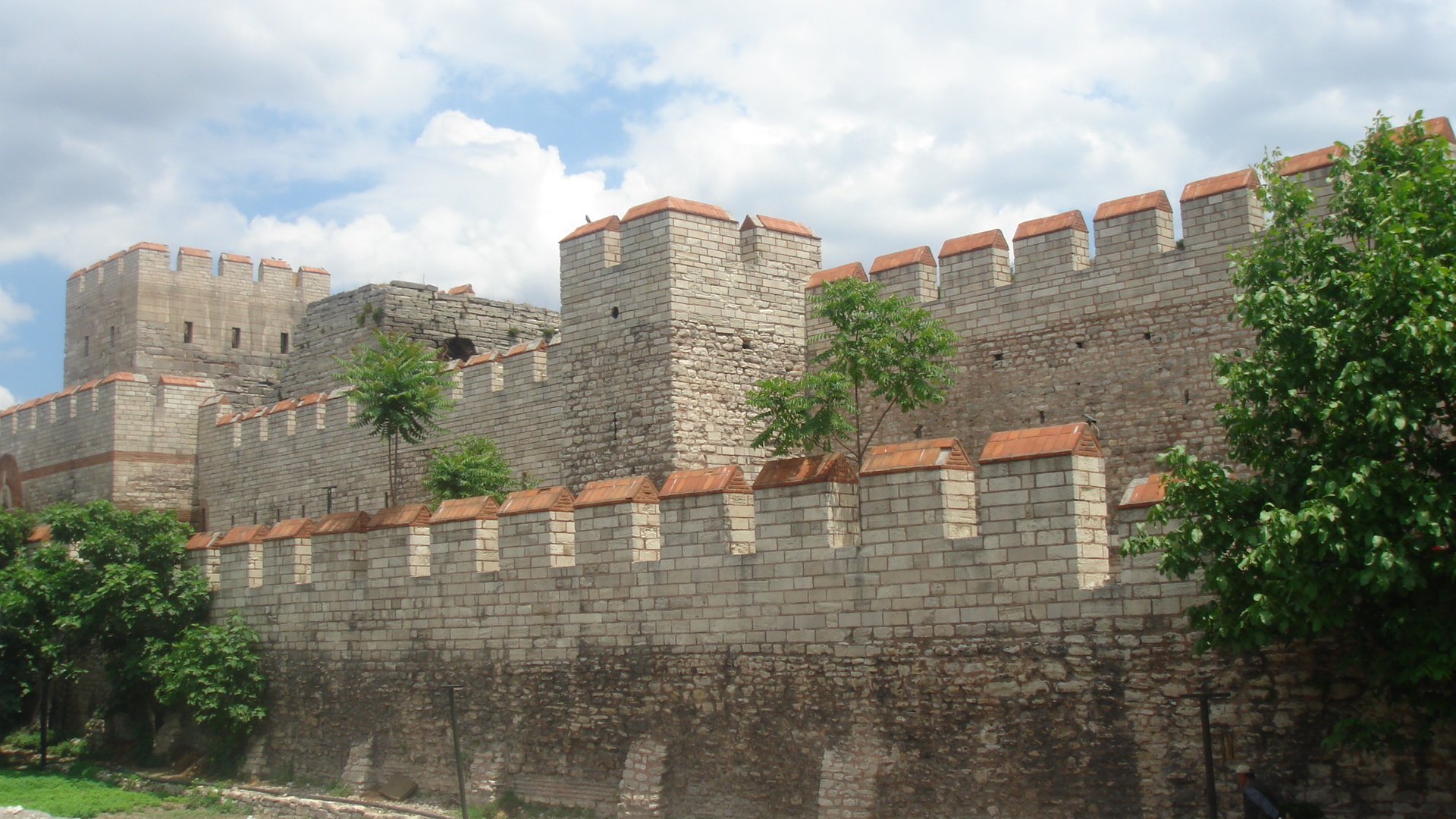
The siege began on the 6th of April 1453. The Ottoman artillery battered the land walls for six weeks. The defenders repaired the damage by night. An Ottoman attempt to break the chain across the Golden Horn was defeated by a Venetian-Genoese naval force; Mehmed's response — to haul his fleet overland on greased rollers from the Bosphorus to the upper Golden Horn — outflanked the chain and put Ottoman ships in the inner harbour. The final assault began before dawn on Tuesday the 29th of May 1453. After three waves of attack, the Janissaries broke through a small postern gate (the Kerkoporta) that had been left open after a sortie. Giustiniani was wounded and withdrew. The defence on the land walls collapsed. Constantine XI, last of the Roman emperors, removed the imperial insignia and fought as a private soldier; he was killed in the rout, his body never identified with certainty. He was forty-nine.
The city was sacked for three days as the conventions of siege warfare required. Mehmed entered the city on the afternoon of the 29th, rode to Hagia Sophia, and ordered the church converted to a mosque on the spot; the muezzin's first call to prayer in the building took place at the next afternoon's prayer. The Roman Empire, in the institutional sense, had ended. The continuous succession of emperors from Augustus to Constantine XI had run for one thousand four hundred and eighty years.
The Greek-speaking inhabitants of the city were either killed, enslaved, ransomed, or, in most cases, allowed to remain as Ottoman subjects. The patriarch of Constantinople continued to function under Ottoman authority as the head of the Orthodox millet. The city would be the capital of the Ottoman Empire for the next 470 years. The next chapter follows what was claimed in the empire's name afterwards.
"The city is fallen, and I am still alive." — traditional last words attributed to Constantine XI, 29 May 1453 (probably apocryphal)
End of Chapter IX