The reigns of Diocletian (284–305) and Constantine I (306–337) are, between them, the foundation of the Late Roman state. Their solutions to the structural problems of the third-century crisis — Diocletian's division of imperial authority among four colleagues, his price-fixing and tax-administering reforms; Constantine's foundation of a new capital, his legalisation and partial sponsorship of Christianity, his administrative reorganisation — produced an empire that looked different from the Augustan one. It also produced an empire that worked. The eastern half of what they founded would survive, in continuous institutional form, until the fifteenth century.
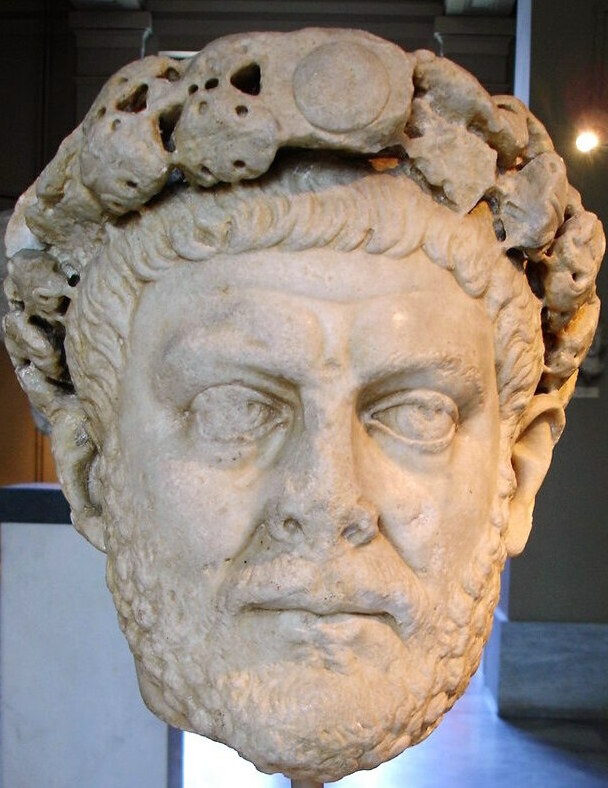
Diocletian's tetrarchy
Diocletian — born Diocles, the son of a Dalmatian freedman, a career officer who had risen to command the imperial bodyguard — was proclaimed emperor by his troops at Nicomedia in November 284 at the age of about forty. He took the throne with a clear analysis of what had gone wrong in the previous fifty years. The empire was too large to be governed by one man; it had too many frontiers and too many crises happening simultaneously. The succession was the central political weakness; an emperor on a distant frontier could be assassinated by a local commander faster than news could reach Rome. The civilian administration was inadequate to either tax or police the empire it was responsible for.
His response, evolved over twenty years, was the so-called Tetrarchy — the rule of four — formally established in 293. Two senior emperors (the Augusti, each with the rank of Augustus) would each rule one half of the empire; each Augustus would adopt a junior emperor (a Caesar) who would govern a quarter and would succeed automatically when the Augustus retired. The four emperors would have geographically separate residences: Diocletian himself at Nicomedia in north-western Anatolia; Maximian (his fellow Augustus) at Milan; Constantius (Maximian's Caesar) at Trier on the Rhine; Galerius (Diocletian's Caesar) at Sirmium on the Danube. The city of Rome remained ceremonially the capital, but no emperor lived there. The senior court was now wherever the senior emperor was, which after 293 meant Nicomedia, Milan, Trier, or Sirmium.
The tetrarchic system had a number of subsidiary reforms attached to it. The number of provinces was doubled (from about fifty to about a hundred) to reduce the territorial authority of any single governor. The provinces were grouped into twelve dioceses, each under a vicar, providing an intermediate tier of administration. Civilian and military authority within each province were separated, to reduce the risk of a single official acquiring the combination of resources needed to mount a usurpation. The army was reorganised into a frontier-defence component (the limitanei) and a mobile field-army component (the comitatenses), the latter held in strategic reserve. A new tax system based on land surveys and head counts (the iugatio-capitatio) replaced the old Augustan combination of tribute and provincial assessment. Diocletian's Edict of Maximum Prices (301) attempted to fix the prices of about a thousand goods and services across the empire to deal with the inflation of the previous half-century; it was largely a failure but is preserved in extensive epigraphic remains and is, by chance, the most detailed surviving document of the ancient Roman economy.
Diocletian also conducted the most systematic persecution of Christianity in Roman imperial history, the so-called Great Persecution of 303–311. Christian churches were ordered demolished, scriptures were ordered burned, Christians were dismissed from the army and civil service, and from 304 onward Christian clergy were required to sacrifice to the traditional gods on pain of execution. The persecution was particularly severe in the east (where Diocletian and Galerius personally enforced it) and milder in the west (where Constantius did not enforce it at all). It produced perhaps three to four thousand martyrs whose names are recorded; total deaths are estimated in the tens of thousands. The persecution failed to suppress the church and, in retrospect, may have strengthened it.
Diocletian and Maximian abdicated together on the 1st of May 305 — the first voluntary abdication of a Roman emperor — and retired to their newly built palaces (Diocletian's at Split in modern Croatia, where it still stands and forms the historic core of the city; Maximian's at the rural villa of Casale in Sicily). The transition to their Caesars Galerius and Constantius was, initially, smooth. The new arrangement collapsed within eighteen months.
The civil wars
The collapse began when Constantius I died at York on the 25th of July 306 while on campaign in Britain, and his troops proclaimed his thirty-two-year-old son Constantine — who had been with him on the campaign — as the new Augustus. This was a violation of the tetrarchic principle of adoption-by-merit rather than dynasty. Galerius refused to accept it; the available imperial seats were quickly contested by a chaotic field of claimants — Maxentius (Maximian's son, proclaimed in Rome in October 306), Licinius (proclaimed by Galerius in 308), Maximinus Daia (Galerius's nephew). By 312 the system had broken down into a series of two-emperor and three-emperor configurations and a succession of civil wars.
The decisive battle was fought on the 28th of October 312 at the Milvian Bridge, just outside Rome, between the armies of Constantine (advancing from Gaul) and Maxentius (defending Italy). Maxentius was defeated and drowned in the Tiber. Constantine entered Rome and became, in practice if not yet in formal title, master of the western empire. The battle has acquired a religious significance entirely out of proportion to its military scale because of Constantine's later claim — preserved by his biographer Eusebius of Caesarea, writing twenty-five years later — that on the day before the battle he had seen a vision of a Christian symbol in the sky with the legend "by this sign conquer" (in Greek, en touto nika; in the Latin version, in hoc signo vinces). Whether the vision was a genuine experience, a later embellishment, or a piece of theological propaganda is one of the most-debated questions in late-antique studies. What is certain is that after 312, Constantine treated Christianity as a religion he favoured.

The Edict of Milan and the foundation of Constantinople
In February 313, Constantine and his then-ally Licinius (who controlled the eastern empire) met at Milan and issued a joint declaration — preserved by Lactantius and known to historians as the Edict of Milan — that legalised Christianity throughout the empire and ordered the restoration of property confiscated during the Great Persecution. The two emperors were, by 324, at war with each other; Licinius was defeated at the battle of Chrysopolis on the 18th of September 324 and was executed the following year. Constantine became sole emperor of a reunified empire, which he would rule for thirteen more years.
His most consequential single act was the foundation of a new imperial capital. In 324, on the site of the Greek colonial city of Byzantion at the mouth of the Bosphorus, Constantine began building a new capital that he originally called New Rome (Nea Roma) and that quickly came to be called, after him, Constantinople. The city was dedicated on the 11th of May 330. It had a new senate, a forum, palaces, a hippodrome, and (in the next reign) a new church of Holy Wisdom (Hagia Sophia, rebuilt by Justinian two centuries later). The strategic logic was unanswerable: Constantinople sat at the junction of the empire's two most important frontiers (the Danube and the eastern frontier with Persia), commanded the sea route from the Aegean to the Black Sea, and was, by virtue of its peninsular geography and Constantine's new walls, extraordinarily defensible. It would survive every assault for the next eleven hundred years.
Constantine also continued to favour Christianity. The bishop of Rome was given the Lateran palace as his residence (it would remain the papal residence until the fourteenth century); the church of St Peter was begun on the Vatican hill, on the site traditionally identified as the apostle's grave; the Council of Nicaea (May–July 325) was convened by Constantine himself in his summer residence to resolve the Arian controversy in the eastern church, producing the Nicene Creed that is still recited by most Christian denominations. Constantine was not formally baptised until his deathbed in May 337, but the empire he left to his sons was decisively closer to a Christian state than the one he had inherited.
He died at Nicomedia on Pentecost Sunday, the 22nd of May 337, aged about sixty-five, having received baptism shortly before. He left the empire divided among his three surviving sons — Constantine II, Constantius II, and Constans — who promptly began the next civil war. The pattern of the tetrarchy was broken; the empire was now a hereditary monarchy in the Constantinian family. It would remain so, intermittently, until the dynasty died out in 363 with the death of Constantine's nephew Julian. The next chapter takes up the story of the two-empire system that Constantine's settlement made possible.
End of Chapter V