The Julio-Claudian dynasty — Tiberius, Caligula, Claudius, Nero — ruled the empire for fifty-four years (14 to 68 AD) and then died out with Nero's suicide, by his own deeply reluctant hand, on the 9th of June 68. The Flavian dynasty that replaced them — Vespasian, Titus, Domitian — ruled for another twenty-seven years (69 to 96 AD), bringing the first imperial century to a close. What the two dynasties have in common is that they made the imperial system — Augustus's careful constitutional fiction — irreversible. By the time Domitian was assassinated in 96, no Roman politician was seriously proposing the restoration of the Republic. The emperor was, by then, simply how the state was organised.

The chapter that follows summarises eighty-two years of complicated dynastic history. Inevitably, much is omitted. The reader interested in the lurid detail — the murders, the orgies, the mushrooms — should read Suetonius and Tacitus, who supply much of our information and whose hostility to most of the Julio-Claudians has shaped Western memory for two thousand years.
Tiberius (14–37 AD)
Augustus's reluctant heir was an able man with a deeply unhappy private history (his beloved first wife Vipsania had been forced upon him to a divorce, and a marriage to Augustus's troubled daughter Julia, that he detested) and an instinctive distaste for the public role. He ruled competently for a decade, then in 26 AD retired to the island of Capri, leaving the administration in the hands of his praetorian prefect Sejanus. Sejanus, an ambitious and effective administrator, used the next five years to build a personal power base and to arrange the murder or exile of Tiberius's potential successors, including Tiberius's son Drusus. He was executed by Tiberius in October 31 AD after a delayed but decisive denunciation read out before the Senate. The succession problem he had left behind — most of the obvious candidates were dead — meant that Tiberius's heir was his great-nephew Gaius Caesar, known to the Roman public as Caligula ("little boots"), the surviving son of the popular general Germanicus. Tiberius died at Misenum on the 16th of March 37, aged seventy-seven, possibly smothered by Caligula's praetorian commander when he had inconveniently appeared to recover from his apparent deathbed.
Caligula (37–41 AD)
Caligula came to the throne at twenty-four, popular and apparently sane. Within a year of his accession he suffered some kind of physical and psychological collapse — possibly meningitis, possibly something else — from which he emerged with what Roman sources describe as a thoroughgoing megalomania. He demanded religious worship of himself. He ordered the Senate to declare his horse Incitatus a consul (probably a humiliation, certainly not a serious appointment). He executed senators on slight pretext. He bankrupted the treasury Augustus had left full. He marched an army to the English Channel and ordered the soldiers to collect seashells as the "spoils of Ocean." After three years and ten months of this, he was assassinated by officers of his own Praetorian Guard on the 24th of January 41 AD, aged twenty-eight, in a corridor of his palace after watching games in honour of Augustus. His wife and infant daughter were murdered the same day.
Claudius (41–54 AD)
Caligula's uncle Claudius — fifty years old, with a limp, a stammer, and a deafness that had caused his family to keep him out of public life — was hauled from behind a curtain by the assassins of his nephew and presented to the Praetorian Guard, who proclaimed him emperor at sword-point. The Senate, briefly entertaining the restoration of the Republic, accepted him within a day. He proved, contrary to the expectations of everybody who had known him as a private citizen, an able administrator. The conquest of southern Britain was carried out in 43 AD under his personal nominal command (he travelled to Britain for sixteen days to take credit for the victory). The corn supply of Rome was reorganised. The Praetorian Guard, whose role in his accession had been alarmingly conspicuous, was given a permanent pay rise in exchange for permanent loyalty — a precedent with long consequences. He was poisoned by his fourth wife Agrippina the Younger (his niece) on the 13th of October 54, by Roman tradition with a dish of mushrooms, in order to clear the throne for her son by an earlier marriage. Her son was Nero.
Nero (54–68 AD)
Nero came to the throne at sixteen, the youngest emperor to date. His first five years — under the joint regency of his mother Agrippina, the philosopher Seneca, and the praetorian prefect Burrus — were administratively competent and remembered, in later Roman tradition, as the "quinquennium Neronis," the five-year period of good government. After 59 AD Nero began to govern personally and the regime grew steadily worse. He murdered his mother in 59 (after several failed attempts, including a collapsible boat). He divorced and then executed his first wife Octavia in 62. He kicked his second wife Poppaea to death in 65 in a domestic quarrel. He executed Seneca, his old tutor, on suspicion of complicity in the Pisonian Conspiracy of 65. He had ambitions as a singer and theatrical performer that scandalised the senatorial class, and he made a triumphal tour of Greece in 66 to win every competition at which he sang.
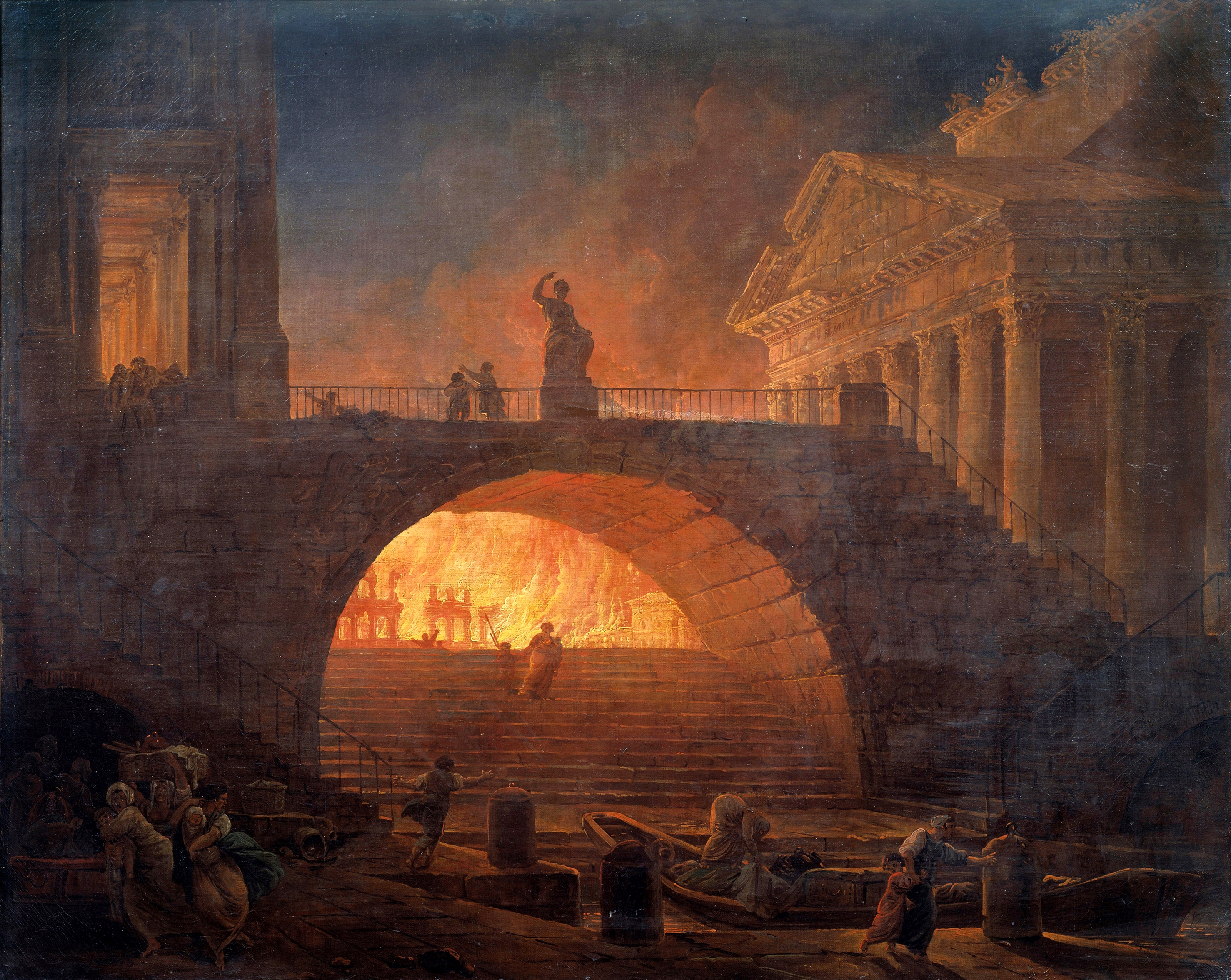
The single event of his reign for which he is universally remembered is the Great Fire of Rome of July 64, which destroyed three of the city's fourteen districts and badly damaged seven more. The story that Nero set the fire himself is almost certainly false — he was at Antium when it began — and the further story that he sang or fiddled while the city burned is a Suetonian elaboration of a story that probably has more to do with his theatrical ambitions than with the actual events. (The fiddle had not yet been invented; he played the lyre.) What is true is that he used the cleared ground to build himself an enormous new palace, the Domus Aurea, occupying a hundred to two hundred acres of central Rome, and that he scapegoated the small Christian community for the fire, providing the first imperial persecution of Christians (an event noted by Tacitus and indirectly by 1 Peter).
The end came when the army turned. The governor of Gaul, Gaius Julius Vindex, rebelled in March 68. The governor of Spain, Servius Sulpicius Galba, joined the rebellion. The Praetorian Guard was bribed to switch sides. Nero, in his flight from the city, ordered a freedman to help him commit suicide. His reported last words — "What an artist dies in me!" — are characteristic and probably authentic. He was thirty.
The Year of Four Emperors (69 AD)
With Nero's death the Julio-Claudian line was extinct. The political settlement that Augustus had set up was about to be tested. From June 68 to December 69, the Roman empire had four different emperors, three of whom were murdered or committed suicide and the last of whom — Vespasian, an able general of unfashionable Italian provincial origin — emerged from the civil war to found the Flavian dynasty. The pattern of "succession by military acclamation" (the army of a province, or of Rome itself, declares its commander emperor and marches on the capital) had now been demonstrated. It would be used about eighty times over the next four centuries.
The Flavians (69–96 AD)
Vespasian was the man of the year of crisis: stolid, plain-spoken, an experienced commander who had been in the field in Judaea suppressing the Jewish revolt when his troops proclaimed him emperor. His reign of ten years (69–79) restored the public finances, rebuilt the parts of Rome destroyed in the civil war, and began the construction of the Colosseum (formally the Flavian Amphitheatre) on the drained lake of Nero's Golden House — a deliberate piece of political symbolism, returning ground that Nero had taken for his palace to the use of the people. The dynasty supplied two more emperors: his elder son Titus (79–81, who finished the Colosseum and dealt with the eruption of Vesuvius and the great fire of Rome in 80) and his younger son Domitian (81–96, an able administrator with a paranoid streak who was assassinated by the praetorian prefect in his bedroom on the 18th of September 96). The Senate damned Domitian's memory the same day and chose a respected elderly senator, Marcus Cocceius Nerva, as the new emperor. The age that follows — the age of the so-called Five Good Emperors — is the subject of the next chapter.
End of Chapter II