The administrative division of the Roman empire into two halves, which would prove permanent, was confirmed by the death of the emperor Theodosius I in January 395. Theodosius — the last emperor to rule the entire empire — left the eastern half to his elder son Arcadius (then aged seventeen, ruling from Constantinople) and the western half to his younger son Honorius (then aged ten, ruling formally from Milan, later from Ravenna). The two halves were not, in theory, separate states; they shared a legal system, a coinage, and a notional collegial relationship between their emperors. In practice, after 395, they would never again be under a single ruler. By 476 the western half had ceased to exist as a Roman state. The eastern half would continue, in unbroken institutional form, for another 977 years.
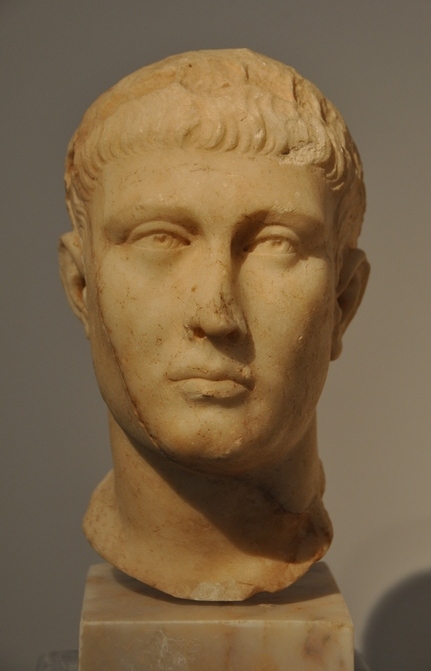
This chapter sketches the period between Constantine's death (337) and the disappearance of the last western emperor (476). It is the period of the so-called fall of Rome — though as the seventh chapter will explain, the framing is misleading.
The Constantinian sons and Julian
Constantine had divided the empire among his three surviving sons. The arrangement collapsed within seventeen years into a sequence of civil wars from which Constantine's middle son Constantius II emerged as sole emperor (350–361). He spent most of his reign on the eastern frontier with Persia and never visited Rome until 357. His cousin Julian — the surviving male of Constantine's family after the dynastic massacre of 337 — was made Caesar in the west in 355, won a series of unexpected victories over the Alemanni on the Rhine, was proclaimed Augustus by his troops in 360, and after Constantius's death in November 361 became sole emperor. Julian (361–363) is principally remembered for his attempt to reverse the Christianisation of the state — he was the last non-Christian emperor and is known to Christian tradition as Julian the Apostate. The attempt was cut short by his death in a Persian campaign in June 363, killed in a skirmish near Samarra by a spear of uncertain provenance. He was thirty-two. Pagan resistance to Christianisation did not produce another imperial champion.
The Christianisation of the state
The decisive legal step in the Christianisation of the empire was taken by Theodosius I (379–395) in the Edict of Thessalonica of 380, which declared Nicene Christianity the official religion of the empire and made all other forms of belief — pagan worship, Arian Christianity, Judaism in some particulars — formally subject to legal disabilities. Subsequent edicts of 391 and 392 closed the temples, prohibited public pagan sacrifice, and ended the Olympic Games (which had been celebrated continuously since 776 BC, a sequence of 293 quadrennial celebrations; the 293rd, in 393, was the last). The Vestal Virgins at Rome were dissolved in 391. The flame of Vesta, kept burning continuously since the foundation of the city according to tradition, went out. The senatorial aristocracy of the city of Rome — still, in 380, predominantly pagan — converted over the next two generations.
What this meant for the institutional structure of the state was a slow but eventually total integration of the Christian church into the imperial administration. Bishops became, increasingly, important civil officials in their cities — responsible for the welfare of the poor, for ransoming captives, for adjudicating disputes between Christians, for representing their communities to the imperial authorities. Theological controversy became an imperial concern, addressed by ecumenical councils convened by the emperor: Nicaea I (325), Constantinople I (381), Ephesus (431), Chalcedon (451). The integration was so complete that, by the end of the fifth century, it is hard to draw a sharp line between "the empire" and "the church" as institutions. They were, in many practical respects, the same institution under two heads.
The federate system
The structural problem of the western empire in the fourth and fifth centuries was that its army was too expensive and too small. The classical Augustan legions had been Roman citizens, paid from the regular budget; the late Roman military, after Diocletian's reforms, was a larger force but mostly drawn from poorer provincial recruits and increasingly supplemented by Germanic troops who were not Roman citizens but who served in Roman pay. After 376 the empire began to admit large groups of Germanic peoples — initially the Visigoths fleeing Hunnic pressure on the Danube — onto Roman territory as foederati, autonomous tribal groups under their own kings, paid an annual subsidy in exchange for military service. The system was a fiscal economy: it was cheaper to subsidise the Visigoths than to raise and pay an equivalent Roman army. It was also a strategic liability, because the foederati had their own dynasties, their own loyalties, and their own ability to renegotiate the contract by force.
The breakpoint was the battle of Adrianople on the 9th of August 378, in which the Visigothic king Fritigern destroyed the army of the eastern emperor Valens, killing two-thirds of the troops and the emperor himself. It was the worst single Roman defeat since Cannae in 216 BC. The eastern empire recovered under Theodosius, who made peace with the Visigoths and resettled them in the Balkans on the foederate model. The peace, however, lasted only as long as Theodosius's personal authority. After his death in 395, the Visigoths under their new king Alaric began to move.
The sack of Rome and the long retreat
Alaric's Visigothic army crossed the Alps in 401 and spent the next nine years marching back and forth across Italy, attempting to negotiate with the western imperial court at Ravenna for a permanent settlement, a regular subsidy, and military commands for himself and his commanders. The court of Honorius — by 408 dominated by court eunuchs and the praetorian prefect Olympius, after the execution of the half-Vandal general Stilicho who had been the empire's most able commander — refused. On the 24th of August 410, Alaric's army entered Rome and sacked it for three days. The damage was modest by ancient standards (the Visigoths were Arian Christians and spared the churches), but the psychological effect was enormous. Rome had not been sacked by a foreign army for eight hundred years. Saint Augustine, then bishop of Hippo in North Africa, would begin writing The City of God in response. Pagan Romans blamed the sack on Christianisation; Augustine's reply has been read continuously ever since.
The next sixty years are a complicated story of barbarian kingdoms — Visigoths in Spain and Gaul, Vandals in North Africa (453, with the loss of the African grain supply that was the single greatest blow to the western fiscal base), Burgundians in eastern Gaul, Suevi in Galicia, Ostrogoths and Lombards still on the Danube frontier preparing to come — and a steadily shrinking imperial authority in the west. The last western emperor of any independent significance was Majorian (457–461), an able commander who attempted to recover North Africa from the Vandals and was murdered by his own general after the expedition's failure. After Majorian, the western imperial throne was occupied by a series of figureheads, all of them appointed and disposed of by the Germanic general staff — chiefly Ricimer (a half-Suevi, half-Visigoth officer) — who effectively governed Italy in the emperor's name.

The end is famous and undramatic. On the 4th of September 476, the Germanic general Odoacer, having mutinied against the previous arrangement, deposed the sixteen-year-old emperor Romulus Augustulus (a boy who had been on the throne for ten months, the son of a court official who had crowned him) and chose not to appoint a replacement. He sent the imperial regalia to the eastern emperor Zeno at Constantinople with a letter saying that one emperor was sufficient. He himself ruled Italy as king of the Italians, with formal authority delegated by Constantinople and with no claim to the imperial title. The western imperial office had ended.
This event is the conventional date for the "fall of the Roman empire." As the seventh chapter will explain, the framing is misleading. Half the empire was still standing, and it would continue to call itself Roman for almost another thousand years.
End of Chapter VI