Foreword
When did it end?
The question is interesting.
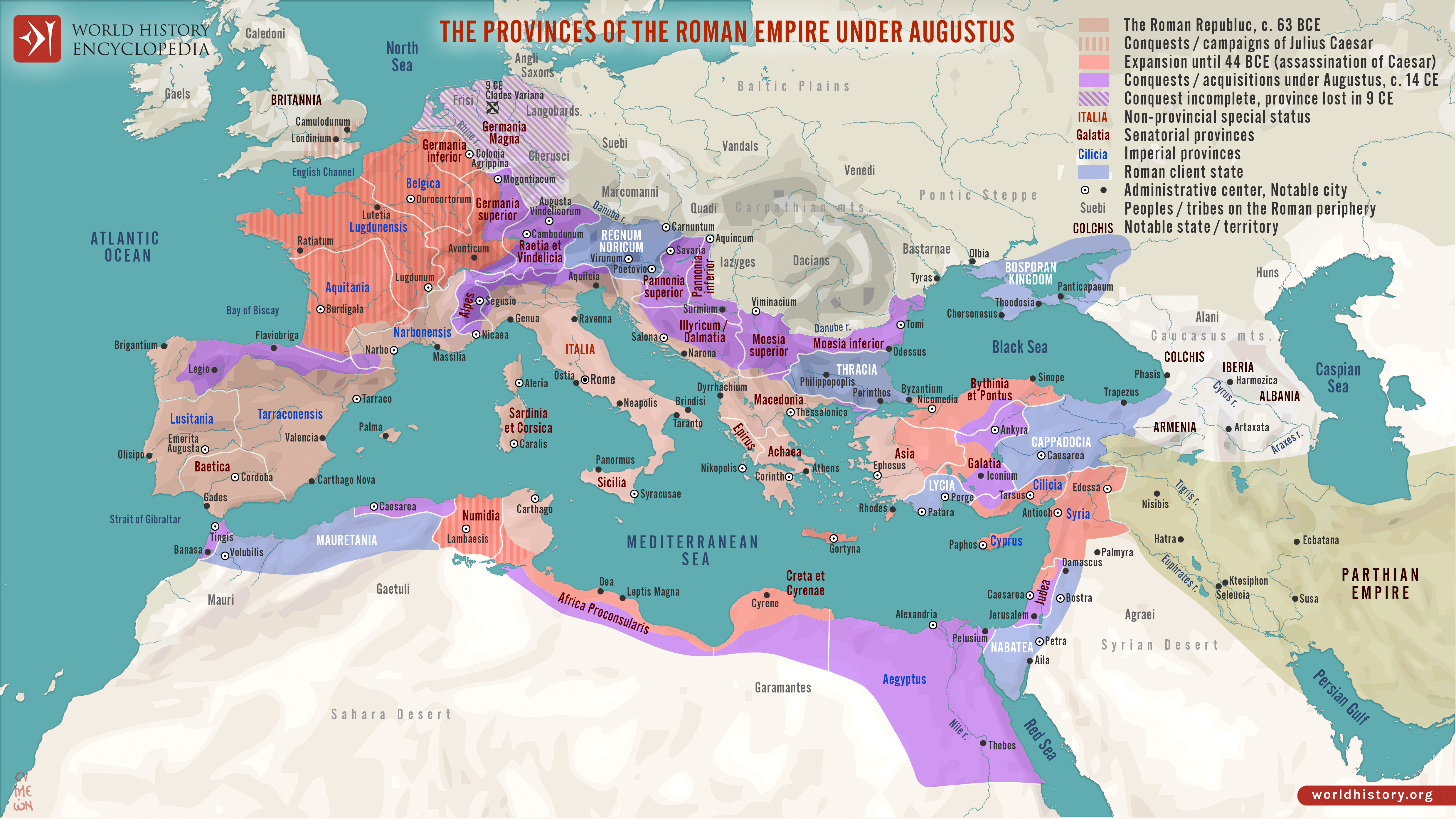
There is no other country that has been declared dead so many times and in so many different years, all of them defensible. The standard Western dates are 410 (Visigothic sack of Rome), 476 (the deposition of Romulus Augustulus), or 1453 (the Ottoman capture of Constantinople). The Greeks would say 1453. Russian Orthodox tradition would say 1917, because Moscow had inherited the title. Modern Italian schools tend to say 476. None of these answers is wrong.
The disagreement is not careless. It reflects a deep feature of the Roman state: that it was, for most of its existence, less a country than a continuous claim. The claim was that the empire was the Roman empire — that its emperor, in unbroken succession, was the heir of Augustus — and that the empire, like the language, the law, the road network, and the Christian church that grew up inside it, was simply how the civilised world was organised. The claim could survive the disappearance of large parts of the original territory. (When the western provinces fell to the Germanic kingdoms in the fifth century, the eastern emperor in Constantinople went on calling himself the Roman Emperor, and went on collecting the taxes, and went on appointing the consuls, and went on issuing the laws.) The claim could survive moving the capital. It could survive changing the language. It could survive losing all of the original Italian provinces. What it could not survive was the loss of Constantinople, because the imperial title was, by then, attached to the office of the emperor at Constantinople, and the line of the office could not be reissued elsewhere by acclamation.
This volume is therefore the obituary of an unusually persistent fiction. The Roman empire of Augustus and the Roman empire of Constantine XI are linked by a continuous line of officials, taxes, court ceremonies, and self-description. They share almost nothing else. The empire that fell on the 29th of May 1453 was a Greek-speaking, Orthodox Christian state of perhaps a quarter of a million subjects, almost all of them inside the walls of one city. The empire of Augustus was a Latin-speaking, polytheistic state of perhaps seventy million subjects across the entire Mediterranean basin and most of Western Europe. The continuity between them was the institutional fiction. The book covers the fiction, and what was real underneath it, in ten chapters.
One caveat about scope. The Roman Republic — the five hundred years of magistracies and Senate before the imperial transformation — is referred to throughout but is not the subject of this volume. The volume begins, formally, with Augustus's settlement of 27 BC, when the Senate granted him the augmented authority that turned the Republic into a one-man state. The Republic deserves its own treatment. The Empire is enough for one book.
"I found Rome a city of bricks and left it a city of marble." — Augustus, near the end of his life (Suetonius, Augustus 28)