Twenty-three years after the official end of Yugoslavia, the territory that was once the federation is — by every measure — a different region. The seven independent states have, with varying speed and success, integrated into European structures. Roads have been rebuilt. Cities have been restored. New constitutions have been written, new currencies adopted, new flags raised. The old federal institutions are gone. The old internal borders are now international. The old languages have begun to diverge in deliberate political ways: what was once "Serbo-Croatian" is now officially Serbian, Croatian, Bosnian, and Montenegrin, four mutually-intelligible-but-politically-distinct languages, each with its own ministry of culture and its own grammar guide.
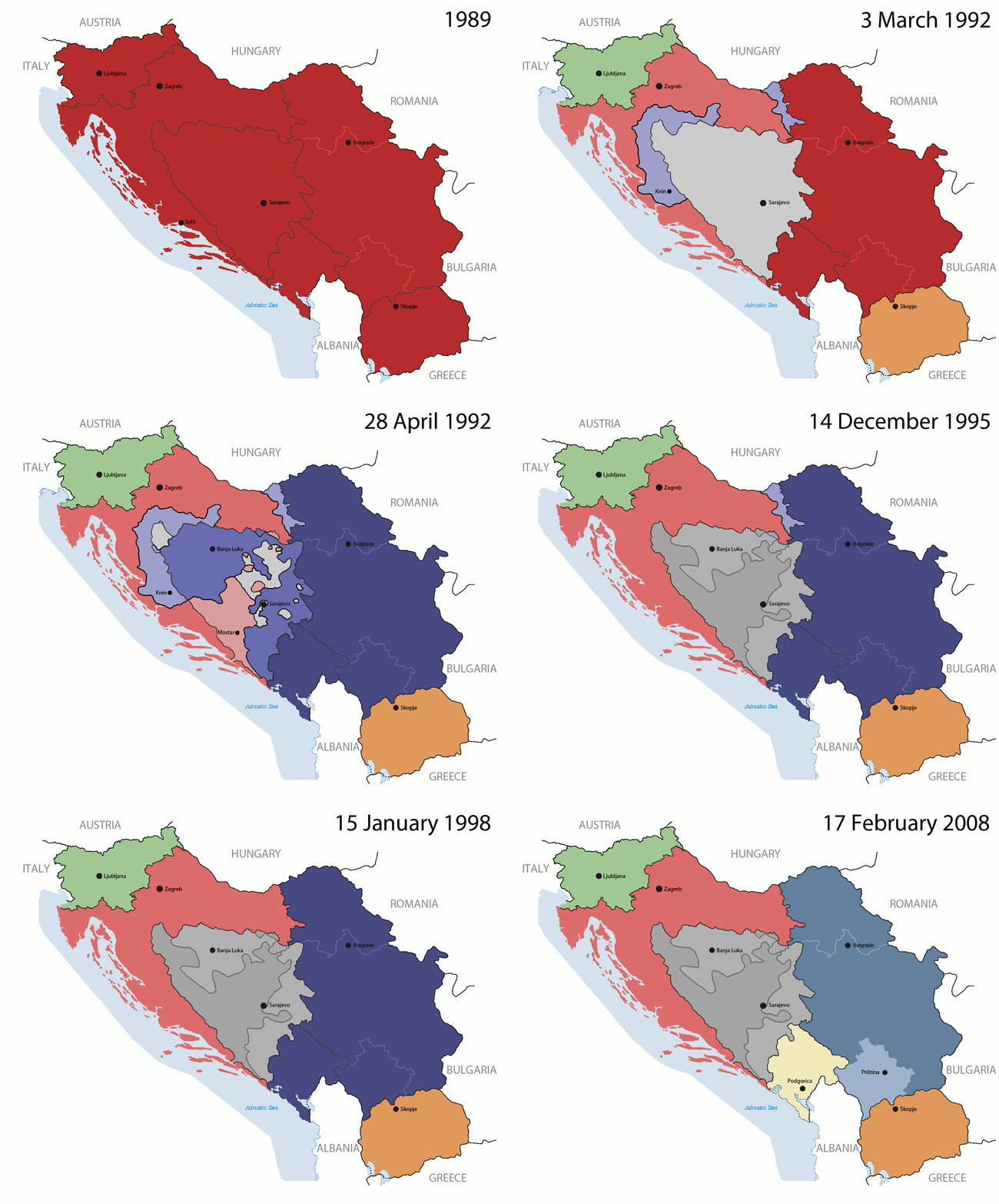
The seven countries
Slovenia (population 2.1 million) has been the most economically successful of the successor states. EU membership since 2004, euro since 2007, NATO since 2004. GDP per capita is around 90% of the EU average. Politics has been relatively stable, with regular alternation between centre-left and centre-right coalitions. Ljubljana — the capital — is a small, attractive, well-administered city of around 300,000 with a good university, a respected art-design scene, and a reputation as the most "Habsburg" of the Yugoslav successor capitals.
Croatia (population 3.9 million) has had a slower transition. The post-Tuđman political class of the 2000s and 2010s wrestled with corruption scandals and a difficult reckoning over the war years (the ICTY tried and acquitted several Croatian generals; the Croatian state continues to celebrate its independence wars as defensive). EU since 2013, euro since 2023, NATO since 2009. Zagreb is the cultural capital; Dubrovnik and the Dalmatian coast generate substantial tourist income (about 20% of GDP).
Bosnia and Herzegovina (population 3.2 million) remains the most politically dysfunctional successor state, governed under the constitutional framework laid down at Dayton in 1995. The country is constitutionally divided between two entities (the Bosniak-Croat Federation and the Serb Republika Srpska), with a weak central government and a High Representative appointed by the international community. EU candidate since 2022; NATO membership has been blocked by Republika Srpska. Economic development is slow; emigration is heavy; Sarajevo and Mostar attract growing numbers of tourists.
Serbia (population 6.6 million) is the largest of the successor states and the one with the most complicated post-1999 political trajectory. EU candidate since 2012; not a NATO member; closer to Russia in foreign policy than the other successor states. The current government of Aleksandar Vučić has been in power since 2014 (under various ruling coalitions); it has presided over substantial economic growth, but also over criticisms of democratic backsliding from Western institutions. Belgrade has become one of the most culturally dynamic cities in southeastern Europe.
Montenegro (population 0.6 million) is the smallest of the successor states. NATO since 2017; euro since 2002 (by unilateral adoption); EU candidate since 2010. The economy depends heavily on coastal tourism (Kotor, Budva, Sveti Stefan).
North Macedonia (population 1.8 million) had to change its name from "Macedonia" to "North Macedonia" by the Prespa Agreement of 2018 to overcome Greek objections to its NATO and EU membership. NATO since 2020; EU candidate since 2005. Politics has alternated between social-democratic and conservative coalitions. Skopje — extensively redeveloped in the 2010s under the "Skopje 2014" project — has a controversial new neo-classical appearance superimposed on its modernist post-earthquake foundations.
Kosovo (population 1.7 million) is, in 2026, the youngest sovereign state in Europe. Partial international recognition; no UN membership; no NATO membership; EU candidate status implicit but stalled. The country is heavily dependent on remittances from the Kosovar Albanian diaspora; the economy is largely informal; politics have been complicated by reform-vs-political-establishment dynamics in the country's relatively short democratic existence.

Yugoslav cultural traces
What remains of Yugoslav identity, twenty-three years after the formal abolition of the name, is — to the surprise of many former Yugoslavs — substantial. The shared cultural inheritance of the federation persists in ways that the political successors have not been able to suppress.
The language: Croatian, Bosnian, Serbian, and Montenegrin are, by every linguistic measure, the same language. The Sarajevo-Belgrade-Zagreb cultural sphere produces, in this language, films, books, music, and television that circulate freely across the borders. The 2003 award-winning Croatian-Bosnian-Serbian co-production No Man's Land, the 2014 Serbian war film Circles, the 2018 Croatian film The Constitution — these are made by Yugoslav directors for a Yugoslav audience that no longer officially exists.
The music: the Yugoslav rock and pop tradition — Bijelo dugme, Ekatarina Velika, Riblja Čorba, Goran Bregović, Lepa Brena — has, since the late 2000s, been increasingly performed and consumed across the former federation. Reunion concerts of pre-war bands have drawn enormous audiences. The Sarajevo singer Dino Merlin's 2008 Eurovision entry "Pokušaj" was a hit across all seven successor countries simultaneously.
The food: the regional Balkan kitchen — ćevapi, burek, ajvar, rakija, baklava, kajmak — is shared across the seven countries, with mutual claims of provenance for most of the dishes.
The infrastructure: the Yugoslav Adriatic Highway, the Belgrade-Skopje railway, the Slovenian-Croatian electricity grid, the shared power station at Đerdap on the Danube. The successor states cannot fully separate themselves from the federal infrastructure they inherited.
The Yugoslav diaspora
The diaspora — the perhaps four million people who left Yugoslavia in the 1960s-1990s as Gastarbeiter, students, refugees, or post-2000 economic emigrants — is one of the principal cultural carriers of Yugoslav identity. In Vienna, Munich, Frankfurt, Stockholm, Sydney, Melbourne, Toronto, Chicago, and New York, the Yugoslav diaspora communities have maintained their own restaurants, cultural associations, football clubs, weekly newspapers, and religious institutions. Among these populations the older Yugoslav identity often persists more strongly than in the home countries themselves. A great many diaspora Yugoslavs continue, in 2026, to identify primarily as "Yugoslavs" rather than as citizens of one of the seven successor states.
The end of the book
The country called Yugoslavia, in any of its three constitutional forms — the Kingdom of Serbs, Croats, and Slovenes from 1918 to 1929; the Kingdom of Yugoslavia from 1929 to 1945; the Socialist Federal Republic of Yugoslavia from 1945 to 1992; the Federal Republic of Yugoslavia from 1992 to 2003 — has been gone for twenty-three years. The territory it occupied is now part of seven different countries. The political experiment it conducted — a federation of three (or six) nations under one flag — was destroyed by the wars of 1991-2001.
What is left, scattered across the seven successor countries, is the cultural and infrastructural inheritance of seventy-four years of common life. The successor states have, in the years since their separations, generally made their peace with each other. Borders are open. Trade is conducted. Tourism flows freely. The wars have receded into recent history without being forgotten, but without — for the moment — controlling the present.
The Yugoslav idea — that the south Slavs are one people — is, in 2026, definitively gone as a political project. But the south Slavs continue to share the territory they have always shared, in the seven configurations they have arrived at, and the cultural memory of a country they all once belonged to continues to shape, in small and large ways, the daily life of the region.
What you can still go and see is the subject of the travel guide that follows.
End of the book.