The Tito-Stalin split was, in retrospect, almost inevitable. Stalin's vision of post-war Communist Europe was a tightly-controlled bloc in which the various national parties operated under Soviet supervision and the national leaders looked to Moscow for guidance. Tito's vision was a Yugoslav state that had liberated itself, was its own Communist authority, had its own ideas about a Balkan federation, and treated the Soviet Union as an ally rather than as a master. The two visions could not coexist.
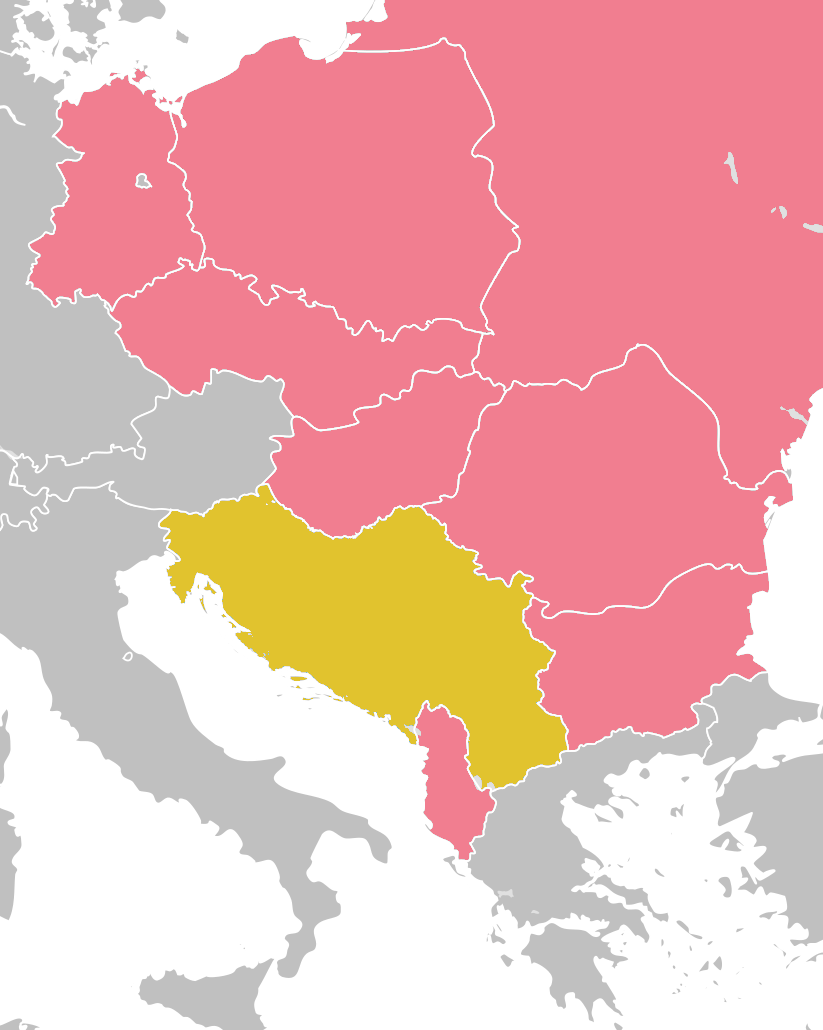
The break unfolded through a series of escalating exchanges between Belgrade and Moscow in the spring of 1948. Stalin demanded changes in Yugoslav foreign policy (over Albania, Greece, and Bulgaria), in Yugoslav economic policy (faster integration into Soviet trade structures), and in Yugoslav internal party affairs (placing pro-Soviet figures in senior positions). Tito refused. The Cominform — the Communist Information Bureau, the loose alliance of European Communist parties that had replaced the dissolved Comintern in 1947 — was used as the instrument of the rupture. On the 28th of June 1948, at a meeting in Bucharest, the Cominform formally expelled the Yugoslav Communist Party for "anti-Soviet and anti-Marxist" deviations. The accompanying resolution called on "healthy elements" within the Yugoslav party to overthrow Tito's leadership.
The expulsion was a serious threat. Yugoslavia was surrounded by Soviet-allied states (Hungary, Romania, Bulgaria, Albania), economically dependent on Soviet bloc trade (about half of Yugoslav exports went east), and ideologically vulnerable to internal subversion. The Yugoslav army, in the months after the expulsion, mobilised along the borders of the surrounding Communist states. Border incidents accumulated — perhaps 7,000 between 1948 and 1953. A Soviet invasion was, in Tito's own later account, considered a serious possibility throughout 1949 and 1950.
Goli Otok

The threat made Tito's regime more, not less, repressive. The Yugoslav Communist Party — which had, before 1948, contained substantial numbers of pro-Soviet members who had spent the war in Moscow — was purged. Around 16,000 party members and sympathisers were arrested between 1948 and 1956 on suspicion of pro-Soviet sympathies. The principal site of their imprisonment was the barren limestone island of Goli Otok ("Naked Island") in the northern Adriatic, where about 13,000 prisoners served sentences under conditions of deliberate brutality. About 400 were executed or died in custody.
The Goli Otok camp was used until 1956 and held political prisoners until 1989. It is one of the most painful and least-acknowledged elements of the Yugoslav Communist past. Tito's regime treated pro-Soviet Communism as the principal internal threat, and it treated this threat with the standard Stalinist techniques: arrest, torture, forced labour, and ideological re-education through public confession.
The opening to the West
The other consequence of the split was an unexpected one: a rapprochement with the United States and Western Europe. The Truman administration, despite its anti-Communist credentials, recognised the strategic value of a Communist regime opposed to Moscow and began providing Yugoslavia with substantial economic and military aid from 1949 onward. Total US aid to Yugoslavia between 1949 and 1955 amounted to about $1.5 billion. Britain and France followed. The country joined the Marshall Plan-adjacent OECD framework. Diplomatic relations with the West, severed during the 1947-48 period, were restored.
The opening went further. In 1950 Yugoslavia signed a defensive treaty (the Balkan Pact) with Greece and Turkey, both NATO members. In 1953 the treaty was upgraded to a quasi-military alliance. The Communist state of Yugoslavia, in other words, had within five years of the Cominform expulsion become a strategic partner of NATO. Tito's diplomacy in this period — careful, opportunistic, and at every stage on its own terms — was one of the most skillful Cold War balancing acts.
Stalin's death and the gradual normalisation
Stalin died on the 5th of March 1953. The new Soviet leadership under Malenkov and then Khrushchev began, within months, to repair the relationship with Belgrade. Khrushchev's famous Belgrade visit of May-June 1955 was the formal end of the Cominform-era rupture. The Soviet leader, addressing a crowd at Belgrade airport, publicly disavowed Stalin's 1948 expulsion as the work of Beria and a faction of bad advisers. The Yugoslav Communist Party was reinstated to good standing within the international Communist movement, though it never rejoined the Warsaw Pact or the renamed Soviet bloc economic organisation (CMEA, which Yugoslavia attended only as an observer).
Non-alignment
By the late 1950s Yugoslavia had developed a distinctive foreign-policy doctrine that would shape the country until Tito's death: non-alignment. The idea — that newly independent and small states should refuse to take sides between the two superpower blocs and should organise themselves into a third force — was developed by Tito in collaboration with Jawaharlal Nehru of India and Gamal Abdel Nasser of Egypt. The first formal Non-Aligned Movement summit was held in Belgrade in September 1961, with 25 founding members. The movement grew through the decade and by Tito's death numbered around 100 member states.
Non-alignment gave Yugoslavia an international position out of all proportion to its size: a Mediterranean Communist state that was on speaking terms with both superpowers, hosted summits, mediated regional disputes, and provided diplomatic cover to anti-colonial movements across Africa and Asia. The position was also commercially valuable: Yugoslav engineering and construction firms (Energoprojekt, Ingra, Granit) built dams, factories, and infrastructure across the non-aligned world, particularly in Africa.
The next chapter takes up the economic and cultural model that emerged from this distinctive foreign-policy position.
End of Chapter V