Belgrade and Serbia
Belgrade · Serbia
The federal capital

The capital of two Yugoslav states (1918–1941, 1945–2003) and now the capital of Serbia. The principal Yugoslav-era sites are the Museum of Yugoslavia complex in Dedinje, on the southern outskirts (Tito's mausoleum — the House of Flowers — is in the grounds; the Old Museum holds the gifts received by Tito on his state visits, an extraordinary collection); the rebuilt central avenues that were bombed in 1941 and 1999; the Brutalist architecture of New Belgrade across the Sava; the Kalemegdan fortress; the city's enormous Hellenistic-era Roman archaeology.
Novi Sad · Serbia · Vojvodina
The northern provincial capital

The capital of Vojvodina, on the Danube, an hour north of Belgrade. The city has a distinctly Habsburg character — its architecture is mostly Austro-Hungarian — and a substantially mixed ethnic composition (Serbian, Hungarian, Slovak, Ruthenian, Romanian). The Petrovaradin Fortress overlooking the Danube is one of the largest preserved early modern fortifications in central Europe. The Exit music festival (early July) is the largest summer music event in southeastern Europe.
Kumrovec · Croatia
Tito's birthplace

The small Croatian village in the Zagorje hills where Josip Broz was born in 1892. The Tito Museum is in his actual birthplace house (a small two-room peasant cottage). The site is, paradoxically, a place of Yugoslav nostalgic pilgrimage (visitors from Bosnia, Serbia, Montenegro, North Macedonia) administered by the Croatian state (which is officially less enthusiastic). Tito Birthday parties on the 25th of May still happen.
Sarajevo and Bosnia
Sarajevo · Bosnia and Herzegovina
The capital of mixed Bosnia

The Ottoman Baščaršija, the Catholic and Orthodox cathedrals within five minutes of the Old Synagogue, the Latin Bridge where Gavrilo Princip shot Franz Ferdinand on the 28th of June 1914, the 1984 Winter Olympics sites on the surrounding hills (Trebević, Bjelašnice — many in ruins after the war), the Sarajevo Tunnel Museum on the airport perimeter (the secret 800-metre tunnel built under the runway between 1992 and 1995 to supply the besieged city), and the new Galleries of Bosnia and Herzegovina. Sarajevo Roses — the resin-filled scars in the asphalt where mortar shells fell during the siege — are still visible in the city centre. The Bridge of Suada and Olga commemorates the siege's first civilian casualties.
Mostar · Bosnia and Herzegovina
Old Bridge / Stari Most

The 1566 Ottoman bridge over the Neretva (Vol. II covers it in detail) was destroyed in November 1993 by Croat artillery during the Bosniak-Croat war and rebuilt 2001-2004. The bridge is the symbol of post-war Bosnian reconciliation, a UNESCO World Heritage Site, and a popular summer event venue (the annual Old Bridge Diving Competition draws international athletes each July).
Srebrenica · Bosnia and Herzegovina
The Potočari memorial

The site of the July 1995 genocide, marked by the Potočari Memorial Centre and cemetery a few kilometres outside the town. The memorial includes the names of the identified victims, the unfinished battery factory used as the UN compound and Bosnian Serb staging point in July 1995, and a small but excellent museum. Not pleasant; one of the most important historical sites in Europe.
The Croatian Coast
Dubrovnik · Croatia
The Pearl of the Adriatic

The medieval and early modern walled town on the southern Croatian coast. UNESCO since 1979. Damaged by JNA shelling in 1991 (about 60% of the buildings in the Old Town were hit; all have been restored). One of the most photographed urban landscapes in the Mediterranean. Substantial Game of Thrones tourism since 2011. Outside the Old Town, the modern city continues with substantial Yugoslav-era housing.
Split · Croatia
Diocletian's palace

The Roman emperor Diocletian's retirement palace, completed in 305 AD, has been continuously inhabited since the seventh century. The medieval and modern city of Split has grown within and around its walls. The Adriatic Highway runs through the city; the post-war Yugoslav resort architecture of the surrounding coast is on full display.
Vis · Croatia
Tito's island

The remote outer Adriatic island that served as Tito's secret partisan headquarters in 1944 and as a Yugoslav navy base from 1945. Closed to foreign visitors during the Communist period. Now open to tourism with a remarkable inheritance of military tunnels, secret submarine pens, and the Tito Cave (Titova Špilja) that served as his command post. A small ferry from Split.
Ljubljana, Skopje, Pristina
Ljubljana · Slovenia
The northern capital

The most economically successful and visually elegant of the Yugoslav successor capitals. The work of the architect Jože Plečnik (1872-1957) gave the city its distinctive look: the Triple Bridge, the Central Market, the Slovene National and University Library, the cemetery at Žale. The Yugoslav-era National Museum of Contemporary History documents Slovenia's relationship to the federation. The city is small (population 300,000) and walkable.
Skopje · North Macedonia
Earthquake city

Rebuilt after the 1963 earthquake by Kenzō Tange and a Yugoslav design team — see Vol. IV chapter 6. Modernist concrete urban planning at city scale, much of it preserved, layered since 2014 with controversial new neo-classical government buildings (the "Skopje 2014" project) which have substantially changed the city centre's appearance. The Stara Čaršija — Old Bazaar — across the Vardar is the largest surviving Ottoman bazaar in the Balkans outside Sarajevo.
Pristina · Kosovo
The youngest capital in Europe

The capital of Kosovo since 1999 (informally) and 2008 (formally). The Brutalist National Library (1982, by Andrija Mutnjaković) is one of the most distinctive Yugoslav-era buildings in the region — wrapped in chain-link cages and topped with metallic domes. The Newborn monument outside the city centre, unveiled on the 17th of February 2008 to mark independence, is repainted each year in a new design. The young population (one of Europe's youngest median ages, around 30) gives the city an unusually energetic feel.
The Spomeniks
Tjentište · Bosnia and Herzegovina
The Sutjeska monument

Miodrag Živković's 1971 monument to the Battle of the Sutjeska of 1943 — Tito's narrowest escape, the Partisans' worst single battle, perhaps 6,000 Partisan dead and Tito himself wounded. Two enormous abstract concrete forms rise from a green valley in eastern Bosnia. The site is preserved as a national park; the monument is in fair condition; the small visitor centre is open in summer.
Petrova Gora · Croatia
The collapsing concrete tower

Vojin Bakić's 1981 monument to the partisan uprising in the Kordun region, on a remote hilltop south of Zagreb. A mushroom-cloud-like structure clad in stainless steel sheets, mostly stripped after 1991 for scrap. Currently in poor condition. Photogenic and slightly unsafe; the structure is technically closed to visitors but accessible.
Kozara · Bosnia and Herzegovina
Dušan Džamonja's vertical fins

Džamonja's 1972 monument to the Battle of Kozara of 1942, on a hilltop in northwestern Bosnia. A circle of vertical concrete fins, each about thirty metres tall, the most architectural of the spomeniks. Substantially intact; preserved by the Republika Srpska as a war memorial.
Smaller Yugoslav survivals
Goli Otok · Croatia
The naked island

The northern Adriatic prison island where Tito's regime held its Cominform-era prisoners from 1948 to 1956. Now uninhabited and accessible by tourist boat from Rab in summer. The ruined prison buildings, the quarry where prisoners broke stone, the small museum at the dock. A serious and rarely visited site.
Bled · Slovenia
Tito's lake

The alpine lake in northern Slovenia with the island church and the cliffside castle. Tito kept Villa Bled here as his summer residence; the building is now a hotel. The lake itself is one of the most photographed places in central Europe.
Kotor · Montenegro
The Adriatic fjord

The Bay of Kotor — geographically a ria, often misdescribed as a fjord — on the Montenegrin coast, with a Venetian-era walled town at its head. UNESCO listed. The Yugoslav Navy had a major submarine base at the bay's southern entrance (Tivat); the underground submarine pens are now partially open as a museum.
Ohrid · North Macedonia
The medieval lake
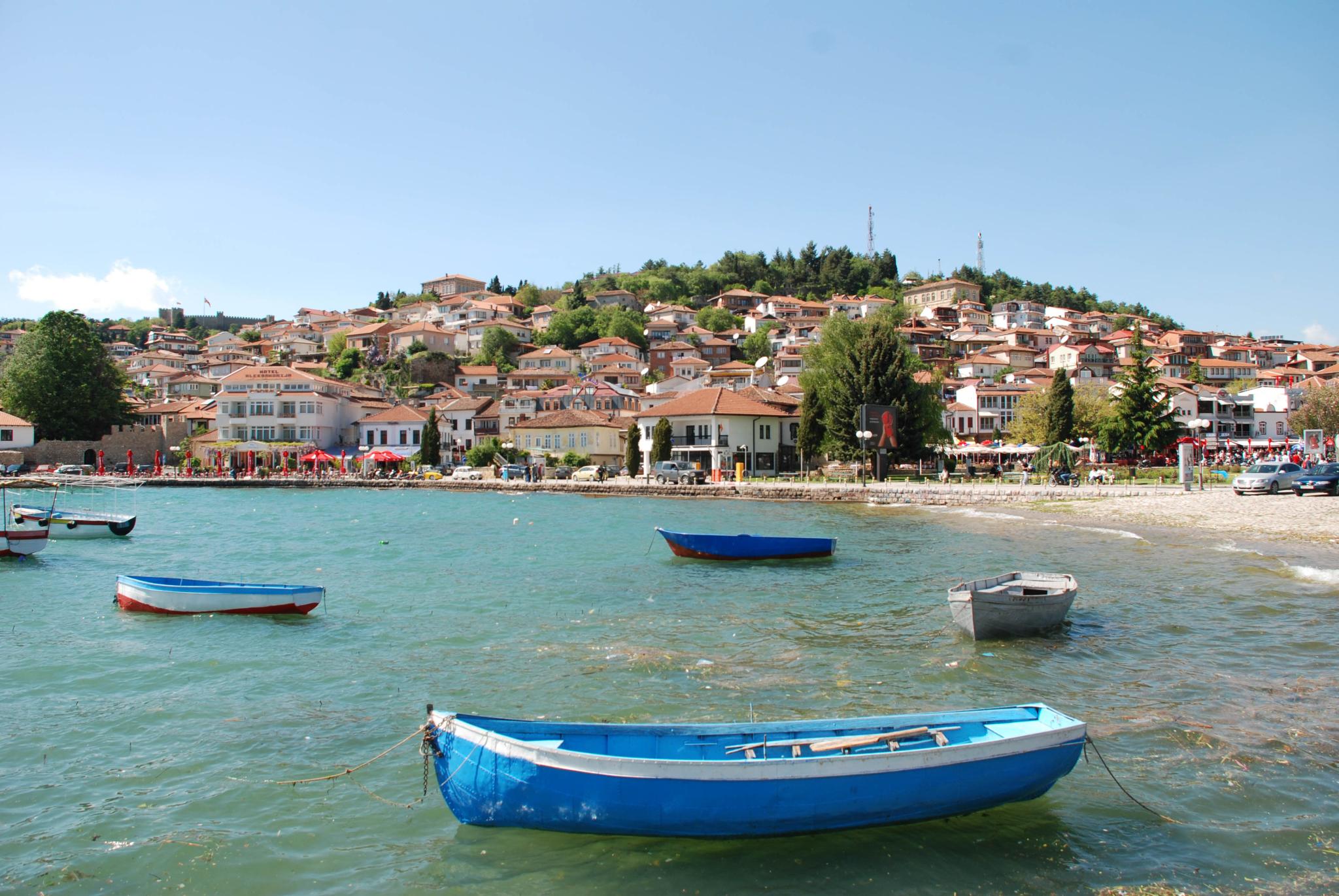
The oldest Slavic literary tradition in Europe was founded here by Saints Cyril and Methodius and their disciples in the ninth century. The town has more than thirty medieval churches, several with extraordinary Byzantine frescoes. UNESCO since 1980 (one of the first 28 sites listed). The lake itself, shared with Albania, is one of the oldest in Europe (3-4 million years old).
Avala · Belgrade · Serbia
The Unknown Hero monument

The 1938 monument on Mount Avala, eighteen kilometres south of Belgrade, designed by Ivan Meštrović — the most internationally famous Yugoslav sculptor. Eight enormous black-granite caryatids representing the constituent peoples of the kingdom hold the tomb of an unknown First World War soldier. A serene and rarely visited site; the surrounding park is a popular Belgrade weekend escape.
End of the travel guide