The dismemberment of Yugoslavia in April 1941 was, by the standards of wartime occupation arrangements, unusually complicated. The country was divided among six occupying powers, with a satellite state inserted into the most populous central region.
The Independent State of Croatia (NDH), under the Ustaše leader Ante Pavelić, was created on the 10th of April 1941 as an Axis client state covering Croatia, most of Bosnia and Herzegovina, and a small portion of Vojvodina. It was officially under joint Italian-German occupation but with its own government, army, currency, and concentration-camp system. The NDH, in its three-year existence, organised one of the most brutal extermination campaigns of the Second World War: Pavelić's regime murdered approximately 320,000–340,000 Serbs, around 30,000 Jews, and around 30,000 Roma in its concentration camps, particularly at Jasenovac, in addition to several hundred thousand more killed in ethnic-cleansing operations across the rural areas. The proportional scale of the Ustaše genocide of Yugoslav Serbs — perhaps a tenth of the Serbian population of the NDH territory — is one of the worst single-country death tolls of the war.
The other territories were divided as follows: Germany took control of northern Slovenia and the Banat; Italy took control of southern Slovenia (with Ljubljana), the Adriatic coast of Dalmatia, and Kosovo; Hungary took control of Vojvodina north of the Drava and a piece of eastern Slovenia; Bulgaria took control of Macedonia. A small puppet government of Serbia under the former Yugoslav general Milan Nedić administered the rump Serbian territory under direct German military occupation. Belgrade was a Wehrmacht headquarters city.
Three resistance movements
Resistance against the occupation began almost immediately. By July 1941, three distinct movements were active.
The Chetniks, under Colonel Draža Mihailović, were a primarily Serbian royalist movement organised around former officers of the Royal Yugoslav Army. They were initially recognised by the British government-in-exile in London as the official Yugoslav resistance, and received Allied air-dropped supplies through 1943. The movement's strategy was conservative: avoid direct engagement with the German occupier (which would only result in reprisals against civilians), wait for an Allied invasion of the Balkans, and then rise. Their conduct of this strategy involved, at various points and in various places, tactical collaboration with both the Germans and the Italians against the third resistance movement, the Communists.
The Communist Partisans, under Josip Broz Tito, were a multi-ethnic Communist-led movement that emerged from the underground Communist Party of Yugoslavia in the summer of 1941. They were initially small but ideologically disciplined and tactically aggressive. Their strategy was the opposite of the Chetniks': constant guerrilla action against the occupation, with the objective of building popular support, accepting the consequences in civilian reprisals, and eventually taking power as a Communist state. By 1943 they had grown to perhaps 250,000 fighters and had built up the most effective anti-Axis resistance movement in occupied Europe.
The third movement was the Ustaše state itself, in the sense that the NDH conducted its own war: not just against Jews, Serbs, and Roma, but against the Croatian and Bosnian Muslim partisan movements that grew within its territory. By 1944 the NDH was effectively at war with most of the population it nominally governed.
Tito
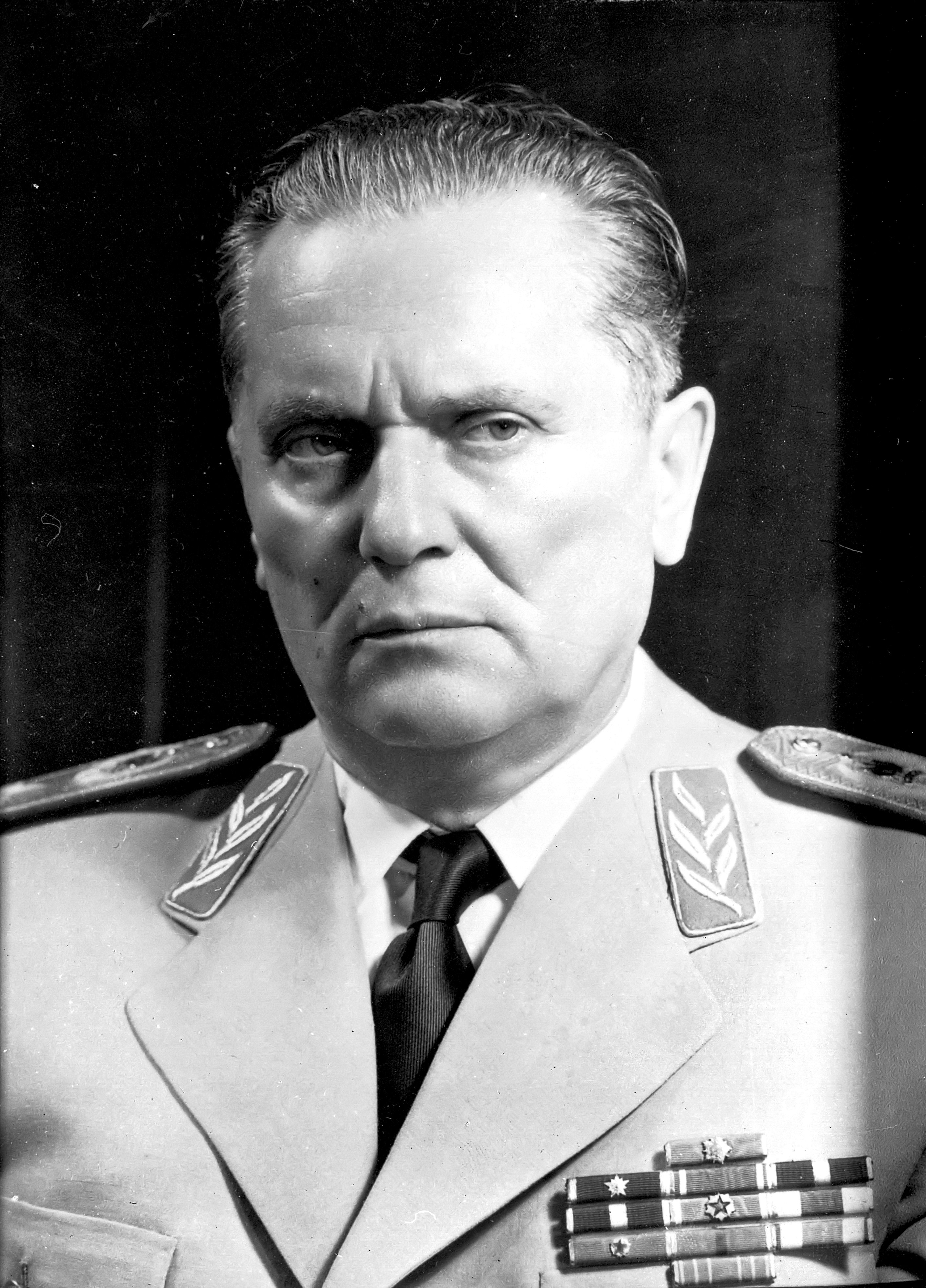
The defining figure of Yugoslav history of the next forty years was the Croatian-Slovenian Communist Josip Broz, known by his nom-de-guerre Tito. He had been born in 1892 in the Croatian village of Kumrovec, in the Habsburg crown land of Croatia-Slavonia, to a Croatian father and Slovenian mother. He had served in the Austro-Hungarian army in the First World War, been captured by the Russians, and spent the Russian Civil War as a Red Army soldier. He had returned to Yugoslavia in 1920 a committed Communist, served in the underground party in the 1920s and 1930s, been arrested and imprisoned for five years (1928–1934), and finally been appointed Secretary-General of the Communist Party of Yugoslavia in 1937 at the age of forty-five. He was a charismatic, intelligent, decisive man with an aptitude for both military command and political manoeuvre. He spoke seven languages, dressed elegantly, and was reportedly capable of remembering the personal details of every soldier he had ever met.
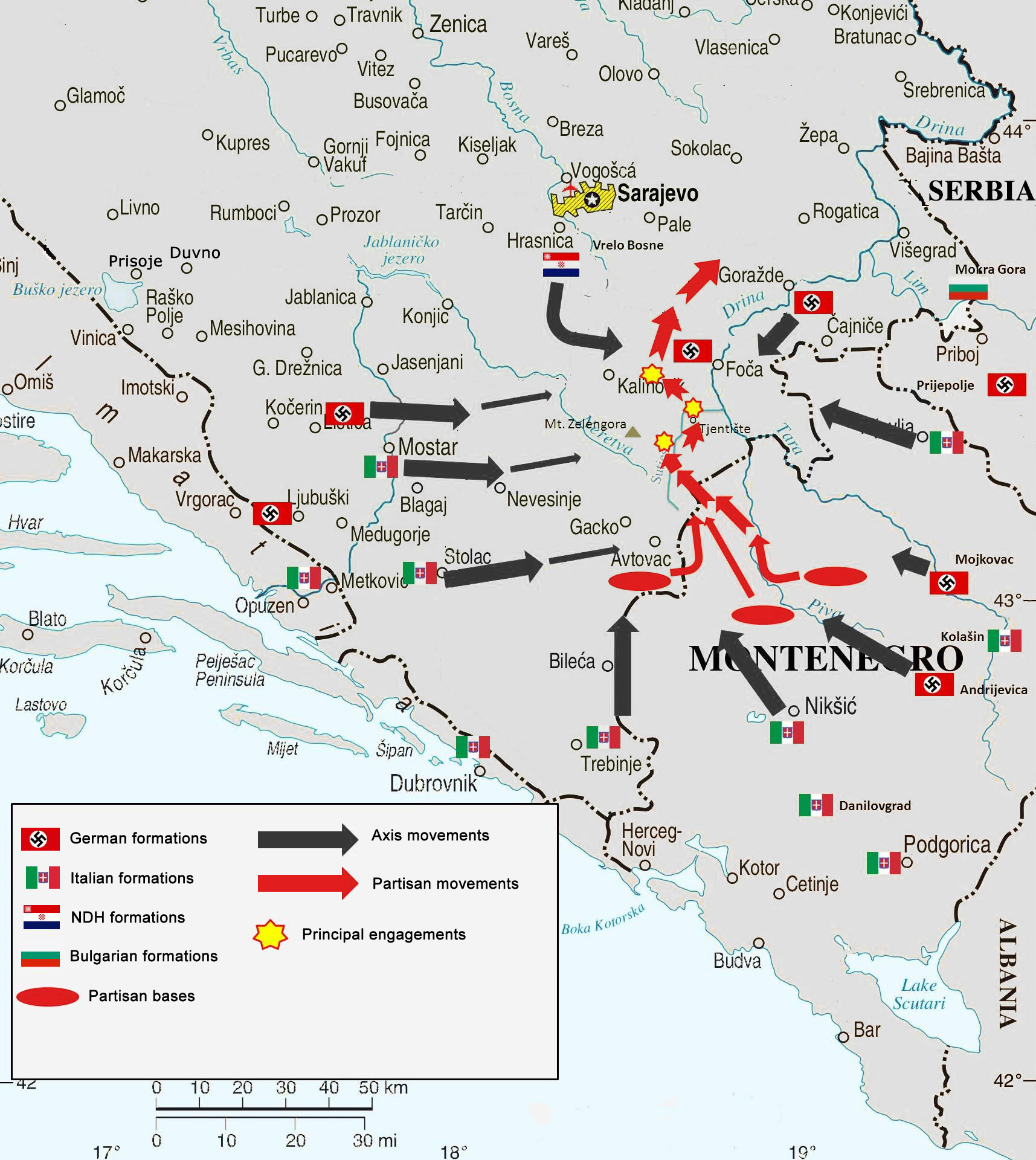
Under Tito's leadership the Partisans conducted a continuous four-year campaign across the mountainous interior of Yugoslavia, fighting seven major German anti-partisan offensives (the "Anti-Partisan Operations"), most named for the operation: First Offensive in Bosnia in 1941; Second Offensive in 1942; Third (around Tito's headquarters at Mount Foča) in 1942; Fourth and Fifth Offensives in 1943, the latter the famous Battle of the Sutjeska in which Tito himself was wounded and his army nearly destroyed; Sixth and Seventh Offensives in 1944. The Partisans lost an estimated 305,000 fighters killed and another 425,000 wounded across the war.
Allied recognition
The British government's recognition of Mihailović began to waver in 1943 as evidence accumulated of Chetnik collaboration with Italian and German forces against the Partisans. The British Special Operations Executive's young liaison officer William Deakin (later a distinguished Oxford historian) and the senior diplomat Fitzroy Maclean, both inserted into Tito's headquarters, both reported back to London that the Partisans were the more militarily effective force. Churchill, in November 1943, made the decision to switch Allied support to Tito. By the spring of 1944 all British and American supply drops were going to the Partisans. The royal government-in-exile, increasingly marginalised, was pressured into agreeing in June 1944 to a coalition with Tito's National Liberation Committee. Mihailović was abandoned.
The end
The Red Army liberated Belgrade in October 1944, in a joint operation with the Partisans that established a coordinating relationship between the Soviet and Yugoslav Communist movements that would last for the next four years. The Partisans pushed north and west through 1944 and into 1945, taking Sarajevo in April 1945, Zagreb in May 1945, and Ljubljana shortly after. The Ustaše state collapsed; Pavelić escaped to Argentina via the Vatican-organised "ratline"; tens of thousands of his fighters and civilian followers, retreating toward Allied lines in Austria, were turned back by the British and handed over to the Partisans, who killed an estimated 30,000–50,000 of them in the so-called Bleiburg massacres of May 1945. Mihailović was captured the following year, tried by a Yugoslav military court for collaboration, and executed in 1946.
The total Yugoslav death toll for the Second World War was approximately one million people — about 7% of the pre-war population. About half died in the inter-ethnic civil war; about half in combat against, or reprisals by, the Axis occupiers. The country emerged in May 1945 as the only country in occupied Europe (other than Albania, in its own much smaller way) whose Communist movement had liberated its own territory without Soviet ground forces. This was the political fact that would, three years later, allow Tito to defy Stalin.
The reconstruction of Yugoslavia as a Communist federation, and the unique position the country would occupy in the post-war Communist world, is the subject of the next chapter.
End of Chapter III