The country that would, eleven years later, be renamed Yugoslavia was proclaimed on the 1st of December 1918, in a small town hall in central Belgrade, by Prince Regent Alexander Karadjordjevic, twenty-nine years old, in the presence of a delegation of South Slav notables from the former Habsburg territories. The proclamation followed a series of fast-moving political events at the end of the First World War: the collapse of Austria-Hungary in October-November 1918; the proclamation by Slovenes, Croats, and Serbs of the former Habsburg Empire of a short-lived "State of Slovenes, Croats and Serbs" with a capital at Zagreb on the 29th of October 1918; and the negotiation, between this northern state and the Kingdom of Serbia, of a fast political union before any of the victorious Allied powers could intervene in the new South Slav region.
The country's first name was the Kingdom of Serbs, Croats and Slovenes. It included: the former Kingdom of Serbia and the Kingdom of Montenegro (united with Serbia under the latter's protest in November 1918); the former Habsburg crownlands of Croatia-Slavonia, Dalmatia, and Carniola (Slovenia); the former Habsburg condominium of Bosnia and Herzegovina; and the Hungarian territories of Vojvodina, with their large Hungarian, German, Slovak, and Romanian minorities. It contained around 12 million people, three principal languages (Serbian, Croatian, and Slovenian — the first two being mutually intelligible variants of the same language, the third a related but distinct South Slavic language), three principal religions (Eastern Orthodox, Roman Catholic, and Sunni Muslim — about 8% of the population), two alphabets, three legal systems, four currencies, four parliamentary traditions, and a national flag designed in three weeks.

The Vidovdan Constitution
The new state's first major political crisis was the framing of its constitution. The Serbian political class — particularly the dominant Radical Party of Nikola Pašić — wanted a centralised state in which the new northern territories would essentially be administered as additional Serbian provinces. The Croat political class — particularly the Croatian Peasant Party of Stjepan Radić — wanted a federal state in which Croatia, Slovenia, and Bosnia would retain substantial autonomy. The two positions were politically incompatible. The Croats walked out of the constitutional assembly in protest in 1921. The remaining deputies passed the so-called Vidovdan Constitution — named for Vidovdan, St Vitus's Day, the Serbian national feast on the 28th of June, on which it was promulgated — by a narrow margin. The new state was constitutionally a centralised parliamentary monarchy in which all real power was concentrated in Belgrade.
The Croatian Peasant Party and its allies refused to recognise the constitution and boycotted the parliament for the next several years. The state was therefore born with its most populous non-Serbian community in open political non-cooperation. The position would soften by stages over the 1920s but would never fully resolve. The Croatian question — the question of whether Croatia would be a partner in the new state or a province of an enlarged Serbia — was the structural problem that no Yugoslav government for the next seventy-three years would manage entirely to solve.
The economic difficulties
The new country had the unenviable distinction of containing some of the most economically backward regions of Europe (the Macedonian highlands, the Bosnian mountains, the Montenegrin karst) and some of its more developed (Slovenia, with its Habsburg industrial infrastructure; the Croatian Adriatic ports). The disparities were enormous: GDP per capita in Slovenia in 1929 was perhaps four times that of Macedonia. Tax policy, transport policy, education policy, and language policy all had to bridge these gaps. None of them did well.
The country also faced, throughout the 1920s, the standard problems of an interwar agricultural economy: declining commodity prices, indebted smallholders, an inadequate banking system, and a peripheral position in European industrial development. About 80% of the population in 1921 was rural; about 50% was illiterate; infant mortality in the south reached medieval levels. Land reform — the breaking up of large estates, particularly those of the former Hungarian and Habsburg nobility in Vojvodina and Slavonia — was extensive and politically popular. It was also, in many regions, agriculturally counterproductive: small subsistence plots were less productive than the estates they replaced.

The Radić assassination
The political crisis came to a head on the 20th of June 1928, on the floor of the National Assembly itself. A Montenegrin radical deputy, Puniša Račić, drew a pistol during a parliamentary session and shot five Croatian Peasant Party deputies, killing two of them outright. The party's leader Stjepan Radić, the central figure of inter-war Croatian politics, was wounded; he died of his injuries eight weeks later on the 8th of August. He was sixty-seven.
The assassination was politically catastrophic. The Croatian Peasant Party withdrew its deputies from the national parliament for the second time. Croatia entered a state of effective political secession. Demonstrations were held throughout the northern territories. The political system the Vidovdan Constitution had set up could not be made to function.
"It is impossible to govern this country by parliamentary means." — King Alexander Karadjordjevic, private memorandum, October 1928
The royal coup
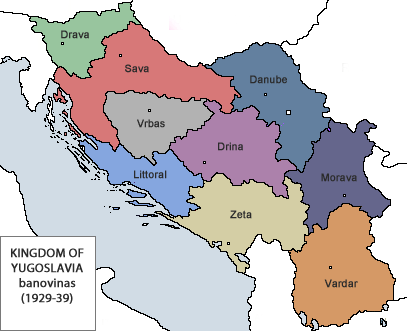
On the 6th of January 1929, King Alexander suspended the constitution, dissolved parliament, and imposed personal rule. He banned all political parties, prohibited the use of religious or ethnic names in political organisations, and re-divided the country into nine new administrative provinces (the banovinas) whose boundaries were drawn deliberately to cut across the old ethnic and historic regions. The country was formally renamed: from the Kingdom of Serbs, Croats and Slovenes to the Kingdom of Yugoslavia.
The renaming was significant. "Yugoslavia" — the kingdom of the South Slavs — was, in its very name, a commitment to a Yugoslav national identity that transcended Serbian, Croatian, and Slovenian particularities. It was also a commitment that almost no Croat or Slovene believed in, and that increasingly fewer Serbs believed in. The country was, from the 6th of January 1929, an authoritarian monarchy that had failed at parliamentary government and was now trying, with limited success, to manufacture by decree the national identity it could not produce by consent.
The royal dictatorship that followed is the subject of the next chapter.
End of Chapter I