Crusader castles are, with the cathedrals of Gothic France, the single most architecturally accomplished surviving group of buildings of the high medieval West. They were also, in their working period, a strategic system: a network of fortified positions linked by sight lines and beacon stations, garrisoned by the military orders, defended by professional standing forces, and supplied by the great commercial ports of the coast. Their preservation is patchy — some are spectacularly intact (Krak des Chevaliers, Margat, Sahyun in Syria; Belvoir, Belmont in Israel; Atlit on the Carmel coast), others reduced to outlines — but the surviving structures are, in their physical presence, the most legible inheritance of the kingdom. This chapter is a thematic interlude on castles and on the military orders that built them.
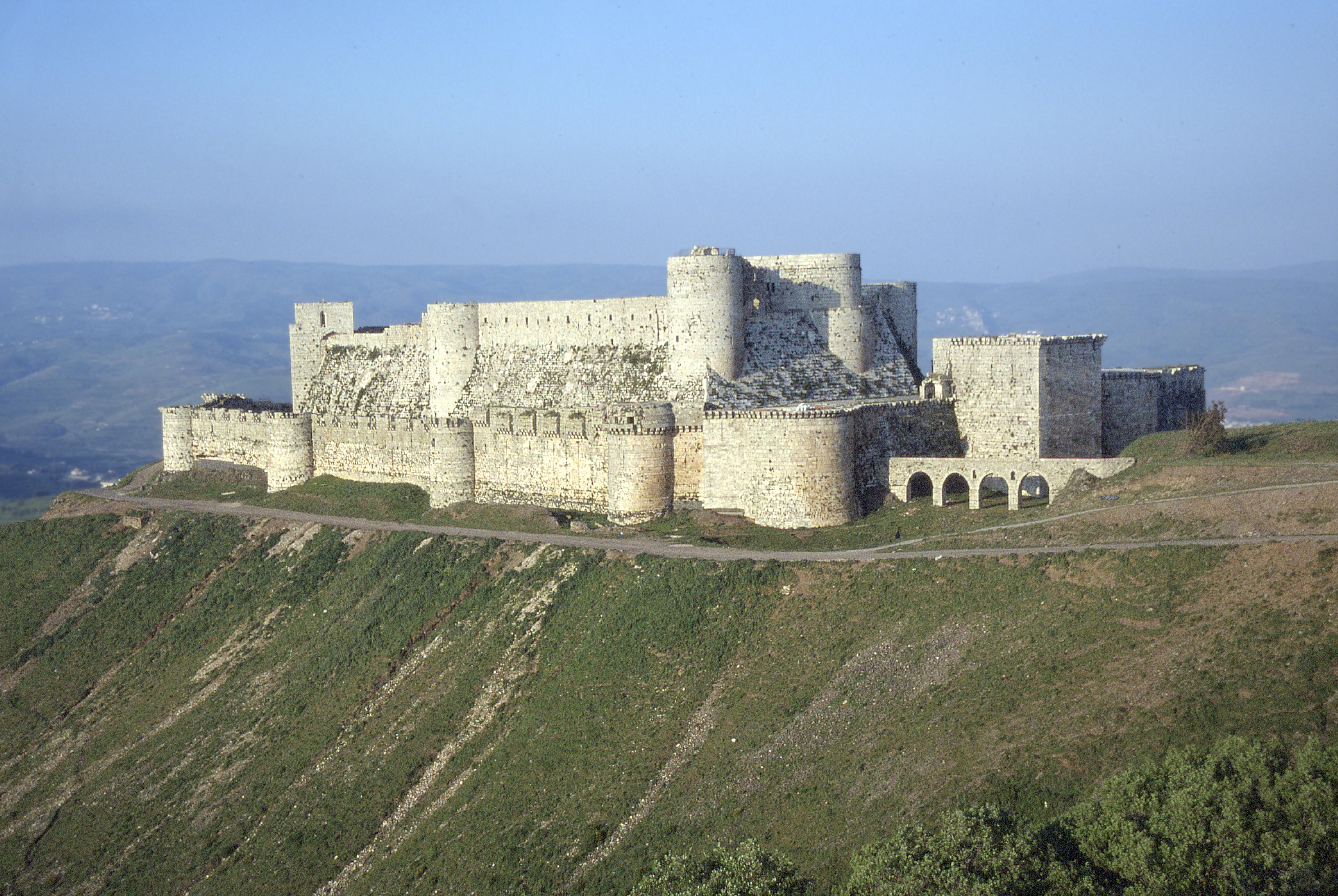
The architectural innovation
The Crusader castles are usually classed by historians of military architecture into three rough generations. The first generation (1100-1140) consisted of repurposed Byzantine and Islamic fortifications, modestly enlarged: the towers of Jerusalem itself; the early stages of Krak des Chevaliers (which the Hospitallers acquired in 1142 from the Counts of Tripoli); the small motte-and-bailey castles built quickly on the Frankish settlement model on the major roads (the Toron des Chevaliers; Latrun; Castel Arnaud at Yalu). The second generation (1140-1180) introduced the so-called concentric design: two parallel rings of defensive wall, an inner and an outer, separated by a defensive corridor, so that a besieger who broke through the outer wall would find himself trapped between two walls with the defenders firing down from both sides. Belvoir (built by the Hospitallers 1168-1187 on a Galilean ridge above the Jordan Valley) is the first fully concentric castle anywhere in the world; it predates by several decades the concentric castles of Edward I's Welsh campaigns (Beaumaris, Caerphilly, Conway), which were built by engineers who had served in the East. The third generation (1180-1291) elaborated the concentric design with massive curtain towers, advanced gateway barbicans, postern sallies, water cisterns sized for years of independent operation, and underground escape tunnels.

Krak des Chevaliers is the type-specimen. It sits on a rocky spur 650 metres above sea level on the road from Homs to the coast, in the County of Tripoli (today in the Homs Governorate of Syria). It was rebuilt by the Hospitallers in the 1170s and 1190s on the concentric model, with two complete rings of wall, twelve major towers, and a great central hall used for both refectory and chapel. Its garrison at peak was about 2,000 men, with stockpiled supplies for a five-year siege. It surrendered to Baybars in April 1271 only after the Mamluks produced a forged letter purporting to come from the Hospitaller grand master at Tripoli, ordering the garrison to surrender; the Hospitallers, suspicious but unable to confirm, accepted honourable terms and were allowed to march out to Tripoli. The castle was occupied by Mamluk garrisons and slowly extended by them; it is preserved today in extraordinary condition. UNESCO World Heritage. The 2011-2014 Syrian Civil War caused some damage; reconstruction is in progress.
The military orders
The military monastic order — a permanent corporate body of celibate men under religious vows, organised on monastic lines for the specific purpose of fighting Muslims and defending the Holy Land — was a Crusader invention without exact precedent. Three major orders and several smaller ones operated in the kingdom.
The Knights Templar (1119-1312) were founded at Jerusalem in 1119 by Hugues de Payens and eight companions, originally to protect pilgrim routes from the coast to Jerusalem. Their first quarters were at the Temple of Solomon (the al-Aqsa Mosque, then used as the royal palace) — hence the name. The order received its charter at the Council of Troyes in 1129 under a rule largely composed by Bernard of Clairvaux. Its membership grew rapidly to a peak of around 15,000 worldwide (perhaps 1,500 fighting knights at any time, plus mounted sergeants and supporting clergy). Its property base — donations of land in Europe, fees, and (eventually) banking operations — made it one of the wealthiest institutions in medieval Europe. The order's distinctive white mantle bore the red cross granted by Pope Eugene III in 1147. After the fall of Acre, the Templars relocated to Cyprus and were suppressed by Pope Clement V at the Council of Vienne in 1312 under pressure from King Philip IV of France, who wanted the order's French property; the suppression, on charges of heresy and blasphemy that have been universally rejected by serious historians since, involved torture and the burning at the stake of the last grand master Jacques de Molay in Paris in March 1314.
The Knights Hospitaller (originally the Order of Saint John of Jerusalem; 1099-present) began as a hospital for pilgrims, founded around 1080 by Italian merchants and reorganised after 1099. The order took on military responsibilities from the 1130s; by the time the Crusader states fell, the Hospitallers held the largest castles in the East (Krak, Margat, Belvoir). After 1291 they relocated to Cyprus, then in 1310 to Rhodes (which they conquered from the Byzantines and held against repeated Ottoman sieges until 1522), then to Malta (1530-1798, until the order's expulsion by Napoleon), then to Rome (where it survives, now called the Sovereign Military Order of Malta, as the world's smallest sovereign entity, with diplomatic relations with about 110 countries and an extensive humanitarian operation). The Hospitaller habit was black, with a white cross; their successors today still wear it.

The Teutonic Order (1190-present) was founded at the siege of Acre in 1190 by German participants in the Third Crusade. Smaller than the other two orders in the East (its Levant property included the castle of Montfort, the chief Teutonic castle of the kingdom, taken by Baybars in 1271), the order's principal field of operations shifted to the Baltic after the 1230s, where the Teutonic Knights conducted the Northern Crusades against the still-pagan Prussians and Lithuanians and established a state of their own (the Ordensstaat, later the Duchy of Prussia — see Volume I). The order survives today as a small Catholic religious community in Vienna.
Smaller orders included the Knights of Saint Lazarus (a leper military order, founded in Jerusalem in the 1130s, in which Baldwin IV himself was a member; the order survived in modified form in Europe and is now a chivalric body without military character), the Knights of Saint Thomas of Acre (an English foundation of 1191, suppressed at the Reformation), and the Knights of the Holy Sepulchre (a less martial order that maintained the church itself).
Frankish urban life
The cosmopolitanism of Outremer's urban life is best documented for Acre in the period 1191-1291, when the city was the capital. Modern archaeological work (the excavations at the Crusader Acre site since the 1990s) has revealed the substructure of the medieval city below the Ottoman-era town: streets, vaulted halls, the Hospitaller compound (open to visitors and one of the best surviving Crusader interior spaces), the underground refectory, the church of St Andrew, the Genoese quarter, the Venetian quarter, the Pisan quarter. The city's population at peak was perhaps 60,000 — a substantial medieval city. Italian merchant communities operated their own legal jurisdictions, their own coinage, their own customs collection. The Italian quarters were, in some sense, sovereign enclaves within the kingdom. The Italian-Crusader maritime law that emerged from this milieu (the so-called Assizes of the Court of Burgesses; the laws of Acre on commercial disputes) was used in Mediterranean shipping disputes for the next four centuries.
The trilingual character of urban Outremer is best preserved in the manuscripts. A small group of luxury illuminated manuscripts produced at Acre in the 1270s and 1280s — particularly the so-called Histoire universelle of around 1287 — show a remarkable synthesis of Western, Byzantine, and Arab visual traditions in a single book. The hands that produced these manuscripts disappear after 1291; the workshop, like the city it had operated in, ended. The next chapter follows what survived.
End of Chapter IX