The strategic environment of the kingdom changed completely between 1244 and 1260. The Ayyubid sultanate of Egypt, which had been the kingdom's principal Muslim neighbour since 1171, was destroyed in a coup in May 1250 — the Mamluk officers who had constituted the sultan's army turned on his successor Turanshah and made themselves the new ruling class of Egypt. The Mamluk sultanate would be the kingdom's adversary for the remainder of its existence and would, ultimately, end it. Meanwhile, in 1260, the Mongol armies that had been advancing west since the destruction of the caliphate of Baghdad in February of that year were defeated by the Mamluks at the battle of Ain Jalut on the 3rd of September 1260 — a battle fought in northern Galilee, on territory that had been crusader land within living memory. The defeat of the Mongols by the Mamluks fixed the political map of the Middle East: the Mamluks would hold Egypt, Palestine, and Syria for the next 250 years; the Mongol Ilkhanate would hold Persia. The crusader states were a small enclave between two large powers that had reached an effective standoff.
Louis IX and the Seventh Crusade
Between 1248 and 1254, the kingdom received the personal attention and presence of one of the most committed crusading monarchs of the medieval period, King Louis IX of France (the future Saint Louis). The Seventh Crusade — Louis's first eastern expedition — attacked Egypt in June 1249, capturing Damietta a second time. The expedition advanced up the Nile, was defeated at the battle of al-Mansurah in February 1250, and was forced to surrender; Louis himself was captured and held for ransom of 800,000 gold bezants and the return of Damietta. He was released in May 1250 after paying half the ransom.
Rather than returning to France, Louis spent the next four years (1250-1254) in the kingdom itself, based at Acre, paying for the reconstruction of the walls of Acre, Caesarea, Jaffa, and Sidon out of his personal funds and overseeing major diplomatic missions to the Mongols (whom he hoped to convert to Christianity and convince to attack the Mamluks; the missions came to nothing). His four years in residence were the kingdom's last period of relative strength. He left in April 1254 on news of his mother Blanche of Castile's death and the need to return to France to govern. He would return on the Eighth Crusade in 1270, dying of dysentery in front of Tunis without reaching the kingdom; he was canonised in 1297.
Baybars
Sultan Rukn al-Din Baybars al-Bunduqdari (1260-1277) is the single figure most responsible for the destruction of the Frankish East. He had come to the Mamluk sultanate through political murder (he assassinated his predecessor Qutuz, the victor of Ain Jalut, in late 1260), and his seventeen-year reign was a remarkable sustained military campaign. He reorganised the Mamluk army, built a strategic road network with the most reliable courier system in the medieval Middle East, and systematically reduced the Crusader strongholds. The pattern was always the same: a Mamluk army would arrive before a fortress, the surrounding territory would be devastated, the place would surrender on terms or be stormed, the local Frankish settler population would be expelled, the fortifications would either be repaired (for Mamluk garrison use) or systematically destroyed. The Crusaders had no field army capable of meeting the Mamluks in the open. The military orders' garrisons in the great castles could resist for months, but no relief was possible.
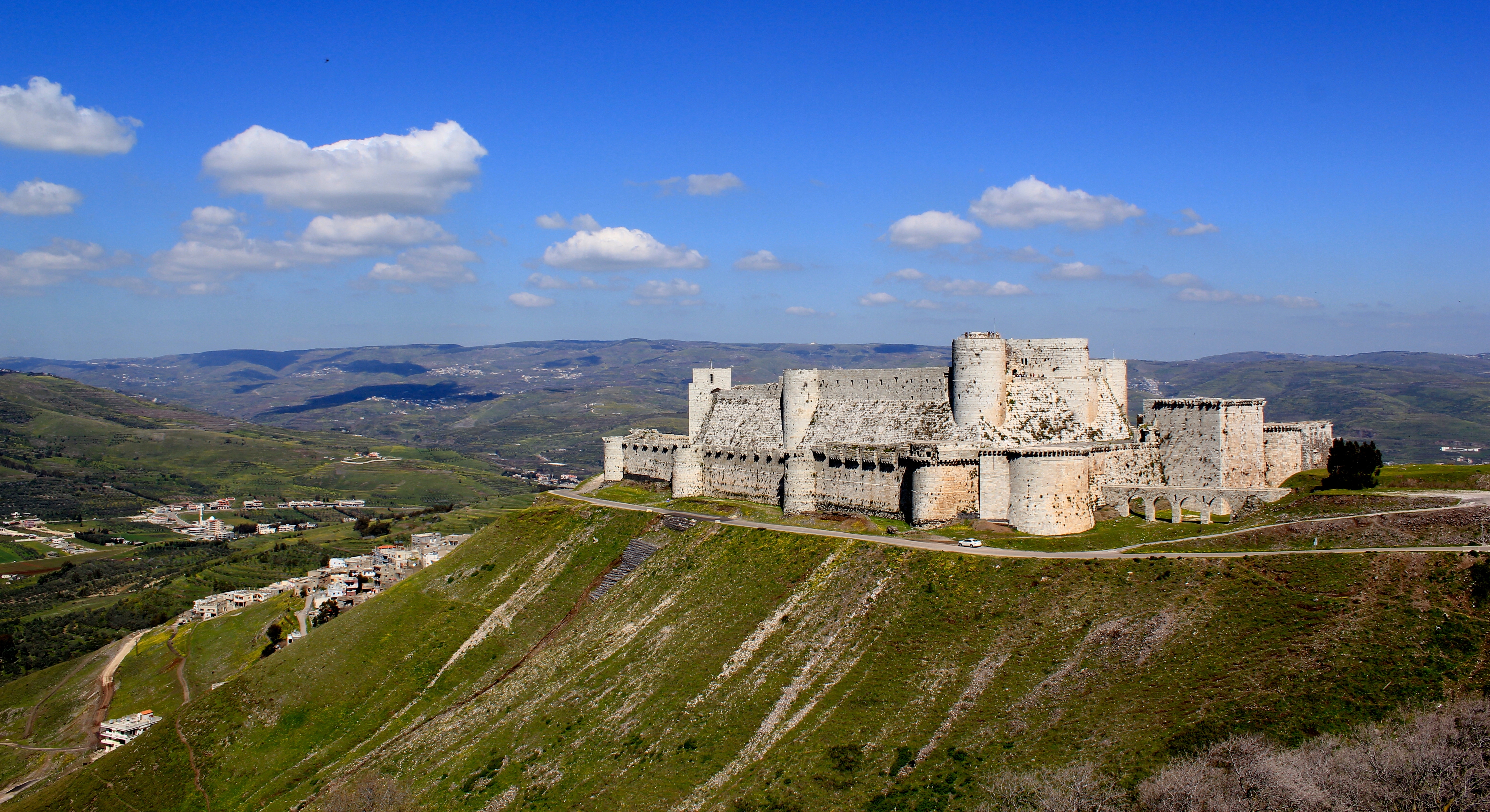
The losses of Baybars's reign: Caesarea (March 1265), Arsuf (April 1265), Safed (July 1266 — the entire Templar garrison was executed), Jaffa (March 1268), Beaufort (April 1268), Antioch (May 1268 — the second-largest Frankish city, taken in five days, with a massacre that horrified the medieval Mediterranean), Krak des Chevaliers (April 1271 — the largest Hospitaller castle, taken after a month-long siege), Montfort (June 1271 — the chief Teutonic castle). The principality of Antioch was destroyed; the county of Tripoli was reduced to the city itself. Baybars died in July 1277 of poison (probably accidental, drunk from a cup he had prepared for somebody else). The pace of the reduction continued under his successors.
Qalawun and the final losses
Sultan Qalawun (1279-1290), Baybars's effective successor after a brief period of instability, took Marqab (1285), Lattakia (1287), and Tripoli (April 1289 — the city was massacred and razed, and the seat of the County of Tripoli was erased from the map). By 1290 the Kingdom of Jerusalem was reduced to Acre, Tyre, Sidon, Beirut, the small castle at Atlit, and the Templar castle at Tortosa. Qalawun mobilised his army in late 1290 to take Acre, but died on the 10th of November 1290 before the campaign began. His son al-Ashraf Khalil took the throne and inherited the campaign.
The siege of Acre
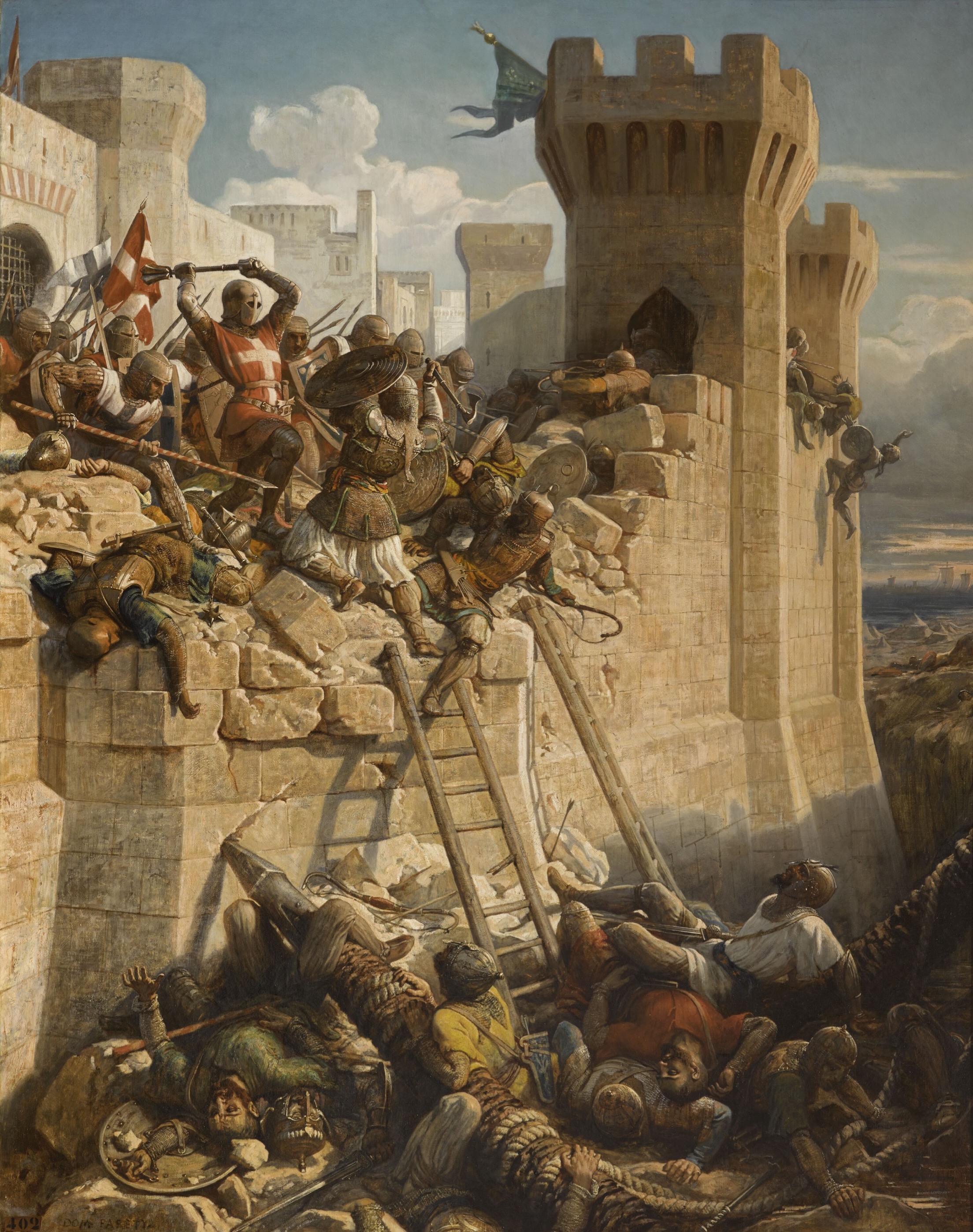
The siege of Acre began on the 6th of April 1291. The Mamluk army of perhaps 70,000 to 100,000 men, with about 70 catapults and trebuchets, surrounded the city. The defenders — about 14,000 fighting men in total, including the garrisons of the three military orders and contingents from Cyprus, France, Italy, and England — held the most heavily fortified Crusader city in the Levant; Louis IX's walls were less than a generation old. The siege lasted six weeks.
The Mamluk artillery breached the outer wall after several weeks of continuous bombardment. The Frankish field defences inside the breach — the so-called Accursed Tower and the surrounding curtain — became the focus of the fighting. King Henry II of Jerusalem (who was also king of Cyprus, the kingdoms having been formally united in 1268) arrived with reinforcements from Cyprus on the 4th of May; the defence was stiffened briefly. The final Mamluk assault began at dawn on Friday the 18th of May 1291.
The fighting that day was concentrated, as in any city storm, on the gates and the most accessible breaches. The Templar grand master Guillaume de Beaujeu was killed in the streets near St Anthony's Gate (his body was carried away by his attendants and would be buried in the Templar quarter; his armour was famously found there during the 2010-2011 archaeological excavations). The Hospitaller grand master Jean de Villiers was severely wounded but was carried, with the residual royal forces, to the city's southern point and to the waiting ships. The civilian population had been evacuating to ships in the harbour for several days. By midday the city was largely lost; the Templar quarter, in the south-western tip of the peninsula, held out for ten more days before its commander, Pierre de Sevrey, agreed to surrender it to the sultan on the 28th of May. The sultan's deputy who entered the quarter to take possession was killed (by Templar knights who feared treachery); the sultan ordered an assault; the underground crypt where the remaining defenders had retreated collapsed on top of them.

The fall of Acre on Friday the 18th of May 1291 is the conventional date for the end of the Kingdom of Jerusalem. In the days that followed, the residual Frankish positions on the coast surrendered or were evacuated: Tyre (without a fight, the population fleeing by sea on hearing of Acre's fall, on the 19th of May); Sidon (29th of June); Beirut (the 31st of July); Atlit and Tortosa (the 3rd and 14th of August). The last Frankish ship sailed from Atlit on the 14th of August 1291. The kingdom on the mainland was over.
The Mamluks systematically destroyed the fortifications of the coastal cities they had captured, on the explicit policy that the Franks should not be able to use them again in any future return. The walls of Acre — which still stand in part today, although the great Ottoman walls now overlay the Crusader system — were partly demolished; the harbour was deliberately silted. Tyre's defences were levelled. The Crusader coast was depopulated of its Frankish settlers for the first time in two centuries. The kingdom continued, in name, on the island of Cyprus. The next chapter takes up what survived.
End of Chapter VIII