Israel and the Palestinian Territories
Jerusalem · Old City
The Holy Sepulchre and the Crusader fabric

The principal Crusader monument is the Church of the Holy Sepulchre itself, which Melisende's masons substantially rebuilt and re-dedicated in 1149. Most of the externally visible Romanesque-Gothic fabric, the south façade, the rotunda's restored arches, and the small Calvary chapels are twelfth-century Crusader work. The Citadel of David at Jaffa Gate preserves further Frankish masonry. The Cardo, in the Jewish Quarter, has a section of Crusader-era paving on display. The Templum Salomonis (now al-Aqsa Mosque) and the Templum Domini (Dome of the Rock) are open to non-Muslim visitors at restricted times.
Acre (Akko) · Israel
The second capital

The capital of the Kingdom from 1191 to 1291, the largest Frankish city of the Levant at its peak (sixty thousand inhabitants), and the site of one of the longest sieges of medieval history. The Crusader-era city is preserved at substructure level below the Ottoman town: the Hospitaller compound (with the dramatic vaulted Hall of the Hospitallers, the refectory, the dormitories, and the chapel), the Knights' Halls, the Templar Tunnel (an underground passage from the Templar fortress to the harbour, discovered in 1994), the Turkish bazaar built over Crusader vaults. UNESCO World Heritage. The single best place to see Crusader urban life.
Atlit · Israel
Château Pèlerin

The Templars' great coastal fortress, ten kilometres south of Haifa, built between 1217 and 1218 and held to the last day of the kingdom. The site sits on a small headland, surrounded by sea on three sides, and is among the best-preserved Crusader castles anywhere. Access is partially restricted (the site is on an active Israeli naval base), but the outer walls, the partly-collapsed inner keep, and the harbour mole are visible from public ground. The Templars evacuated the castle in August 1291 without resistance.
Belvoir Fortress · Israel
Kokhav HaYarden — Star of the Jordan
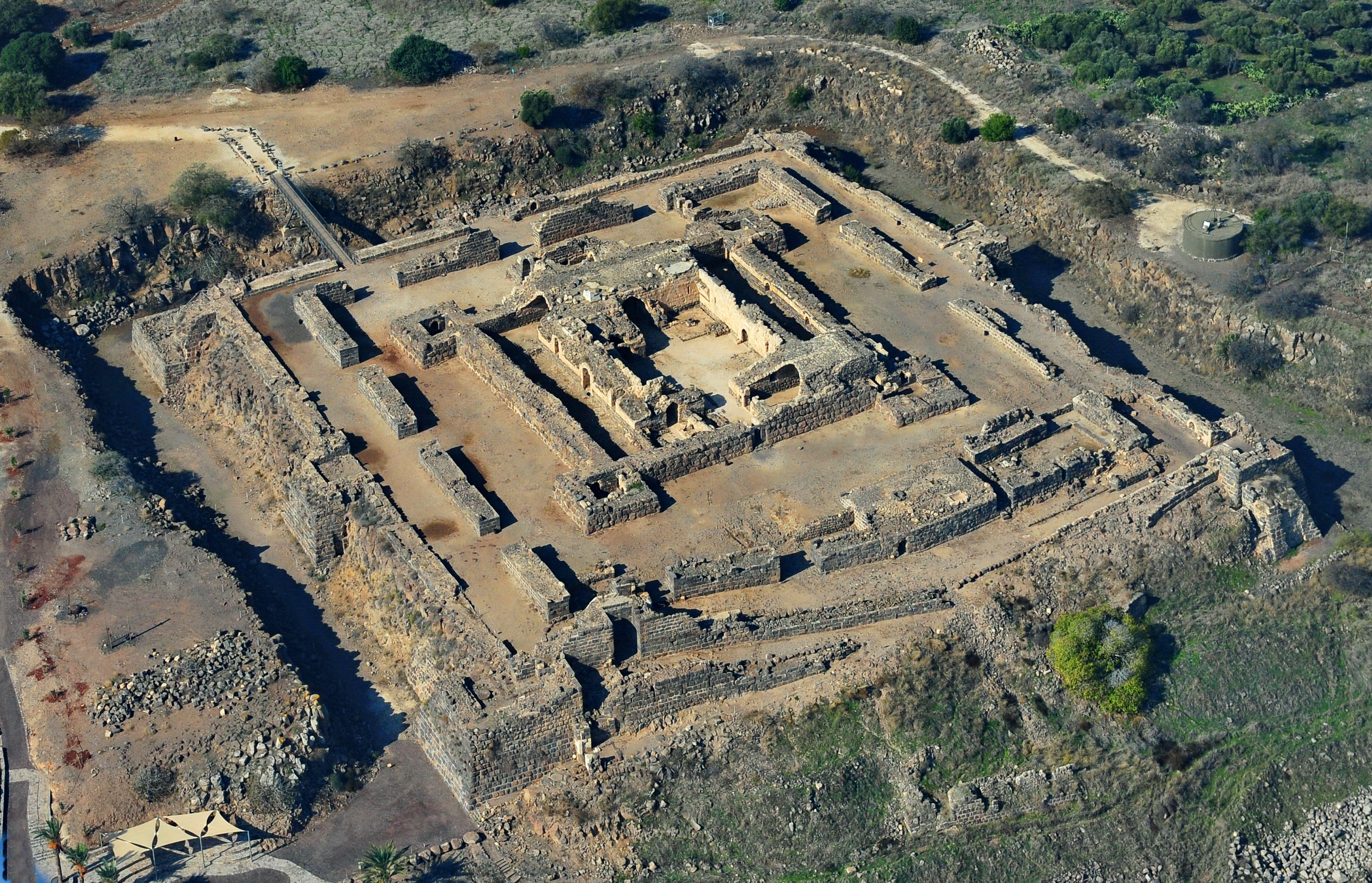
The first fully concentric castle in the world (Hospitallers, 1168-1187), on a ridge five hundred metres above the Jordan Valley in Lower Galilee. The site has been excavated and conserved; the outer wall, the inner keep, the chapel, the gate complex, and the entire dry moat are walkable. Surrendered to Saladin in 1189 after a year-long siege; partially demolished by the Mamluks. Spectacular views east into Jordan.
Caesarea Maritima · Israel
The Roman port and the Crusader citadel

Roman foundation by Herod the Great; Frankish from 1101 to 1187, again 1191 to 1265. Louis IX rebuilt the walls in the 1250s; Baybars destroyed them and the harbour in 1265 with explicit thoroughness. The site preserves the Crusader-era citadel walls, the cathedral foundations, and the harbour mole, alongside the Roman theatre and hippodrome.
Nazareth · Israel
The Crusader cathedral foundations

Tancred founded the Crusader principality of Galilee in 1099 with its seat at Nazareth. The town's medieval Latin cathedral (twelfth century) was destroyed by Baybars in 1263; its foundations are visible under the modern Catholic basilica of the Annunciation. The twelfth-century capitals from the Crusader cathedral — recovered in archaeological investigation in the 1860s — are among the finest pieces of Crusader sculpture; they are displayed in the basilica's museum.
Jordan
Kerak · Jordan
The lord of Oultrejourdain's castle

Built by Pagan the Butler in 1142 on a high spur above the King's Highway, Kerak was the principal castle of the lordship of Oultrejourdain — the frontier territory south-east of the Dead Sea — and from 1176 the residence of Raynald of Châtillon. Saladin besieged it twice (1183, 1184) without success; it surrendered after Hattin in November 1188 after a long blockade and famine. The Crusader castle is in good condition with most of the curtain walls, the keep, and the chapel preserved.
Montreal (Shobak) · Jordan
Mons Realis

The first Crusader castle in Oultrejourdain, built in 1115 by Baldwin I on a high conical hill on the King's Highway south of Kerak. The site preserves the curtain walls, a small chapel, and (a Mamluk addition) substantial Islamic-era inscriptions. The surrounding country gives the visitor the geography of Crusader frontier defence at a glance — desert in every direction, the castle visible from twenty kilometres away.
Lebanon
Tripoli · Lebanon
The county's capital

The capital of the County of Tripoli, the third of the four crusader states, from 1109 until the Mamluk sack of 1289. The Citadel of Raymond de Saint-Gilles, on the hill overlooking the modern city, is in part Crusader work (much overlaid by Mamluk and Ottoman additions). The 1289 destruction of the city was so thorough that the modern Tripoli is built on what was, until the late thirteenth century, a separate settlement around the citadel; the original Crusader port-city has not been re-occupied. Security conditions vary; check current advice.
Byblos (Jbeil) · Lebanon
The Frankish bishopric

The Phoenician-Roman-Crusader site of Byblos; the Crusader-era castle in the upper town (twelfth century, Genoese-built) is in excellent condition. The Romanesque church of St John the Baptist, in the old quarter, is largely twelfth-century Crusader work, still in use.
Sidon (Saida) · Lebanon
The Sea Castle

The thirteenth-century Crusader sea castle of Sidon — built on a small island connected to the mainland by a causeway — is the most photogenic surviving Frankish building in the Levant. Built in 1228 by Frankish settlers and reinforced under Louis IX in the 1250s. The land castle (also Crusader) on the inland edge of the modern city is partly preserved. Sidon surrendered to the Mamluks in 1291.
Beirut · Lebanon
The lordship of Beirut

Capital of the Ibelin lordship of Beirut, the most powerful Frankish baronial family in the Second Kingdom. The Crusader fabric is largely destroyed — the city has been repeatedly rebuilt — but the National Museum of Beirut holds significant Crusader artefacts, and the medieval substructure of the city is visible in several archaeological excavations in the modern downtown.
Syria
Krak des Chevaliers · Syria
The Hospitallers' great castle
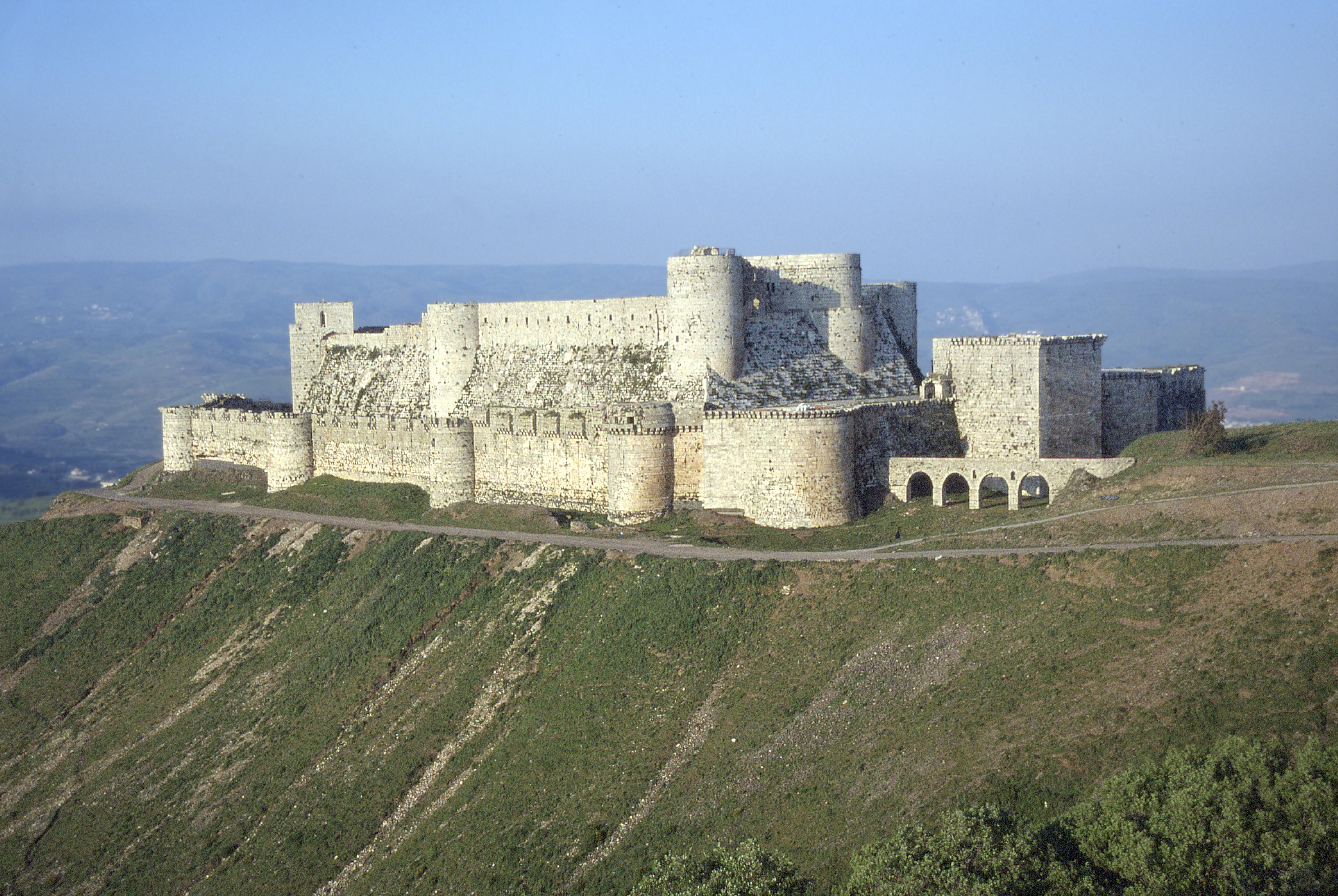
The single most architecturally accomplished Crusader castle anywhere, on a spur 650 metres above sea level on the road from Homs to the coast. Built by the Hospitallers from 1142 onward; surrendered to Baybars in April 1271 under a false letter ruse. The concentric design — two complete rings of wall, twelve major towers, an inner cistern complex, a refectory hall with Gothic vaulting — has been studied as a textbook of medieval military architecture since the nineteenth century. UNESCO World Heritage. Sustained damage in the 2011-2014 Syrian Civil War; reconstruction is in progress. Security conditions vary; check current advice.
Margat (Qalat al-Marqab) · Syria
The black castle

The other great Hospitaller castle, on a basalt headland above the coast at Banias, north of Tartus. Built by the Mazoir family from 1118 onward; transferred to the Hospitallers in 1186. The black basalt walls give the castle its characteristic appearance. Surrendered to Qalawun in 1285 after a five-week siege. Substantially preserved; security conditions vary.
Saone (Sahyun, Qalat Salah ad-Din) · Syria
The frontier castle of Antioch

A spectacular Crusader fortress on a knife-edge ridge in the mountains east of Latakia. The site combines a Byzantine acropolis with substantial Crusader curtain walls, a great deep rock-cut moat (twenty-eight metres deep, cut by hand through the limestone), and a Crusader keep. Saladin took it in 1188 after a brief siege; the Ayyubids and Mamluks added Islamic-period work. UNESCO World Heritage (jointly with Krak). Security conditions vary.
Tartus · Syria
The last Templar position

The mainland Templar headquarters in the final decades of the kingdom; the Templars evacuated it on the 3rd of August 1291, two weeks after the fall of Acre. The Templars then retreated to the small offshore island of Arwad (Ruad), which they held until 1303 — making Arwad the last Crusader position on the eastern Mediterranean coast. Tartus's medieval cathedral (twelfth century, Crusader) is partly preserved.
Cyprus, Greece, and the diaspora
Nicosia · Cyprus
The Lusignan capital

The capital of the Lusignan Kingdom of Cyprus and Jerusalem after 1291. The Latin cathedral of Saint Sophia (now the Selimiye Mosque, in the northern half of the divided city) is a French Gothic building of the late thirteenth and early fourteenth centuries, with the dynastic tombs of the Lusignan kings in its floor. The Venetian walls of the city (1567) overlay the earlier Lusignan fortifications.
Famagusta · Cyprus
The medieval Mediterranean's wealthiest city

The Lusignan port city of Famagusta, in the eastern Cyprus, reached the wealth of a Venice or a Genoa in the fourteenth century; its harbour and walls were said by contemporaries to be the most defensible in the eastern Mediterranean. The cathedral of St Nicholas (now the Lala Mustafa Pasha Mosque) is one of the finest French Gothic buildings outside France, modelled on Reims. About forty other medieval churches survive within the walls in varying conditions of preservation.
Rhodes · Greece
The Hospitaller successor state

The Hospitallers conquered Rhodes from the Byzantines in 1310 and held it as the headquarters of their order until the Ottoman siege of 1522. The medieval Old Town — the largest inhabited medieval city in Europe — preserves the Palace of the Grand Master, the Street of the Knights (lined with the hospices of the seven national tongues of the order), the cathedral of St John, the Hospitaller hospital (now an archaeological museum), and the entire eight-kilometre circuit of city walls. UNESCO World Heritage.
Valletta · Malta
The Hospitaller capital
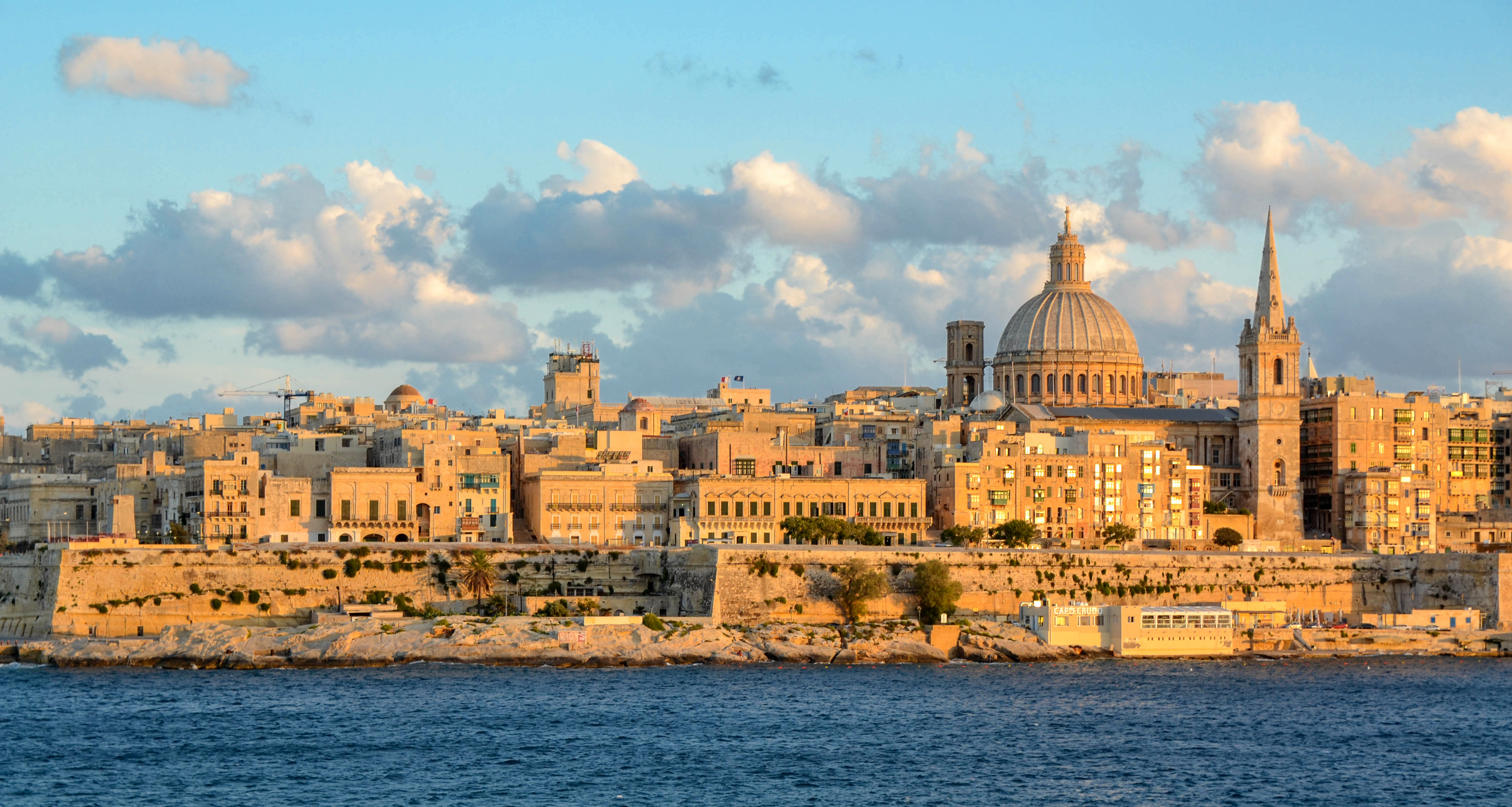
The Hospitallers — by then known as the Order of Malta — moved to Malta in 1530 after their expulsion from Rhodes; they would hold the island until Napoleon expelled them in 1798. The capital, Valletta, was founded after the Great Siege of 1565 and is preserved in its sixteenth-century form: the Co-Cathedral of St John (with the original Hospitaller commemorative monuments and Caravaggio's Beheading of St John the Baptist), the Grand Master's Palace, the auberges of the order's national tongues, the immense bastioned walls, the hospital (the Sacra Infermeria, an active hospital until the early twentieth century). UNESCO World Heritage. The Crusader institutional inheritance, after seven centuries, still in operation.