The Kingdom of Jerusalem from 1192 onward had a different character from the original twelfth-century state. It was a smaller territory, focused on the coastal cities; it was wealthier in per-capita terms (the Italian merchants of Acre, Tyre, and Beirut were doing very well out of the Levantine trade); it was less militarily independent (the kingdom's defence depended increasingly on the military orders and on irregular reinforcements from the West); and it was less politically self-governing (the High Court's authority was challenged from outside the kingdom, and the throne was, for most of this period, held by absentee monarchs whose primary political base was European). The kingdom was, in some sense, an extension of European political networks into the Levant, governed by regents and viceroys, rather than a self-contained Frankish state.
The marriage politics
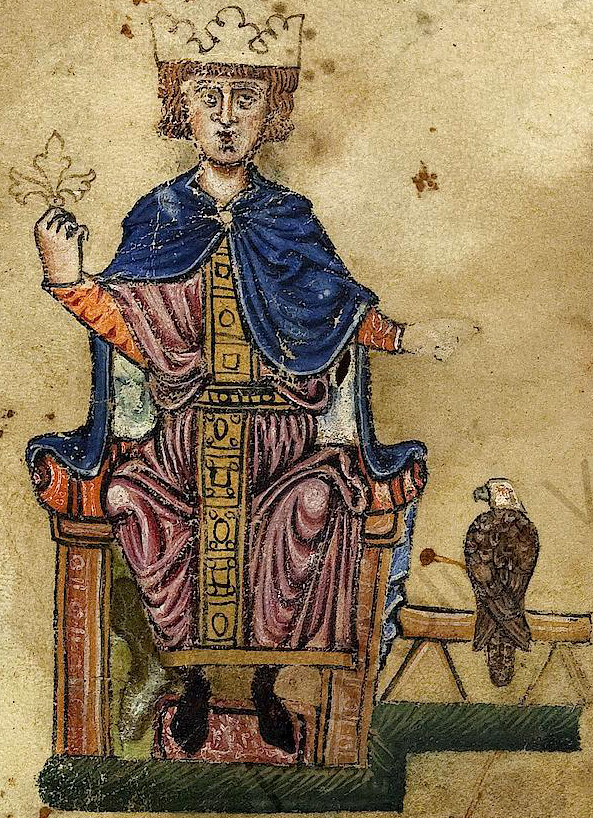
The crown's politics in this period were defined by dynastic marriages. After the assassination of Conrad of Montferrat in 1192, his widow Isabella I — the daughter of Amalric I, half-sister of Baldwin IV — was the legitimate heir; her successive husbands were Henry II of Champagne (1192-1197), Amalric II of Lusignan (1197-1205, who was also king of Cyprus, briefly uniting the two crowns), and after both of these died, no further husbands. Isabella died in 1205, leaving the kingdom to her daughter (by Conrad of Montferrat) Maria, who was queen from 1205 to 1212 under various regents. Maria's marriage to John of Brienne in 1210 brought him into the kingdom as king-consort; their daughter Isabella II ("Yolande"), born 1212, inherited the kingdom on Maria's death. Yolande was married, in 1225 at the age of thirteen, to the Holy Roman Emperor Frederick II Hohenstaufen, who became king of Jerusalem on his marriage and would govern the kingdom — usually from southern Italy and Sicily, rarely from the kingdom itself — until his death in 1250.
The Fifth Crusade
The Fourth Crusade of 1202-1204 (the Venetian-directed expedition that captured Constantinople and is the principal subject of Chapter IX of the Roman Empire volume) brought no military assistance to the Kingdom of Jerusalem. The Fifth Crusade of 1217-1221 was, in some respects, an attempt to repair the damage. The strategic concept this time was to attack Egypt — by then the heartland of the Ayyubid sultanate, Saladin's family — and use the Egyptian capital Damietta as a hostage to negotiate the surrender of Jerusalem. Damietta was captured in November 1219 after a year-long siege. Negotiations with Sultan al-Kamil (Saladin's nephew) followed; the sultan offered, in 1220, to return Jerusalem (which had been demilitarised; Saladin had dismantled its walls in 1219 in anticipation of just such a Crusader strategy) in exchange for Damietta. The papal legate Pelagius of Albano, commanding the Crusader operation, refused on theological grounds: the kingdom should be reconquered by Christian arms, not received from infidel hands. The negotiation collapsed. The Crusader army, advancing inland up the Nile, was trapped by the rising flood in August 1221 and forced to surrender. Damietta was returned to the Ayyubids in exchange for the army's safe withdrawal. The expedition was a complete failure and accomplished nothing.

The Sixth Crusade and the diplomatic recovery of Jerusalem
The most extraordinary single episode of the Second Kingdom was the so-called Sixth Crusade of 1228-1229 under Emperor Frederick II. Frederick — who had taken the cross in 1215 and repeatedly delayed his departure, eventually being excommunicated by Pope Gregory IX in September 1227 for failing to honour the obligation — finally arrived at Acre in September 1228 with a small army (perhaps two thousand knights and ten thousand infantry). He was an unusually multilingual and cultured monarch (he spoke Latin, German, French, Italian, Arabic, and Greek; he had been raised in Sicily, where his court included Muslim scholars; his interests included falconry, mathematics, and natural philosophy), and his approach to the recovery of Jerusalem was that of a diplomat rather than a conqueror.
Frederick had been corresponding for years with Sultan al-Kamil of Egypt, the same al-Kamil who had offered to return Jerusalem during the Fifth Crusade. Al-Kamil, locked in a dynastic struggle with his nephew an-Nasir Dawud (the ruler of Damascus, who currently held Jerusalem), found it diplomatically useful to detach Frederick from a potential Damascene alliance. The result was the Treaty of Jaffa, signed on the 18th of February 1229. Frederick received Jerusalem (excluding the Temple Mount, which remained under Muslim religious control with free Christian access to the Holy Sepulchre), Bethlehem, Nazareth, the corridor connecting Jerusalem to the coast, and ten years of peace. He gave up nothing he had previously held. The treaty was bitterly opposed by Pope Gregory IX, by the patriarch of Jerusalem (who refused to crown Frederick king of Jerusalem and even placed an interdict on the city), and by much of the Crusader baronage (which considered the imperial absentee monarch a foreign imposition). Frederick crowned himself king of Jerusalem at the Holy Sepulchre on the 18th of March 1229 — an extraordinary self-coronation, performed because no patriarch would do it — and left the kingdom seven weeks later to deal with a papal-supported invasion of his Italian territories. He never returned. Jerusalem was, however, in Christian hands again. The Treaty of Jaffa is the only successful diplomatic recovery of Jerusalem in the entire history of the Crusades.

The fall of Jerusalem in 1244
The Treaty of Jaffa expired in 1239 and was renewed only in modified form. The period 1239-1244 was a complicated diplomatic three-way game among the kingdom, the Ayyubid sultans of Egypt and Damascus, and the displaced Khwarezmian Turks — a tribal confederation that had been dispossessed of its Central Asian homeland by the Mongol conquest of 1219-1221 and had been mercenary-soldiering its way south-west across the Middle East for two decades. In 1244 the Sultan al-Salih Ayyub of Egypt hired the Khwarezmian army for use against his Ayyubid rival in Damascus, who had recently allied with the Crusaders. The Khwarezmian force of about ten thousand mounted men marched into Palestine and, on the 11th of July 1244, took the city of Jerusalem. The garrison and most of the Christian population were massacred — perhaps seven thousand killed, including pilgrims, hospitallers, and the Templars who had remained at the Temple Mount under the 1229 terms. The Holy Sepulchre was desecrated; the tombs of the Crusader kings (including Baldwin I, Baldwin II, Fulk, Baldwin III) were broken open and the bodies thrown out.
The Crusader field army, attempting to relieve the city, was destroyed at the battle of La Forbie on the 17-18th of October 1244, in what was, by aggregate casualties, the worst Crusader defeat after Hattin. About sixteen thousand Crusader soldiers were killed; the master of the Templars, the master of the Hospitallers, and the constable of the kingdom were all dead or captured. The kingdom never recovered a field army on that scale again. Jerusalem itself remained in Muslim hands and would remain so for the next 673 years (it would not be taken by Christian arms again until General Allenby's British army entered the city in December 1917). The Crusader state was, from 1244, restricted to the coast permanently. The remaining half-century of the kingdom is the subject of the next chapter.
"I came not to make peace, but to perform my pilgrimage." — Emperor Frederick II's response to his critics, 1229
End of Chapter VII