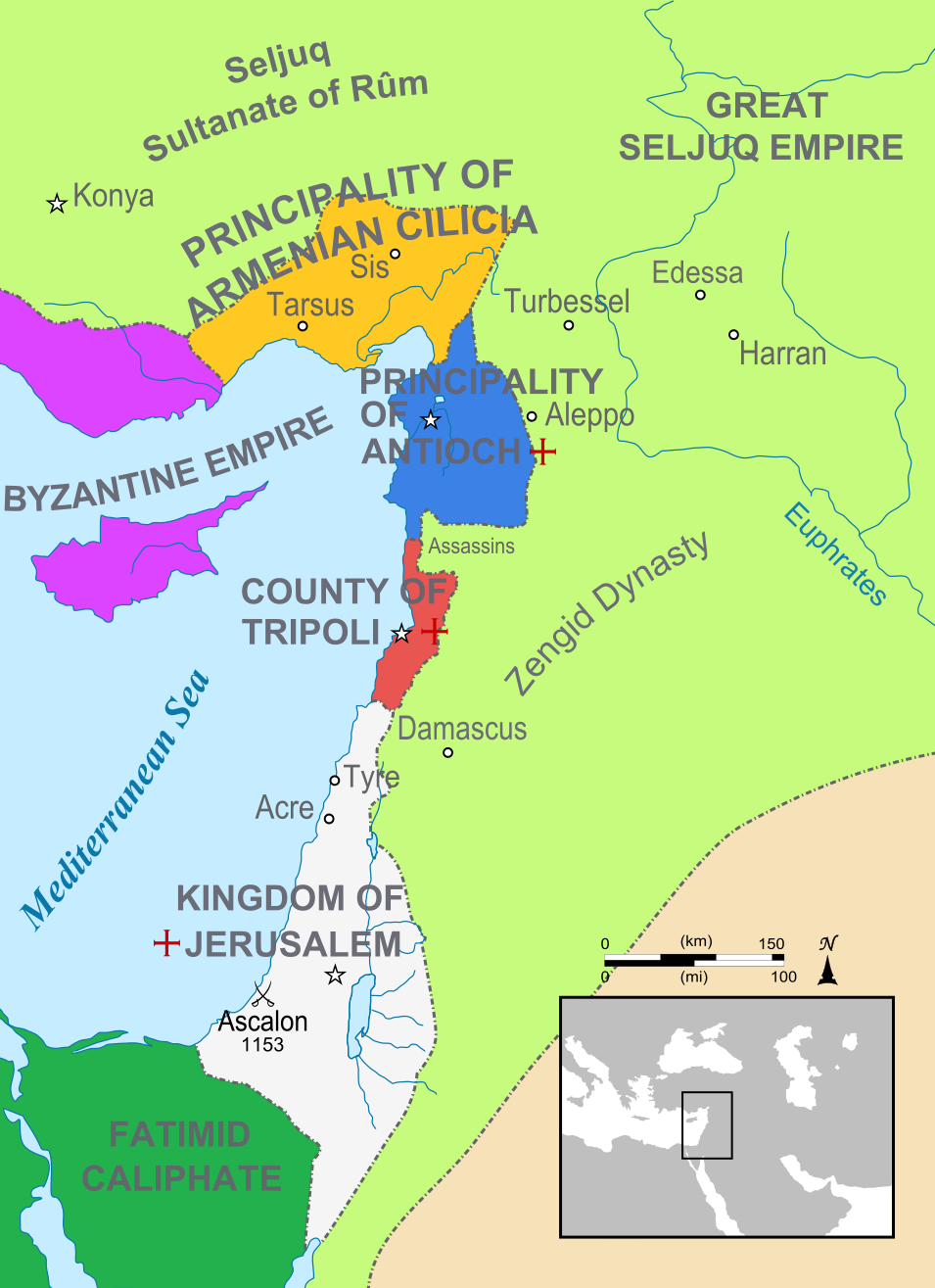
The four decades from the accession of Fulk and Melisende in 1131 to the death of Amalric in 1174 are the peak of the kingdom's strength, its territorial extent, and (in the judgement of most historians of Outremer) its political competence. The Frankish settler society of the eastern Mediterranean was, in this generation, securely established: the major coastal cities were in Crusader hands, the countryside was producing tax revenue, the chancery was operating in the local Frankish dialect of French, the great castles were under construction, and the Eastern Christian, Muslim, and Jewish populations of the kingdom — perhaps four-fifths of the total — were administered through their respective communal authorities under generally bearable conditions. The kingdom was a working state. The cultural synthesis was an interesting one. Frankish nobles took to wearing Arab silks and eating local food; intermarriage with Eastern Christians was common; the Frankish settler class of the third generation, the so-called poulains, were native Arabic-speakers as well as French-speakers. The visiting western chronicler William of Tyre — himself Outremer-born, archbishop of Tyre — wrote of his own society in the 1170s with an awareness that it had become something different from Western Europe.

Fulk and Melisende
The joint reign of Fulk (1131-1143) and Melisende (1131-1153, alone after Fulk's death) was politically a partnership of equals that occasionally became a partnership of rivals. Fulk attempted, early in his reign, to sideline Melisende and to govern in his own name with his Angevin advisers; Melisende's faction at court resisted, and a brief armed crisis in 1134 (over a manufactured accusation against Hugh II of Le Puiset, Count of Jaffa, that historians have read as a proxy attack on the queen) ended with Melisende's authority restored and Fulk's reliance on the Angevin faction broken. The arrangement that followed — Fulk handling external military operations, Melisende controlling internal administration and ecclesiastical patronage, both signing royal charters — produced the most stable thirteen years of the kingdom's early existence. Fulk died in November 1143 of a hunting accident outside Acre, leaving Melisende as regent for their thirteen-year-old son Baldwin III.
Melisende's regency, and her continued joint rule after Baldwin III came of age in 1145, ran until 1152. She was the principal builder among the kingdom's rulers: the rebuilding of the Holy Sepulchre in its present (largely surviving) form was substantially her patronage, completed and dedicated on the 15th of July 1149, the fiftieth anniversary of the city's capture. Her chapel at Bethany (now in the Palestinian Authority's Eizariya area) survives in part. She also commissioned the Melisende Psalter, one of the masterworks of twelfth-century manuscript illumination (now British Library Egerton MS 1139), which combines Western, Byzantine, and Eastern Christian visual traditions in a way characteristic of the Outremer cultural moment.

The Second Crusade
The single major military event of Melisende's regency was the Second Crusade of 1147-1149, called in response to the Muslim atabeg Zengi of Mosul's capture of Edessa in December 1144 — the loss of the first crusader state. The Second Crusade was led by King Louis VII of France and Emperor Conrad III of the Holy Roman Empire and arrived in the East in poor condition (the German army had been largely destroyed in Anatolia by the Seljuks of Rum; the French army had crossed Anatolia in better order but with substantial losses). The combined Crusader force, joined by King Baldwin III and the local barons, made the strategically baffling decision to besiege Damascus — a Muslim city ruled by the Burid dynasty, which had been an ally of the kingdom against the Zengid threat — in July 1148. The siege failed within five days under a combination of military setbacks and political dispute among the Crusader leaders. The expedition returned to Europe with nothing accomplished. Damascus, alienated, fell to Zengi's son Nur ad-Din in 1154; the long process of unifying the Muslim opposition to the Crusader states had begun.
Baldwin III and Amalric
Baldwin III (sole monarch from 1153 to 1163) and his younger brother Amalric (1163-1174) are the two ablest kings the kingdom would produce. Baldwin III's reign extended Crusader control to the Egyptian frontier with the capture of Ascalon on the 19th of August 1153, after a five-month siege — the last Egyptian fortress on the Palestinian coast and a permanent threat to Jerusalem itself. Its fall ended the Fatimid strategic position in Palestine and opened the way for Frankish operations south. Baldwin III married the Byzantine princess Theodora Komnene in 1158, restoring the kingdom's relationship with Constantinople (a relationship that had been damaged by the Crusaders' independent course since 1098 and by Bohemond's frequent wars with the Eastern empire). He died in February 1163, aged thirty-two, of an undiagnosed illness. He had no children.
Amalric (Amaury in modern French; both forms are used in the chronicles) inherited the throne at twenty-six and ruled for eleven years. His central policy was an attempt to take Egypt — the most populous and richest of the kingdom's neighbours, and a state in serious internal decay after the assassination of the Fatimid vizier al-Salih Tala'i in 1161 and the collapse of central authority in Cairo. The strategic logic was that Crusader control of Egypt would isolate the Muslim east, would secure the kingdom's southern flank permanently, and would provide a fiscal base far larger than anything Outremer itself could generate. Amalric launched four major Egyptian expeditions between 1163 and 1169, each in alliance with one or another Fatimid faction. The campaigns were inconclusive: the Crusaders won most of the battles but could not hold the country, and the result was to bring in, as a counter-force, the Zengid armies under Nur ad-Din's general Shirkuh, who took Cairo and the Fatimid vizierate in 1169. Shirkuh died within months. His nephew, the young Kurdish officer Salah ad-Din Yusuf ibn Ayyub — known to Europe as Saladin — succeeded him as vizier of Egypt and, by 1171, abolished the Fatimid caliphate and brought Egypt formally under Sunni Abbasid suzerainty (and his own personal control). The Crusader strategic situation was now profoundly worse than it had been a decade before. Amalric himself died of dysentery on the 11th of July 1174, aged thirty-eight. He left behind a son of thirteen, Baldwin IV, whose accession is the subject of the next chapter.
The settler society
What was Frankish life like in the kingdom's high period? The principal source is the Latin chronicle of William of Tyre (1130-1186), born in Jerusalem of immigrant parents, educated in Paris and Bologna, archbishop of Tyre from 1175; his great work, the Historia rerum in partibus transmarinis gestarum (History of Deeds Done Beyond the Sea), is the most important surviving narrative of the Latin East. William describes a kingdom in which the Frankish settler population had — at least in the second and third generations — settled into a working accommodation with their Eastern Christian, Muslim, and Jewish neighbours. Mixed marriages between Frankish men and Eastern Christian women were common (though formal marriage with Muslims and Jews was prohibited). The settler class spoke Arabic and a Crusader French dialect at home; they ate the local food; they wore Arab clothing under European armour. Frankish travellers from Western Europe expressed shock at how Levantine the local Franks had become.
The rural population — perhaps four to five hundred thousand people, mostly local Muslim and Eastern Christian peasants under Frankish landlords — was administered on broadly Islamic-era lines: the village headman (the ra'is) reported to a Frankish or Eastern Christian estate manager, who reported to the Frankish lord; tax was paid as a share of the harvest. Modern archaeological investigation (particularly the work of Ronnie Ellenblum on the rural Frankish presence) has substantially revised the older view that Frankish settlement was confined to the towns and castles. There were Frankish villages, Frankish-built churches in the countryside, and significant Frankish agricultural investment in sugar and olive production. The kingdom was, by any measure, a colonial society — with the imperfect race relations of one — but it was also a substantively integrated one, of a kind that disappeared completely after the Mamluk reconquest.
End of Chapter III