Baldwin IV of Jerusalem (r. 1174–1185) is the central tragic figure of the Crusader kingdom. He was born in 1161 to King Amalric I and his first wife Agnes of Courtenay. As a child, his tutor — William of Tyre, later the kingdom's great historian — noticed that the boy felt no pain when pinched on the arm. The implication was understood. Baldwin had leprosy. The disease was, in twelfth-century Europe and the Mediterranean, both medically untreatable and socially catastrophic; lepers were ritually separated from communal life, declared legally dead, given a special habit, made to ring a bell to announce their approach. For a member of the royal family, the prognosis was death by his mid-twenties at the latest. For a king, it was an additional political problem: the succession had to be arranged in his lifetime, but at the same time the king's authority had to be maintained against factions that would prefer to govern in his name.
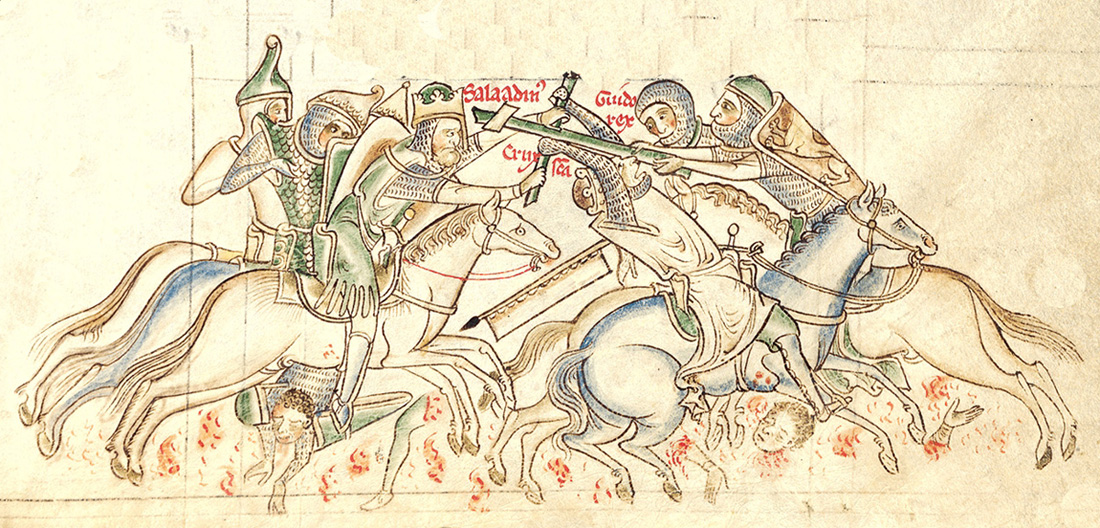
Amalric I died in July 1174 when Baldwin was thirteen. The boy was crowned within four days. The regency was held first by Miles of Plancy (assassinated in October 1174 in mysterious circumstances) and then by Raymond III of Tripoli, the king's senior cousin, who governed competently until Baldwin came of age at fifteen. From 1176 Baldwin attempted to rule personally, although by then the visible symptoms of his leprosy — facial disfigurement, loss of fingers, blindness in one eye — were progressing rapidly.

Saladin
The strategic situation Baldwin inherited was profoundly worse than his father had left. Saladin, having abolished the Fatimid caliphate in 1171, was now master of Egypt, and after the death of his nominal overlord Nur ad-Din in May 1174 he set about uniting the Muslim Levant under his personal rule. Between 1174 and 1183, in a sequence of campaigns and political marriages, Saladin took Damascus, Aleppo (after a long stalemate), Homs, Hama, Edessa, and substantial parts of the Jazira. By 1183, for the first time since the First Crusade, the Crusader states were surrounded on all sides by a single Muslim power. The unification of the Muslim opposition that the kingdom's strategists had feared since the time of Zengi was now complete.
Baldwin IV's military response, despite his disease, was vigorous and tactically successful. His greatest victory was at the battle of Montgisard, on the 25th of November 1177, a Crusader force of 375 knights and perhaps three thousand infantry, with the sixteen-year-old leper king carried in a litter, defeated a Saladin Egyptian army of perhaps thirty thousand near Ramla. The Crusader force, including most of the Templars from Gaza under their grand master Odo de Saint Amand, struck Saladin's army at the moment it was crossing a defile. Saladin escaped with difficulty; perhaps ninety percent of his army was killed or scattered. The Crusaders held religious processions in Jerusalem with the True Cross on the boy king's return. The victory bought five years of grace.
The court factions
The political problem of the leper king's reign was not military but dynastic. Baldwin could not marry — leprosy was, in medieval canon law, an impediment to a valid marriage — and therefore could not have a direct heir. The succession had to pass through his elder sister Sibylla (born 1160), who in 1177 was sixteen and would, by tradition, govern the kingdom through her husband. Two factions formed at court around her marriage and remarriage. The native baronial party, led by Raymond III of Tripoli, William of Tyre, and the kingdom's senior office-holders, favoured experienced military husbands of established Frankish settler families. The court party, led by the king's mother Agnes of Courtenay and her younger brother Joscelin III of Edessa, favoured Western European newcomers who would owe their position to royal patronage rather than to the local barons. The factional struggle defined the kingdom's politics for the next decade.
Sibylla's first husband, William of Montferrat ("Longsword"), arrived in the kingdom in October 1176 with the native baronial party's approval and died of malaria six months later. He left a posthumous son, Baldwin V, who would be a candidate for the throne in his own right. In 1180 the court party engineered Sibylla's remarriage to Guy of Lusignan, a Poitevin knight of modest reputation, in defiance of the High Court's preference. Guy was a divisive figure (the contemporary chronicler Ernoul, writing for the baronial party, described him in deliberately unflattering terms; modern historians have been more sympathetic, but the contemporary record is hostile). The marriage produced a permanent breach between the court and the baronial party that would shape the kingdom's strategic decisions for the next seven years.

The truce and the breaches
Baldwin IV concluded a series of truces with Saladin between 1180 and 1185, partly to give himself time to settle the succession and partly because the kingdom's military resources were strained by simultaneous defensive needs on all frontiers. The truces were broken, repeatedly, by Raynald of Châtillon, the lord of Oultrejourdain — the desert frontier territory south-east of the Dead Sea — whose castles at Kerak and Montreal overlooked the caravan routes between Egypt and Syria. Raynald, who had spent sixteen years as a Muslim prisoner at Aleppo (1160-1176) and emerged with an indelible personal hatred of his former captors, used his frontier position to attack Saladin's caravans, including pilgrim caravans to Mecca. In 1182-1183 he launched a notorious naval expedition into the Red Sea, threatening Mecca and Medina themselves — a religious provocation Saladin could not let pass.
Baldwin IV died on the 16th of March 1185, aged twenty-four, of complications from his leprosy. His final years had been spent fully blind, carried in a litter, but mentally alert and continuing to direct policy. He had nominated his eight-year-old nephew Baldwin V (Sibylla's son by William of Montferrat) as his successor, with Raymond III of Tripoli as regent. Baldwin V died sixteen months later, in August 1186, of unknown causes — almost certainly of natural illness, although the timing has invited later speculation. The High Court was now required to choose a new monarch from the available adults. The candidate selected, by the court party in a coup against the regency, was Guy of Lusignan as king consort of his wife Sibylla.
The disputed succession of August 1186 — Sibylla and Guy crowned by the court party at Jerusalem, the baronial party preparing to recognise Isabella (Baldwin IV's younger half-sister) and her husband Humphrey IV of Toron as the rival royal couple — was prevented from becoming a civil war only when Humphrey, lacking ambition, refused to be crowned and made his obeisance to Guy. The kingdom now had Guy as its king and Saladin as its irreconcilable adversary on the eastern frontier. Within ten months, on the 4th of July 1187, the Crusader army of the Kingdom of Jerusalem would be destroyed in a single afternoon at a place called the Horns of Hattin. The next chapter follows it.
End of Chapter IV