Foreword
A French kingdom
in the Levant.
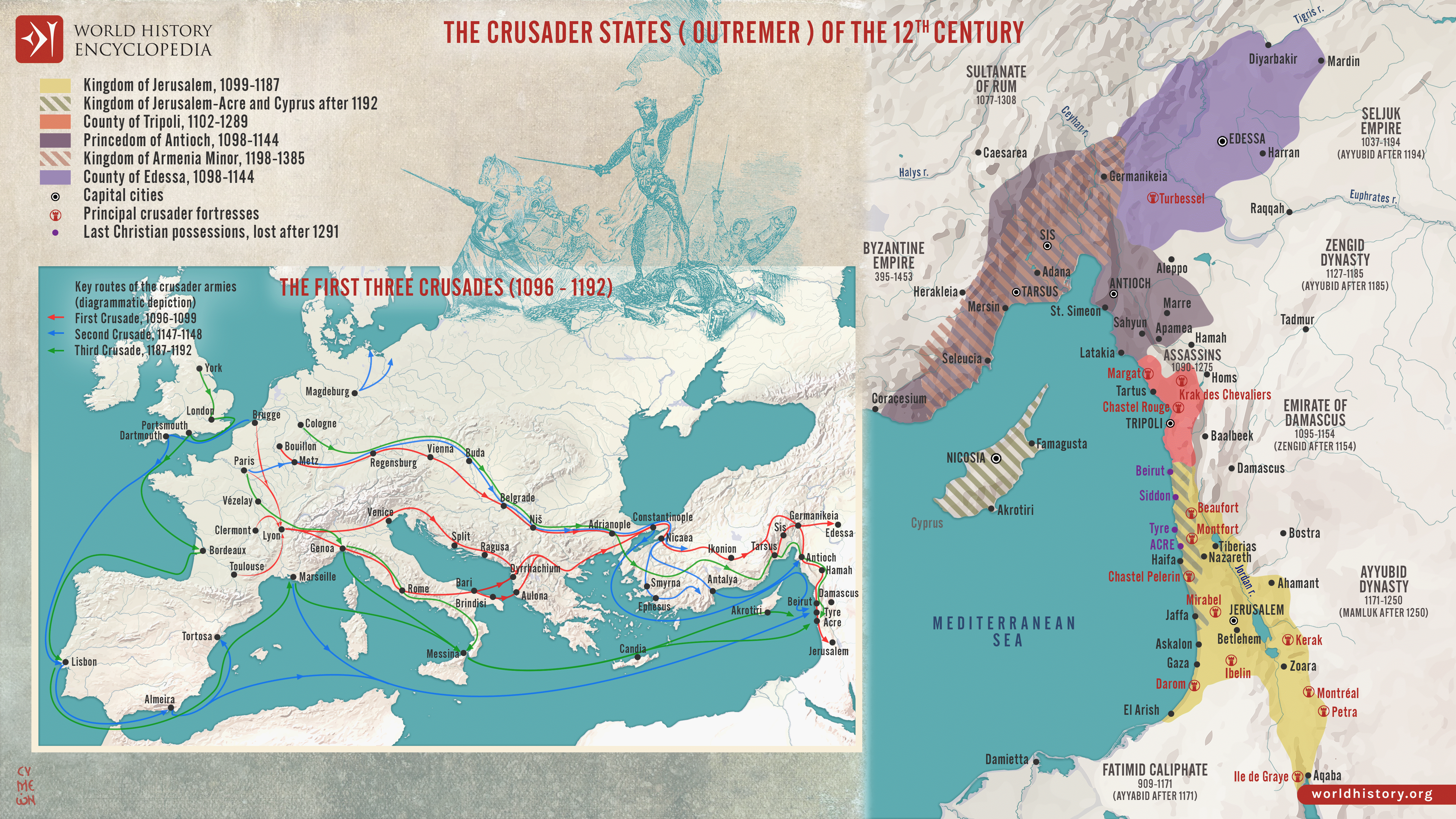
The four crusader states established between 1098 and 1109 — the County of Edessa, the Principality of Antioch, the County of Tripoli, and the Kingdom of Jerusalem — were, for two centuries, the only Christian polities in the Middle East under European rule until the late nineteenth century. They have been variously interpreted: as the first European colonial enterprise, as a religious aberration, as a creative cultural synthesis, as a brutal occupation. They were all of these things at different moments and to different people. This volume is principally about the largest and longest-lived of them, the Kingdom of Jerusalem.
The Kingdom of Jerusalem was founded on the 15th of July 1099, when the First Crusade's army stormed the walls of the Holy City after a five-week siege. It was officially called, in its own Latin chancellery, the Regnum Hierosolymitanum — the Kingdom of the Jerusalemites — though the Latin chronicles often used the briefer term. Its formal capital was Jerusalem from 1099 to 1187, and the coastal city of Acre from 1191 to 1291 (the title "King of Jerusalem" was retained throughout, although the city itself was held by the kingdom for less than seven of those last hundred years). At its height in the 1170s the kingdom controlled most of modern Israel, the West Bank, Lebanon, and the coastal strip of Syria, with the four crusader states between them ruling from Antioch in the north to Aqaba on the Red Sea. At its end it controlled only the city of Acre and a small surrounding strip.
This volume is, like the others, written as long-form editorial prose rather than as a chronological catalogue. The political history of the kingdom — the kings, the assemblies of the High Court (Haute Cour), the marriages, the assassinations, the campaigns — is dealt with in the first eight chapters. The two final chapters deal with the social and material culture of the kingdom (the great castles, the multilingual urban society of Acre, the assimilated Frankish settler class that nineteenth-century historians called the poulains — the "young ones," the European-Levantine hybrid) and with the kingdom's afterlife: the long Cypriot exile, the persistence of the Jerusalem royal title in European heraldry into the modern period, and the physical traces of the kingdom that survive in fifteen countries today.
One terminological caveat. This volume uses the word "crusader" because it is the standard English term for the European armed pilgrims who established and defended the kingdom. The word is a back-formation from the Latin crucesignatus ("one who has taken the cross"); it was not used by the participants themselves, who described themselves as pilgrims (peregrini) or as soldiers of Christ (milites Christi). The Muslim chronicles called them al-Faranj — the Franks — without regard to actual ethnic origin (the kingdom's population came from across Europe). Both terms are used here, depending on context.
"Deus vult — God wills it." — traditional cry at Clermont, 27 November 1095; first recorded a generation after the council