The proximate cause of the disaster of 1187 was Raynald of Châtillon's raid, late in 1186, on a Muslim caravan crossing through his lordship of Oultrejourdain. The raid was a deliberate breach of the existing four-year truce with Saladin; the caravan was attacked, its escort killed, its passengers (including, according to one account, a sister of Saladin) taken prisoner. Saladin demanded reparations; King Guy of Lusignan ordered Raynald to pay; Raynald refused. Saladin took the breach as legal justification for a full-scale invasion of the kingdom and issued the call for general jihad in early 1187. By June he had assembled an army at the Tiberias plain — perhaps thirty thousand men, including a strong contingent of Mamluk regular cavalry and substantial numbers of mounted archers — and crossed the Jordan into Crusader territory.
The decision
The Frankish army that mustered at Saffuriyya in the upper Galilee on the 1st of July 1187 was the largest the kingdom had ever assembled: about 1,200 knights, perhaps 4,000 light cavalry (the so-called Turcopoles, locally recruited mounted troops in Frankish service), and 15,000 infantry. Almost every fighting man in the kingdom was present. The position at Saffuriyya was a strong one — well-watered, with springs sufficient for the whole army, on high ground commanding the approach from Galilee to the coast.
The strategic question facing the army's command council on the night of the 2nd–3rd of July was whether to remain at Saffuriyya, letting Saladin's army exhaust itself in offensive operations in waterless country, or to advance to relieve the small Crusader garrison at Tiberias, which Saladin's army had besieged on the 2nd of July. Raymond III of Tripoli — whose wife Eschiva was actually in the Tiberias citadel — argued for remaining at Saffuriyya, on the explicit grounds that Tiberias could be retaken after Saladin's army had withdrawn, and that the survival of the kingdom mattered more than the safety of his own wife. The Templar grand master Gerard of Ridefort and Raynald of Châtillon argued for an immediate march. King Guy, after initially accepting Raymond's advice, was persuaded — overnight, by Gerard's accusations of cowardice — to reverse the decision. The army left Saffuriyya on the morning of Friday the 3rd of July, marching east toward Tiberias across waterless basalt country in the high summer heat.

The battle
The march of the 3rd of July was conducted under continuous harassing attack by Saladin's mounted archers. The Frankish column, encumbered with infantry and baggage, made about twenty kilometres before its water was exhausted. The army camped overnight on a high plateau called the Horns of Hattin, a couple of kilometres west of the Sea of Galilee — without water, in oppressive heat, surrounded by Muslim forces. Saladin's troops set fire to the dry summer grass on the plateau through the night; the smoke from the fires drifted into the Frankish camp.
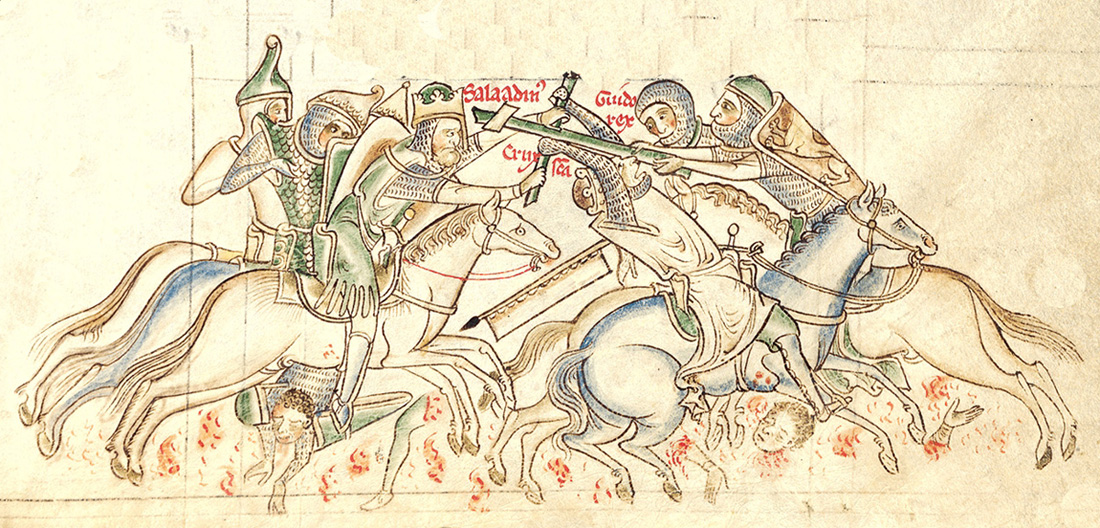
The battle on the morning of Saturday the 4th of July 1187 lasted perhaps six hours. The infantry, demoralised by thirst, broke first; many of them surrendered or were cut down. The knights, fighting under the True Cross which the bishop of Acre had carried out with the army, attempted three desperate cavalry charges to break through the encircling Muslim forces. Raymond III of Tripoli's contingent succeeded in breaking through on the third charge and escaped north (Raymond himself escaped to Tripoli, where he died of pleurisy three months later — many in the kingdom blamed him for the defeat, though by all serious analysis he had argued against the march that produced it). Most of the other Crusader knights were captured or killed. King Guy of Lusignan was captured alive. So was Raynald of Châtillon. So was the True Cross. The relic was sent to Damascus, where it was held until 1229 and was then taken further east; it never reappeared, and is, on the best modern analysis, the True Cross's last historical mention.
Saladin's treatment of his prisoners was an early indication of his political style. Most of the captured knights were ransomed in the months that followed. The two Templars and Hospitallers captured at the battle were executed by Sufi volunteers from Saladin's army on his orders, as enemies of the faith. King Guy himself was treated honourably: Saladin offered him water in his tent and reassured him of his life. Raynald of Châtillon — the breaker of the truce — was personally beheaded by Saladin, who is reported to have struck the first blow with his own sword in fulfilment of an earlier oath. Raynald was sixty-two.

The fall of the kingdom
The Crusader army was destroyed. The kingdom now had no field force to oppose Saladin's advance. The Muslim army moved rapidly. Acre surrendered on the 9th of July. Nazareth, Saffuriyya, Caesarea, Haifa, Sebastia, Nablus, Jaffa, Sidon, Beirut, Jubail, Ascalon — all surrendered between July and September 1187 with minimal resistance. The interior was almost entirely overrun within ten weeks. Only Tyre, on its rocky peninsula, held out against Saladin's attempts; the Genoese fleet had prevented its surrender and the recently arrived Crusader commander Conrad of Montferrat (a brother of Sibylla's first husband) was making it the rallying point for the kingdom's remnant.
Jerusalem itself was the symbolic prize and was Saladin's principal objective. His army arrived before the city on the 20th of September 1187. The garrison commander was the experienced baron Balian of Ibelin, whom Saladin had permitted to enter the city under safe-conduct to retrieve his family after Hattin and who had then, on the request of the patriarch, broken his safe-conduct to take command of the defence. (Saladin released him from his oath in a magnanimous gesture; the medieval West considered the move characteristic.) The defence held for two weeks. On the 2nd of October 1187 — by the date Saladin himself preferred, the anniversary of Muhammad's Night Journey to Jerusalem — Balian negotiated the city's surrender.
The terms were lenient by the standards of medieval siege warfare. The defenders were permitted to ransom themselves for ten dinars per man, five per woman, one per child, with a forty-day window in which to raise the money or be sold into slavery. The patriarchate paid the ransoms of many of the poor. About fifteen thousand were unable to pay and were sold; the rest — perhaps sixty thousand people, including the entire Frankish population of the city — were escorted by Saladin's troops to Christian-held territory. There was no massacre. The behaviour was compared, deliberately and publicly, with the massacre of 1099. The contrast was an important element in the medieval Muslim image of Saladin, and survived into the European medieval romance tradition (where Saladin was the model of the chivalrous Muslim knight, by the thirteenth century the protagonist of his own French verse romance).
The True Cross was lost. The city was in Muslim hands for the first time in eighty-eight years. The kingdom's territory was reduced to Tyre and a few isolated castles. The patriarchate, the High Court, and the chancellery moved to Tyre. The Latin Kingdom of Jerusalem as a state in the original Frankish territorial sense was, in the autumn of 1187, effectively over. What replaced it would be a different kingdom in a different city. That story is the next chapter.
"Have I not asked you to compose this affair? Have I not warned you that this man was an evil man and a breaker of oaths?" — Saladin to the captured King Guy, after beheading Raynald (Ibn al-Athir)
End of Chapter V