By late 1977 the Rhodesian government had concluded that the bush war could not be sustained on its existing terms. The economic indicators were poor (real GDP had contracted three percent in 1976 and again in 1977); the demographic indicators were worse (white emigration was running at about twelve thousand per year, against a base population of two hundred and forty thousand, with the most mobile and able-bodied departing fastest); and the diplomatic position was deteriorating (the new Carter administration in Washington had abandoned the Kissinger-era ambivalence toward Rhodesia and was actively pressing for a settlement that delivered majority rule). Ian Smith began, in October 1977, the series of conversations that would produce the so-called "internal settlement" — an attempt to construct a moderate, biracial Rhodesian government acceptable enough to both white settlers and a substantial part of the African population to forestall a Patriotic Front-led outcome.
The internal settlement
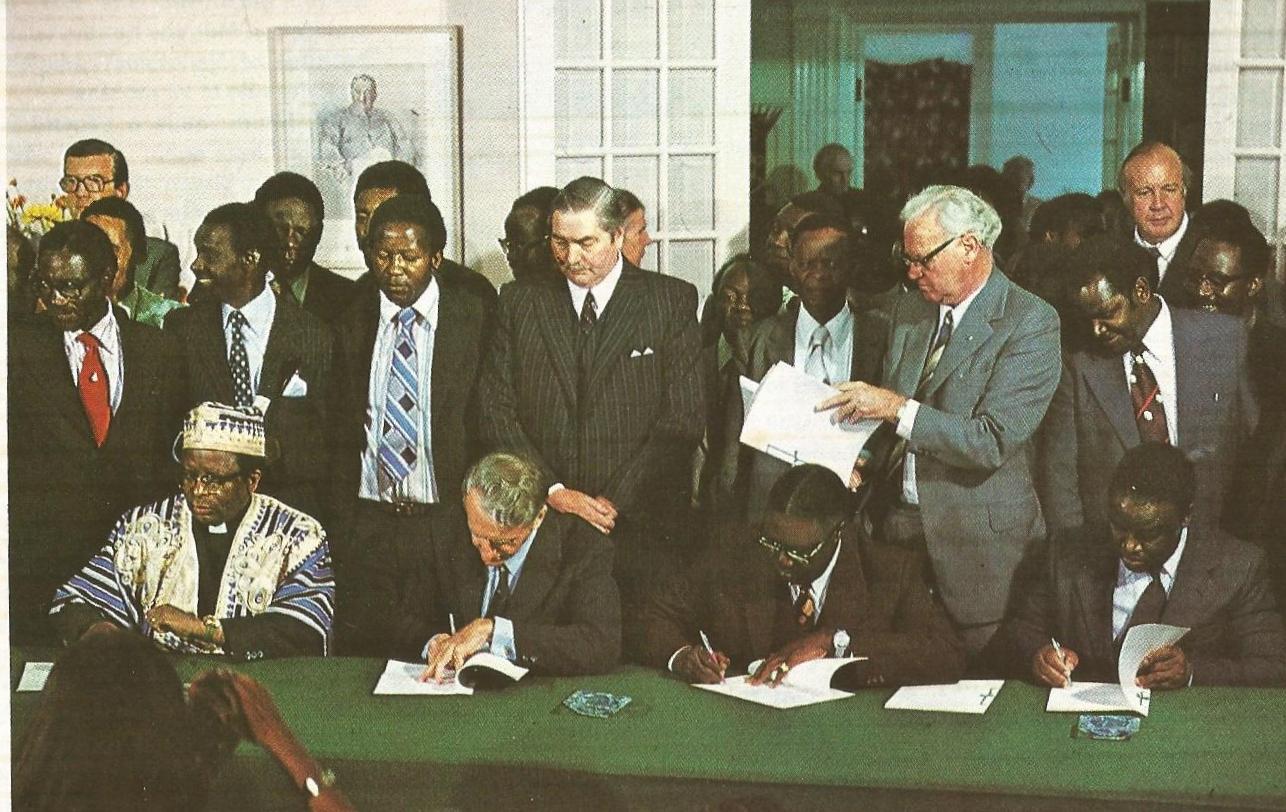
The internal settlement was announced on the 3rd of March 1978 as an agreement between the Smith government and three African political leaders: Bishop Abel Muzorewa of the United African National Council (a moderate Methodist clergyman who had emerged as a relatively conciliatory political voice), the Reverend Ndabaningi Sithole (the original founder of ZANU, now leading a domestic faction after being displaced by Robert Mugabe from the external ZANU leadership), and Chief Jeremiah Chirau (a Council of Chiefs leader representing traditional tribal authority). The agreement provided for a transitional Executive Council on which Smith, Muzorewa, Sithole and Chirau would sit as joint chairmen; an interim constitution that extended the franchise to all adult African Rhodesians; an election to be held in April 1979 on universal adult suffrage; the renaming of the country from "Rhodesia" to "Zimbabwe-Rhodesia"; and a transitional commitment to a long list of reserved positions for the white minority (28 reserved seats in a 100-seat Parliament, ten years of "blocking minority" rights over constitutional changes, protected positions in the civil service, the judiciary and the armed forces).
The reserved positions were the principal difficulty. They were designed to give the white population an effective veto over major constitutional change for the first decade of majority government — a structural protection that the existing Rhodesian electorate insisted upon and that no Patriotic Front government could possibly accept. The internal settlement therefore had to walk a narrow path: it had to be radical enough to attract internal African support, conservative enough to retain white acquiescence, and entrenched enough to survive the inevitable Patriotic Front pressure for further change after independence. It would, in the end, be too radical for one side and not radical enough for the other.
The April 1979 election
The election under the transitional arrangements was held on the 17th to 21st of April 1979. The franchise was universal adult suffrage for the first time in Rhodesian history; turnout was about 64 percent of registered voters; international observers (mostly American, although Britain refused to send any) judged the conduct of the election as generally fair. The Patriotic Front (ZANU-PF under Mugabe, ZAPU under Nkomo) boycotted the election from their exile bases and called on the African population to stay away from polling stations; the call was widely ignored. The result was a substantial majority for Muzorewa's United African National Council, which won 51 of the 72 African-roll seats; the Rhodesia Front took all 28 of the white-roll seats; minor parties took the balance.
Muzorewa was sworn in as the first Black Prime Minister of Zimbabwe-Rhodesia on the 1st of June 1979. The new constitution took effect; Smith stepped down from the premiership (he became a minister-without-portfolio in Muzorewa's cabinet); a Black Cabinet majority was formed for the first time in the country's history; the country's symbolic apparatus was modified (a new flag, a new anthem). The election would, in any other context, have been described as a decisive transition of power. In this context, however, almost no country in the world was willing to recognise the new arrangement. The United Kingdom and the United States refused to lift sanctions; the United Nations refused to acknowledge the constitutional change; the Organisation of African Unity rejected the internal settlement; the Patriotic Front rejected it; the front-line states rejected it. The Soviet Union, predictably, also rejected it. China rejected it. Even South Africa — which had quietly supported the settlement — did not recognise it formally.
Why nobody recognised it
The international rejection of the internal settlement reflected three converging judgements. The first was that the reserved-seat constitutional structure made the new government ineffective in real terms — that despite the Black Prime Minister, the existing security apparatus, civil service, judiciary and economy remained under substantially white control through reserved positions, and that this did not represent a genuine transfer of sovereignty. The second was that the bush war would not stop until the Patriotic Front was included in any settlement; an election held without ZANU and ZAPU could not, by definition, produce a peace, and a peace was what the international community wanted more than a constitutional formula. The third was a more political judgement: the Carter administration and the Callaghan British government had committed themselves, through 1977 and 1978, to a settlement involving the Patriotic Front, and they could not now accept a non-PF outcome without losing diplomatic face with the front-line states.
The result was the strange six-month government of Bishop Muzorewa — internationally unrecognised, militarily unable to end the bush war (which intensified through 1979 as the Patriotic Front responded to the new constitution by escalating its operations), and unable to secure international sanctions relief. By August 1979 it was clear that Muzorewa's government could not survive without international recognition, and that international recognition would require a new conference at which the Patriotic Front would be present.

Margaret Thatcher and the Commonwealth conference
The new British Conservative government of Margaret Thatcher, elected in May 1979, had campaigned on a position that was sympathetic to the internal settlement and that initially appeared likely to recognise it. The Thatcher government's first foreign-policy crisis was the Lusaka Commonwealth Conference of August 1979, at which Thatcher was directly confronted by the African Commonwealth leaders (especially Julius Nyerere of Tanzania and Kenneth Kaunda of Zambia) over the Rhodesian question. The diplomatic pressure was substantial. By the end of the conference Thatcher had reversed her position and agreed to convene a new constitutional conference involving all parties — including the Patriotic Front — to negotiate a settlement that the international community could accept.
The new conference was scheduled for September 1979 at Lancaster House in London, under the chairmanship of the Foreign Secretary Lord Carrington. Muzorewa, in Salisbury, accepted the invitation. The Patriotic Front, in Maputo and Lusaka, accepted the invitation. Smith and the Rhodesia Front, although deeply sceptical, accepted as part of Muzorewa's delegation. The talks would last fourteen weeks and would produce, in December 1979, the constitutional settlement that would finally end the country.
Zimbabwe-Rhodesia, the country that had existed under that name for six months, would end on the 12th of December 1979 with the return of Rhodesia (the older name) under temporary British administration. Rhodesia itself would end on the 17th of April 1980 with the inauguration of Zimbabwe. The internal settlement had been, in retrospect, an attempt to construct a moderate alternative to the Patriotic Front that simply did not have the international support to survive.
End of Chapter VII