The Central African Federation of Rhodesia and Nyasaland — formally constituted on the 1st of August 1953 and formally dissolved on the 31st of December 1963 — was the British government's attempt to construct a multi-racial, multi-colony federal state in central southern Africa as a counterweight to the consolidating power of apartheid South Africa to the south and the various decolonising states to the north. It was, on paper, an imaginative constitutional experiment: three colonies (Southern Rhodesia, Northern Rhodesia, Nyasaland) joined under a federal government in Salisbury, with shared currency, customs, defence and federal services, while each territory retained its own constitution for internal affairs. It was, in practice, a ten-year failure. Its principal lesson — for the white settler population of Southern Rhodesia — was that British policy could not be relied upon to defend white-minority interests indefinitely. From that lesson, in 1965, came UDI.
The federal proposition
The federation was advanced by British conservative governments in the early 1950s for several converging reasons. First, the British Treasury wanted to consolidate the substantial copper revenues of Northern Rhodesia with the agricultural and industrial economy of Southern Rhodesia, creating a financially self-sustaining unit that would not require London subsidies. Second, the southern Rhodesian settler establishment wanted political linkage to the wealthier copper-mining north to reduce its dependence on London. Third, the British government wanted to create, in central Africa, a moderate alternative to the rapidly consolidating apartheid government in South Africa, which had won power in 1948 and was pursuing increasingly aggressive policies of racial segregation. Fourth, the British government believed — wrongly, as it turned out — that a federal structure would allow African political development in Nyasaland and Northern Rhodesia to be channelled through the federation's institutions without producing the rapid decolonisation pressures that had broken India.
African political organisations in all three territories opposed the federation from the moment it was proposed. The Nyasaland African Congress, the Northern Rhodesian African National Congress, and the Southern Rhodesian African National Congress jointly issued a memorandum opposing federation in May 1953, on the grounds that it would consolidate white settler political dominance over the African majorities of all three territories, would transfer copper revenues from the substantially African Northern Rhodesian economy to the substantially white Southern Rhodesian economy, and would slow rather than accelerate African political development. The British government noted the objections and ratified the federation anyway.
How it worked, briefly
The federal government — based in Salisbury, with a Prime Minister (Roy Welensky from 1956), a Federal Assembly of 59 members (44 white, 15 African by reserved-seat arrangement), and a federal civil service — handled defence, foreign affairs, external trade, federal taxation, the post and telecommunications system, the railways, the federal university (later Rhodes University at Salisbury), and the federal capital itself. Each territory's own government handled "African affairs", local police, local administration, primary education, and land tenure.
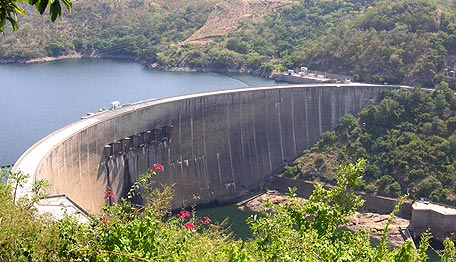
The federation produced, in its first five years, substantial economic growth. The Kariba Dam on the Zambezi was completed in 1959, creating what was then the world's largest artificial lake by volume; the federation's combined GDP grew about 8% per year between 1953 and 1957; the federal capital at Salisbury saw substantial new construction. The white population of all three territories grew rapidly: from about 240,000 in 1951 to about 320,000 by 1960.
Why it failed
What undermined the federation was the rising tempo of African political organisation. In Nyasaland, the African National Congress was banned in March 1959 after disturbances, but the resulting Devlin Commission of inquiry — appointed by the British government — produced a famous and damaging report in July 1959 that found the colonial response had created "a police state" in Nyasaland and that "almost the whole of the politically conscious African population" opposed the federation. The Devlin Report was the beginning of the British government's reassessment of the federal project.
The reassessment moved quickly. The 1960 Monckton Commission (appointed at the federal government's request to review the federation's constitution) reported that the federation could not be sustained without substantial African political concessions in both Northern Rhodesia and Nyasaland, which the federal government refused to make. Conferences in 1960 and 1961 produced, against federal opposition, new constitutions for Nyasaland (which moved decisively toward African majority rule) and Northern Rhodesia (which moved more slowly in the same direction). By the end of 1962, both territories had elected African majority governments. The federation's constitutional foundation — three territories, all proceeding at the same pace — had collapsed.
The British Conservative government, under Harold Macmillan and then Alec Douglas-Home, decided in 1963 to dissolve the federation. The dissolution took effect on the 31st of December 1963. Northern Rhodesia became independent as Zambia in October 1964; Nyasaland became independent as Malawi in July 1964. Southern Rhodesia, with its substantial white settler population and its long history of separate self-government, was left as a residual colony with an unresolved constitutional question: at what pace, and on what terms, would the franchise be extended to the African majority?

The Rhodesia Front
The Southern Rhodesian general election of December 1962 — held in the federation's final year, on the existing whites-only franchise — was won by the newly formed Rhodesia Front, a settler-conservative party committed explicitly to opposing African majority rule and, implicitly, to independence on the existing white-minority constitutional basis. The Rhodesia Front took 35 seats in the Legislative Assembly to the United Federal Party's 15. The party's first leader, Winston Field, became Prime Minister.
Field's tenure was short. In April 1964 the Rhodesia Front caucus replaced him with Ian Douglas Smith, a wartime RAF veteran and tobacco farmer from Selukwe (modern Shurugwi) in central Rhodesia. Smith was forty-five years old, a quiet and somewhat introverted man, an effective public speaker in a flat low-key style, and politically committed to the proposition — which the Rhodesia Front had won the 1962 election on — that the Rhodesian white population had earned the right to determine its own constitutional future without external interference. Within eighteen months Smith would issue the Unilateral Declaration of Independence, and the country's constitutional improvisation period would be over.
Before that, however, came a year of negotiation: between Smith's Rhodesian government in Salisbury and Harold Wilson's Labour government in London, between Smith and the African nationalist leaders Joshua Nkomo and Ndabaningi Sithole (both already in detention), and between Smith and his own caucus. The negotiation reached an impasse in late October 1965. UDI followed on the 11th of November.
End of Chapter III