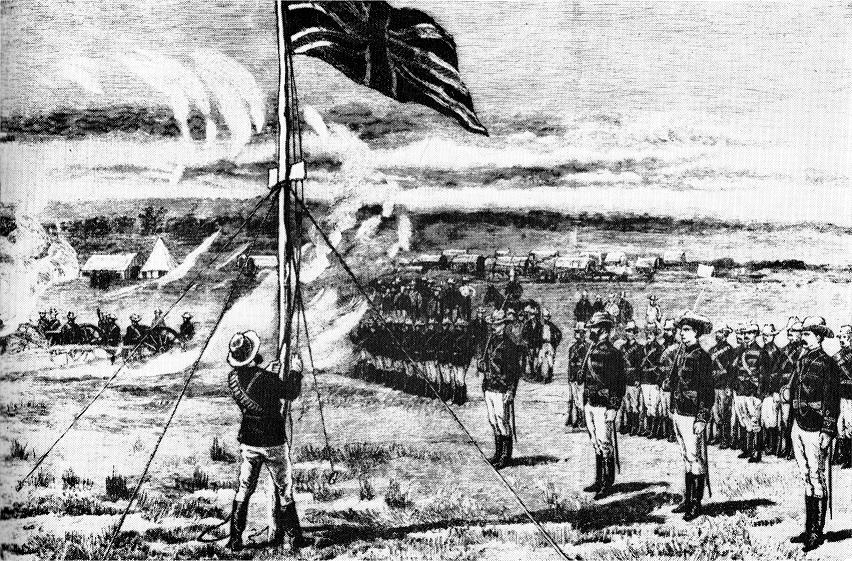
On the 13th of September 1890, a column of two hundred British settlers and five hundred mounted police, accompanied by wagons and oxen and a small steam locomotive disassembled for transport, crossed the Limpopo river into what is now southern Zimbabwe. They had set out from Macloutsie in modern Botswana three months earlier; they had been recruited at Cape Town the year before; their wages and equipment were paid for by a private company chartered under the laws of the United Kingdom and operating, in effect, as a sovereign authority — the British South Africa Company, with its head office at 2 Saint Swithin's Lane in the City of London. The column raised the Union Jack at a place they called Fort Salisbury, after the Prime Minister of the United Kingdom, the Marquess of Salisbury. The site is the centre of what is now Harare, the capital of Zimbabwe. The country they founded that morning was, for the next ninety years, called Rhodesia, after Cecil John Rhodes, the company's founder and its largest single shareholder.
Rhodes
Cecil Rhodes was, in 1890, thirty-seven years old, the second-richest man in the British Empire, the Prime Minister of the Cape Colony, the founder of the De Beers diamond mining company, the owner of the Goldfields of South Africa gold-mining venture, the Privy Counsellor for Imperial Affairs, and the holder of a Royal Charter granting his private company the right to administer, settle, exploit and tax a territory the size of France in what was then southern Africa. He had been born in 1853 in the English market town of Bishop's Stortford, the son of a clergyman. He had arrived in southern Africa at seventeen, in pursuit of cures for a chronic lung condition. He made his initial fortune at the Kimberley diamond fields between 1871 and 1880; he consolidated the diamond industry between 1880 and 1888 by buying out his competitors (De Beers Consolidated Mines, founded 1888); he expanded into gold at the Witwatersrand boom from 1886 onward; and he turned to the territorial ambition that would consume the last decade of his life: the construction of a continuous British-administered land corridor from the Cape to Cairo.
The Cape-to-Cairo project was an idea that Rhodes had absorbed from the imperial geography of his Oxford undergraduate days and from the wider Victorian discourse on the strategic importance of railway corridors. The argument was: a British-controlled railway running from Cape Town to Cairo would connect every major settler and mining colony on the African continent, would make the British Empire continuous from the Mediterranean to the Indian Ocean, and would lock out French and Belgian ambitions in central Africa. The argument was strategically incoherent (there was no obvious commercial market for a 9,000-kilometre rail line in 1890) and depended on the prior assumption that the African polities along the route would either consent to being absorbed or be incapable of resisting absorption. Rhodes believed both. He set about acquiring the lands.
The Rudd Concession
The key transaction was the so-called Rudd Concession of October 1888 — a document signed by Lobengula, the king of the Ndebele people, granting Rhodes's agent Charles Rudd "complete and exclusive charge over all metals and minerals situated and contained in [Lobengula's] kingdoms, principalities, and dominions". The document, in English, also granted "full power to do all things deemed necessary to win and procure the same", which would later be interpreted by Rhodes's company to authorise the settlement of the country and the construction of fortified posts. In return, Lobengula was promised £100 per month, a thousand Martini-Henry rifles with ammunition, and a Zambezi gunboat (which was never delivered).
Lobengula, who could not read English, signed the concession after assurances from Rudd that only ten men would come into the country to dig — assurances that turned out, of course, to be false. When Lobengula later realised what he had signed, he formally repudiated the agreement; the British government, in a formal response from the Colonial Office, told him the repudiation had no legal effect. The Rudd Concession, however dubious its provenance, was the legal instrument on which the British South Africa Company's Royal Charter of October 1889 was based.
The First Matabele War — 1893
The Ndebele kingdom did not accept the Company's settlement passively. Disputes between Ndebele cattle-raiding parties and Company settlers in 1893 produced the First Matabele War, a three-month campaign in October–December 1893 in which a Company column of about 700 men — armed with five Maxim machine-guns, which would here be used in combat for the first time — destroyed the principal Ndebele impis (regiments) at the battles of Shangani (25 October) and Bembesi (1 November). Lobengula's capital at Bulawayo was burned. He fled north, died of smallpox in January 1894, and was buried in an unknown grave somewhere in the Matobo Hills. The Ndebele state was abolished; its cattle were confiscated; its land was distributed to white settlers; the survivors were assigned to two reserves, Gwaai and Shangani, in marginal land north and west of Bulawayo.
The First Chimurenga — 1896
In March 1896 the Ndebele rose in revolt, joined three months later by the Shona people of Mashonaland. The rising — known in Zimbabwean memory as the First Chimurenga, "the first liberation war" — lasted eighteen months. It killed approximately 400 white settlers (about one in six of the white population at the time) and was suppressed only by an extended and brutal Company counter-insurgency campaign that killed perhaps 10,000 African civilians and combatants. The Company's relief expedition was led, in part, by Lt-Col Robert Baden-Powell (later founder of the Scout movement). The pacification produced the indaba at the Matobo Hills in August 1896, where Rhodes himself negotiated terms with the surviving Ndebele indunas (chiefs). The terms included a substantial concession: African chiefs would retain ceremonial authority, certain lands would be reserved for African use (which became the basis of the later "Tribal Trust Lands" reserve system), and the Company would refrain from collecting hut-tax from any chief who acknowledged Company sovereignty.
The terms were not entirely honoured, but they constituted the first negotiated rather than imposed settlement in the country's colonial history. Rhodes — who had asked to meet the chiefs unarmed and alone in the Matobo wilderness — produced a moment of personal-political symbolism that he immediately monetised: he subsequently arranged to be buried in the same hills, on a granite rock he called View of the World, at his death in 1902. His grave is still there.

Company rule, 1890–1923
From 1890 until 1923 the country was governed by the British South Africa Company under its Royal Charter — making it one of only three African territories ever administered by a private chartered company in the modern era (the others being the Royal Niger Company in Nigeria, until 1900, and the Imperial British East Africa Company, until 1895). The Company's administration was thin: a Senior Administrator at Salisbury, a small police force (the British South Africa Police), a Legislative Council that included elected white settlers from 1898 onward, and a judiciary that operated under English common law. African affairs were administered separately, through the system of indirect rule via "headmen" appointed by the Company in each district.
The white settler population grew steadily — from about 1,500 in 1891 to about 35,000 by 1923. The economy was tobacco (planted from the early 1890s, dominant by 1920), maize, beef cattle, and mining (gold and chrome in particular; the diamond boom that Rhodes had hoped for never materialised). A rail line was completed from Cape Town to Salisbury (1899) and from Salisbury to Beira on the Mozambican coast (1899); the Victoria Falls Bridge across the Zambezi was completed in 1905, the only piece of the Cape-to-Cairo railway that was actually built. Rhodes himself died in March 1902 at his Cape Town residence — of complications from heart disease, aged forty-eight. The country survived him by seventy-seven years.
In 1923, after a referendum in which the settler population was asked to choose between joining the Union of South Africa or becoming a self-governing British colony, they voted by 8,774 to 5,989 for the self-governing colony option. The Company's charter was wound up; Southern Rhodesia became a self-governing colony of the British Crown, with a Legislative Council elected by the white settler population. The structural framework that would, forty-two years later, produce the Unilateral Declaration of Independence was now in place.
End of Chapter I