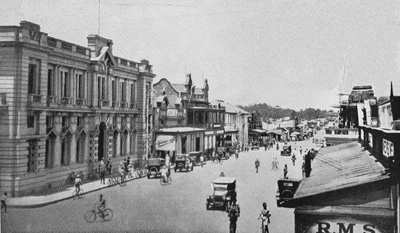
From the 1st of October 1923, when the British South Africa Company's charter formally lapsed, until the 1st of August 1953, when Southern Rhodesia entered the Central African Federation, the country was a self-governing British colony of an unusual constitutional kind. Its government was elected by a small franchise of about 18,000 white settlers; its laws were made by an elected Legislative Assembly in Salisbury; its head of state was a London-appointed Governor; the United Kingdom retained reserve powers over African affairs (specifically, the right to veto any Rhodesian legislation that "differentiated unfavourably" between the races, a power exercised only twice in the period). Day-to-day, Southern Rhodesia governed itself. It built schools, roads and railways for its white settler community; it tolerated almost none of the political development that British policy elsewhere in southern Africa was beginning to encourage among Black colonial subjects; and it accumulated, over three decades, the institutional and demographic patterns that would make a Black-majority constitutional settlement, when finally proposed by Britain, deeply unwelcome to the white population.
Tobacco
The dominant commercial activity of Southern Rhodesia from the 1920s onward was tobacco farming. The country's high savanna plateau (the highveld), with its red soils, its dry winters, and its summer rains, turned out to be one of the better tobacco-growing climates in the world. Flue-cured Virginia tobacco — the variety used in most cigarettes — became the country's largest single export by 1925. By 1939 about 130 million pounds (60,000 tonnes) were being produced annually; by 1960 nearly 300 million pounds. Most of it went to the British and Commonwealth tobacco market. The price per pound was high and the labour costs were low: a Rhodesian tobacco farmer in the 1930s could expect to earn ten to twenty times what the same scale of agricultural operation would have produced in the United Kingdom.
The tobacco boom shaped the country's social structure. White farmers settled in concentrated districts (the Mashonaland tobacco belt around Marondera and Mount Darwin); Black farm-labour was recruited from the Tribal Trust Lands reserves under labour contracts of one year, renewable, with housing provided by the farm; the railway network expanded to serve tobacco-loading depots; the auction floors of Salisbury became, by the 1950s, the largest single tobacco trading floor in the world after the United States. The Rhodesian tobacco economy was, in effect, an export-oriented plantation system, although the legal structure differed from that of the Caribbean or the American South in important respects.
Maize, cattle, mining
Tobacco was not the only export. Maize was the largest staple crop, with about half the production going to domestic consumption (especially the African urban population that was now growing in the mining and industrial centres) and half exported, particularly to South Africa. Cattle ranching was substantial in the lower-rainfall districts of Matabeleland; the country was a net beef exporter from 1930 onward. The mining industry — chrome, gold, asbestos, copper, lithium — was substantial but not dominant; total mineral exports were typically about a third of total agricultural exports by value through the interwar period.
The Land Apportionment Act, 1930
The single most consequential piece of legislation passed by the self-governing colony was the Land Apportionment Act of 1930. It divided the country's 390,000 km² between racially designated land categories: about 51% to white "European" use (the highveld, the most productive farming land); about 30% to "Native Reserves" (the Tribal Trust Lands, generally on the drier, lower, and less productive periphery); about 8% to "Native Purchase Areas" (where Black farmers with sufficient capital could buy farms freehold, subject to substantial restrictions); the balance to forest reserves, urban areas, and unassigned crown land. Within the "European" area, no African could lawfully own or rent land. Within the "Native Reserves", no European could lawfully own land. The act, intended to "protect" African land tenure from white speculation, in fact codified a racial geography that would, by the 1960s, leave 90% of the population on 30% of the country.
The Land Apportionment Act was, more than any other single Rhodesian law, the source of the political grievance that would drive the African nationalist movements of the 1950s and 1960s. It would also be one of the most difficult legacy issues for independent Zimbabwe after 1980, where the land question — which farms had been taken from which African families, when, and what was now to be done about it — would dominate domestic politics for the next forty years.

African political organisation
African political activity in this period was, by white settler standards, modest, but it existed. The African National Congress (Bulawayo branch) was founded in 1934; the Industrial and Commercial Workers Union of Rhodesia operated from 1928; the National Congress (Salisbury) was founded in 1957. These organisations operated under tight legal restrictions. They could not organise strikes. They could not publish unsubsidised newspapers in the African languages. Their leaders were periodically detained without trial under the Rhodesian Emergency Powers regulations. By the late 1950s, the main African political movement had divided into two strands: a moderate constitutionalist tendency seeking the gradual extension of the franchise (the original ANC line), and a more militant nationalist tendency demanding immediate majority rule.
The white settler population was, in this period, also politically diverse — split between the Rhodesia Party (later the United Federal Party, generally pro-imperial and pro-federation), the Rhodesia Front (a settler-conservative formation founded in 1962, later to be Ian Smith's party), and various smaller groupings. The political alignment that would, in 1962, give the Rhodesia Front a clear electoral majority was still in formation through the 1940s and early 1950s.
The Second World War
Southern Rhodesia contributed substantially to the Second World War in proportion to its white population: about 26,000 white men volunteered (out of a white male population of perhaps 35,000 of fighting age), and a roughly equal number of Black men served in the Rhodesian African Rifles and various auxiliary units. The country also hosted the Empire Air Training Scheme, which produced about 8,000 Allied pilots between 1940 and 1945. The wartime experience produced a generation of Rhodesian veterans — some of whom would later be in the Rhodesian government during UDI, including Ian Smith himself (RAF, shot down twice, prisoner of war, escaped). The wartime experience also produced economic prosperity: Rhodesian tobacco, maize and chrome exports surged, the budget went into surplus, and the white settler economy emerged from the war wealthier and more confident than it had been before it.
By 1953 the white population was about 135,000 (up from 35,000 in 1923) and the Black population was about 2.4 million. The federal arrangement with Northern Rhodesia (modern Zambia) and Nyasaland (modern Malawi), proposed by the British government as a regional accommodation between settler interests and African political development, was about to be tried. The country's politics were about to enter a much faster phase.
End of Chapter II