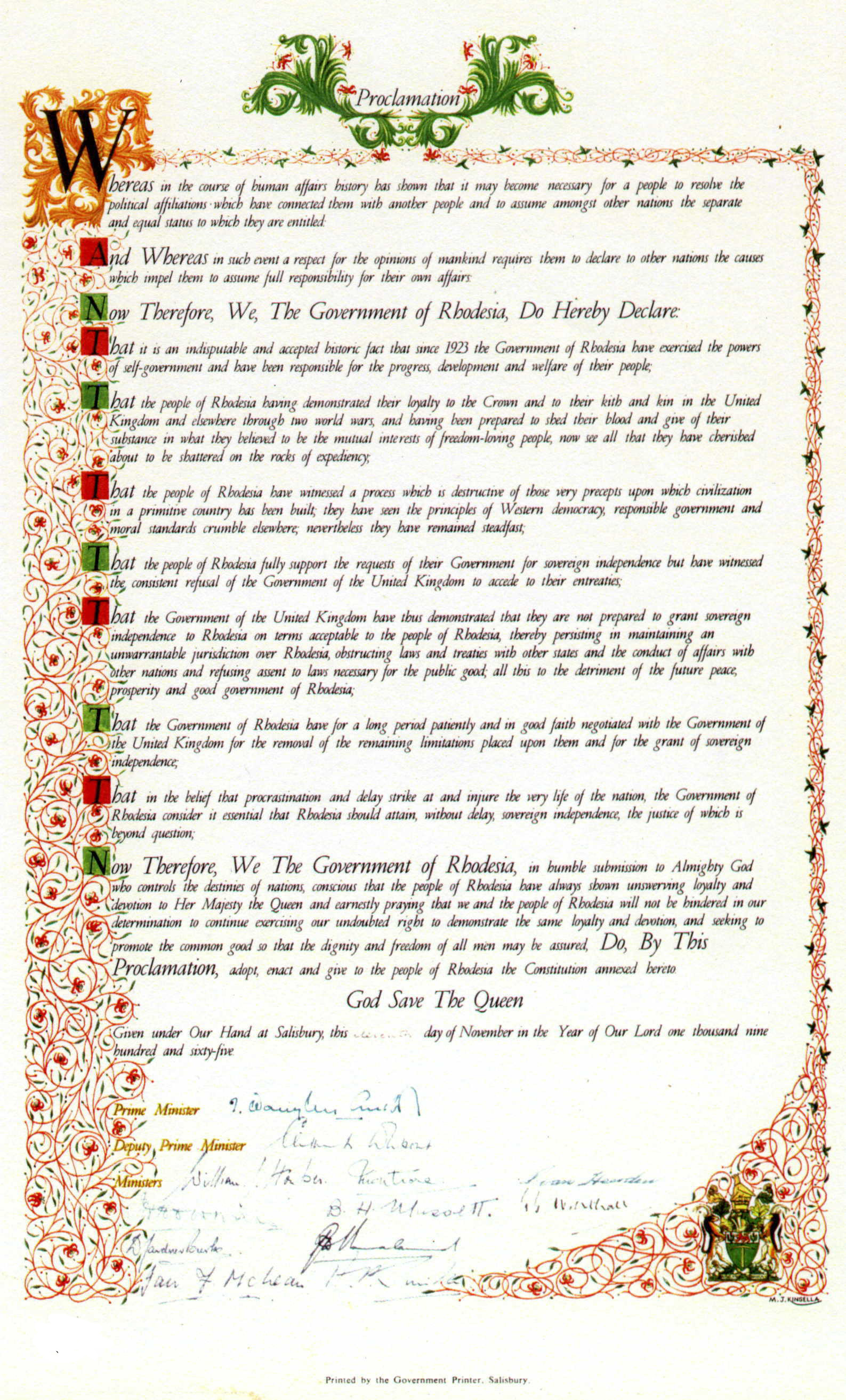
At one minute past eleven on the morning of the 11th of November 1965 — Armistice Day, deliberately chosen for its symbolism — Ian Smith and the eleven members of his Cabinet, in the conference room of the Prime Minister's office in Salisbury, signed a document that began: "Whereas in the course of human affairs history has shown that it may become necessary for a people to resolve the political affiliations which have connected them with another people". The phrasing was lifted almost verbatim from the American Declaration of Independence of 1776, which Smith and his ministers had read in advance with this purpose in mind. The Rhodesian Unilateral Declaration of Independence — the UDI — declared the country an independent sovereign state, dissolved the constitutional links to the United Kingdom, replaced "Her Majesty" with "Her Majesty in respect of Rhodesia" in domestic law, and explicitly retained the existing 1961 constitution with its restricted franchise. The eleven signatures were affixed by hand. The radio broadcast announcing the declaration went out at 1115 hours local time. Within minutes the British Prime Minister Harold Wilson, in London, had issued the statement that the action was "an act of rebellion against the Crown".
The negotiations
The UDI was the endpoint of fourteen months of negotiation. From April 1964, when Ian Smith became Prime Minister, until November 1965, when he signed the declaration, the British and Rhodesian governments had attempted to find a constitutional formula that would: (a) grant Rhodesia formal independence under its current constitutional structure; (b) commit the Rhodesian government to an eventual transition to African majority rule; and (c) provide guarantees that the transition could not be reversed by future Rhodesian governments. The two governments could not agree on the second and third terms. The Rhodesian position was that majority rule was not on the immediate agenda and that, in any case, no transitional commitments could be made because no future government could bind its successors. The British position — articulated by Wilson and his Commonwealth Secretary Arthur Bottomley in a series of communiqués through 1964 and 1965 — was that independence could not be granted on the existing constitutional basis because the franchise was too narrow.
The British government also imposed five preconditions for an independence agreement, known as the "Five Principles", and added a sixth in 1966 (the so-called NIBMAR principle, "No Independence Before Majority African Rule"). The Five Principles were: (1) unimpeded progress to majority rule, already enshrined in the 1961 Constitution, would have to be maintained and guaranteed; (2) there would have to be guarantees against any retrogressive amendment of the Constitution; (3) immediate improvement in the political status of the African population; (4) progress toward ending racial discrimination; (5) the British government would have to be satisfied that any basis proposed for independence was acceptable to the people of Rhodesia as a whole. The Rhodesian government accepted the first four; it disputed the fifth, on the grounds that the Rhodesian people had already voted (through their elected representatives) for independence on the existing basis. The disagreement was, ultimately, irreconcilable.
The act itself
At the Cabinet meeting on the morning of the 11th of November 1965, the agenda included a single item: the signature of the proclamation. The text had been drafted over the previous fortnight by the Attorney General Desmond Lardner-Burke and the Cabinet Secretary, working from the American declaration as a template. The proclamation was signed by Smith and the eleven ministers in alphabetical order; the document was witnessed by the Cabinet Secretary; a colour copy was prepared for public display. At noon Smith broadcast a fifteen-minute address on the Rhodesia Broadcasting Corporation, reading from a prepared text. The address closed with the words: "Let us be loyal to the principles which we believe in. Let us be loyal to the destinies of our people. Let us not be afraid. God bless you all".
The constitutional act of UDI was, in international law, a nullity. The British government's position — that Rhodesia remained a colony of the Crown, that its current government was illegal, and that any future government would also be illegal until restored on constitutional terms — was formally accepted by the United Nations General Assembly within days, by the Organisation of African Unity, and (eventually, although with substantial dissent) by every member state of the Commonwealth. No country, not even apartheid South Africa or Portugal (whose Mozambican colony bordered Rhodesia to the east), ever extended formal diplomatic recognition to the post-UDI Rhodesian government.

The first reaction
The British reaction was political rather than military. The British government considered, briefly, military intervention to overthrow the Smith government. The Royal Navy could have imposed a blockade; British infantry could have been flown in via Zambia; the small Rhodesian armed forces (a regular army of about 4,000 men, an air force of about 1,000 with mostly British-supplied aircraft) could not have resisted a serious British expeditionary force. Wilson concluded — correctly, on the basis of contemporary Cabinet discussions — that any British military action would have produced political consequences in the United Kingdom that he could not absorb. The Labour Party's left wing favoured intervention; the Conservative opposition opposed it; the British armed forces (which contained many Rhodesians and many Rhodesia-sympathetic personnel) were ambivalent. Wilson chose instead to impose economic sanctions and to pursue the political isolation of the Rhodesian government.
The sanctions were imposed by the United Kingdom unilaterally in November 1965 (oil, tobacco purchases, sterling area expulsion), extended to selective sanctions by the United Nations in November 1966, and converted to comprehensive mandatory sanctions in May 1968. The 1968 resolution — Security Council Resolution 253 — was the first time the United Nations had ever imposed mandatory comprehensive sanctions on a sovereign or quasi-sovereign state. The resolution was therefore a constitutional landmark in the history of the United Nations sanctions regime, even though its target — Rhodesia — proved able to evade it substantially for the next fourteen years.
The internal reaction
Inside Rhodesia, the white population's reaction to UDI was, by survey evidence at the time and oral history since, broadly enthusiastic. The Rhodesian general election of May 1965, held six months before UDI, had returned the Rhodesia Front with 50 seats out of 50 in the white electoral roll. The election of April 1965 (after UDI had been re-confirmed through an Indaba of chiefs and a token African referendum), produced similar results. The white settler population — many of whom were second- or third-generation Rhodesian, with substantial economic interests in the country, no realistic exit option, and a strong sense of having been let down by the British government — substantially supported the Smith government's position.
The African political organisations — the Zimbabwe African People's Union (ZAPU, under Joshua Nkomo) and the Zimbabwe African National Union (ZANU, under Ndabaningi Sithole and increasingly under Robert Mugabe from 1965) — were both proscribed and their leaders detained from August 1964 onward. The two organisations operated through underground structures inside the country and through political headquarters in Lusaka (Zambia) and later Maputo (Mozambique). They began, from 1966 onward, the slow process of organising guerrilla forces — ZIPRA (Zimbabwe People's Revolutionary Army, ZAPU's military wing) and ZANLA (Zimbabwe African National Liberation Army, ZANU's). The bush war was about to begin.
For the next fourteen years Rhodesia would be a country that did not, in any internationally recognised sense, exist — and that nonetheless ran a substantially normal national life. The next chapter is the story of that survival under sanctions.
End of Chapter IV