The economic sanctions imposed on Rhodesia were the first comprehensive mandatory sanctions regime in the history of the United Nations. They lasted fifteen years. They were, by every public measure of the time, meant to bring the Smith government down "within weeks rather than months" (the phrasing was Wilson's, in a House of Commons speech of January 1966). They did not. Rhodesia survived them through a combination of South African and Portuguese-Mozambican logistical support, ingenious domestic industrial substitution, oil delivered via Mozambican pipelines and Portuguese-flag tankers, tobacco smuggled into the South African and German markets through Maputo, and a population that genuinely believed they were on the right side of a moral question and was willing to absorb substantial economic costs to prove it. The sanctions period therefore reveals as much about the limits of multilateral economic coercion as it does about Rhodesia itself.
What the sanctions were
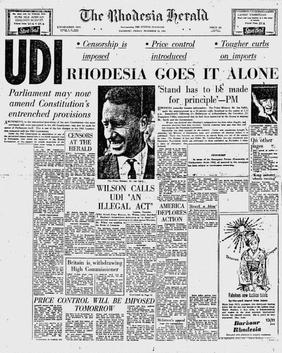
The original British sanctions of November 1965 covered tobacco, sugar, oil exports to Rhodesia, and Rhodesian access to the sterling currency area. The United Nations Security Council Resolution 217 of November 1965 called on member states to refrain from recognising Rhodesia. Resolution 232 of December 1966 imposed selective mandatory sanctions on Rhodesian exports (tobacco, asbestos, chrome, copper, meat, sugar, hides) and on certain imports (oil, arms). Resolution 253 of May 1968 extended sanctions to all Rhodesian exports and to all imports except those specifically humanitarian; it required all UN member states to take active steps to enforce them.
The enforcement was uneven. South Africa, although not a UN member state at this point in its history, was supposed by treaty to comply with the resolutions; in practice it did not, and the Rhodesian government's relations with the South African National Party government were close throughout the sanctions period. Portugal — itself under a different and lesser UN sanctions regime — controlled the Mozambican coast (especially the port of Lourenço Marques, now Maputo, and the railway link from Salisbury to Beira) and provided substantial transit infrastructure for Rhodesian trade. The United States complied with the sanctions formally but, in a notable exception, the 1971 Byrd Amendment authorised continued American imports of Rhodesian chrome on the grounds that the only alternative supplier was the Soviet Union. The Byrd Amendment was repealed in 1977 under the Carter administration.
How the sanctions worked in practice
The Rhodesian government adopted, from December 1965 onward, a comprehensive sanctions-evasion strategy known internally as "the Mozambique-South Africa option". Tobacco exports — the country's largest single foreign-exchange earner — were sold through a system of multiple intermediaries: Rhodesian tobacco was shipped to a Mozambican or South African port, repackaged as "African tobacco" (without country-of-origin labelling), and then re-exported to European and Asian markets that nominally observed the sanctions but did not look closely at the documentation. The German Federal Republic, in particular, was a major destination via this route — German cigarette manufacturers preferred Rhodesian flue-cured Virginia over the alternative supplies, and German customs authorities were not aggressive about origin verification.
Oil supply was the most strategically important sanctions-evasion operation. Rhodesia produced no oil; it consumed about 4 million barrels per year (12,000 barrels per day) of refined products. The supply came via two channels: (1) the Maputo-Salisbury pipeline, which carried refined product from the Lourenço Marques refinery to Rhodesia and was technically a sanctions violation but never closed; (2) tanker deliveries to Lourenço Marques from various points of origin (including the so-called "Bingham route" through Mozambique to Rhodesia, exposed in detail by the British Bingham Report of 1978). The British and other oil majors — Shell, BP, Mobil, Caltex — were substantially involved in the sanctions evasion, with the knowledge of their British and American governments, throughout the period. The Bingham Report, which documented the violation in detail, was published in 1978 and produced substantial embarrassment but no significant legal consequences.
The domestic economic effect
The sanctions did not collapse the Rhodesian economy. Real GDP growth between 1965 and 1974 averaged about 6% per year, slightly above the pre-UDI trend. Industrial production grew substantially, driven by import substitution: when sanctions blocked the supply of foreign manufactured goods, Rhodesian industry expanded to make domestic substitutes. The Rhodesian motor vehicle industry, which had assembled imported British and American cars before UDI, by 1972 was producing complete domestic vehicles (including the locally-designed Rhino armoured car and the Mazda-licensed locally-assembled passenger cars). The Rhodesian textile, chemical, electrical-goods, food-processing and pharmaceutical industries all expanded to fill the import gaps left by sanctions. By 1975 Rhodesia had become substantially self-sufficient in manufactured goods.
The cost of this self-sufficiency was substantial but absorbable: domestic prices rose roughly 50% in real terms between 1965 and 1975, primarily because domestic substitutes were less efficient than imports; living standards for the white population declined modestly; the budget went into chronic deficit, financed by domestic borrowing and South African capital lines; and the country's external debt — calculated for normal commercial purposes after independence — accumulated rapidly. But these effects were absorbable in the short and medium term. The sanctions did not, by themselves, win the political argument.

What the sanctions did not affect
One of the more striking features of the Rhodesian sanctions period is what was not affected. The Rhodesian armed forces — the Rhodesian Light Infantry, the Rhodesian African Rifles, the Selous Scouts, the SAS, the Air Force — were maintained at peak operational capability throughout the period. The country had a small but effective domestic arms industry (which produced the Rhodesian variants of the FN-FAL rifle, the locally-modified G3 rifle, several types of armoured vehicles, and improvised tactical equipment). The Air Force flew Hawker Hunter fighters, Canberras, Vampires, Provosts and (later) Cessna ground-attack aircraft, all maintained domestically with parts smuggled from South African and Israeli sources. The military intelligence services (Special Branch, the Central Intelligence Organisation under Ken Flower) were highly competent and produced detailed intelligence on the guerrilla forces operating against Rhodesia from Mozambique and Zambia.
The Rhodesian state retained, throughout the sanctions period, the institutional capacity that distinguished a state from a quasi-state — a functioning treasury, a coherent armed forces, a developed civil service, a Reserve Bank that operated against sustained external pressure, a national broadcaster, a postal service, a domestic legal system, and a public health and education system that — for the white population — operated to first-world standards.
It is worth being clear about what this analytic conclusion does not mean. It does not mean that the sanctions failed in their broader political objective; they did succeed, over time, in delegitimising the Rhodesian state internationally and in raising the costs of survival to a level that, in combination with the bush war, eventually forced political compromise. It does mean that economic sanctions, by themselves and on the time-frame Wilson and Bottomley imagined in 1965, did not work as expected. The political compromise that ended the Rhodesian state would come from the bush war, not from the customs forms.
End of Chapter V