The Day of Potsdam, on the 21st of March 1933, was a piece of theatre designed to make the new National Socialist regime look like the legitimate heir of the old Prussia. The Reichstag, which had been burned a month before, had been temporarily relocated to the Garrison Church in Potsdam — the same church in which Frederick the Great was buried, the same church whose foundations had been laid by the Soldier King in 1730. President Hindenburg, in his old field marshal's uniform with the bicorne hat, sat in the front pew. Chancellor Hitler, in a black frock coat, walked down the aisle behind him. The two men shook hands at the door of the Hohenzollern crypt. The photograph of this handshake — a senile old field marshal in imperial dress, a smiling Austrian autodidact in formal mourning — was distributed to every newspaper in Europe within hours. It was meant to signal that the new Germany was the old Germany. The new Germany would, over the next twelve years, demonstrate that nothing of the kind was true.

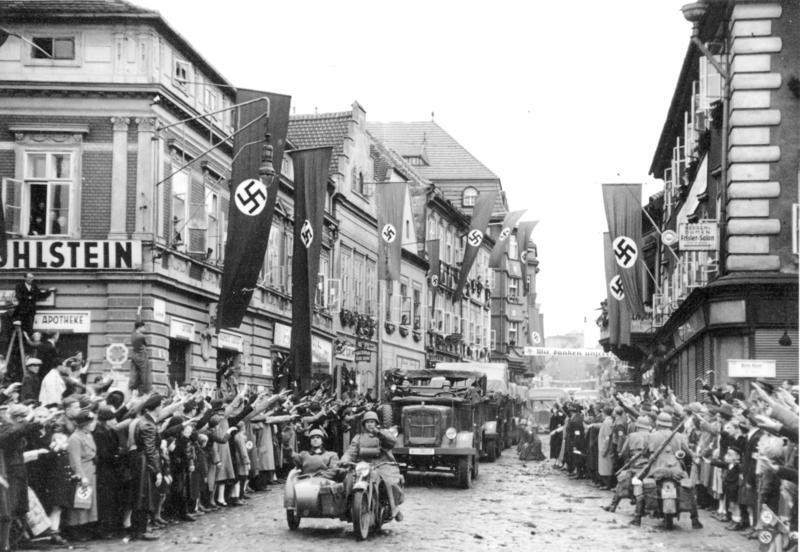
The actual abolition of Prussia as a meaningful political unit happened in stages over the following four months. In March 1933 the Prussian state parliament was dissolved by the Enabling Act. In April Hermann Göring, who had been Papen's Reich Commissioner for Prussia, was appointed Minister-President of the Free State; the post existed thereafter only as a personal honour for Göring, who held it until 1945. In July 1933 the regional administrative units of the Reich — the Gaue of the Nazi Party — were superimposed on the older Prussian provincial structure, with Party officials given executive authority that overrode the old provincial governments. By the spring of 1934 the Prussian ministries — Interior, Education, Finance — had been merged with their federal counterparts in a process called Gleichschaltung, coordination, that made Prussia indistinguishable from the rest of the Reich in administrative practice.
Prussia continued to exist on paper for another thirteen years. Its civil servants kept their letterheads. Its police kept their uniforms, briefly. Its parliament was a phantom. Its government had no powers that the Reich did not allow it. By the early years of the war it was, in any meaningful sense, already gone.
The plotters
And yet, paradoxically, the most consequential resistance to Hitler from within the German state came largely from old Prussian aristocrats.
The conspiracy that culminated in the bomb of the 20th of July 1944 had been gestating since 1938. Its architects were almost without exception products of the old Prussian gentry. Claus von Stauffenberg, who placed the bomb in the briefcase at Hitler's headquarters, was a Bavarian-born aristocrat married into the Lerchenfeld and Lehndorff families of East Prussia. Henning von Tresckow, the central conspirator within Army Group Centre, was a Pomeranian Junker. Ludwig Beck, the former Chief of the General Staff and the figurehead of the plot, was a Hessian general from a Prussian military family. Helmuth James Graf von Moltke, the leader of the Kreisau Circle, was the great-grandnephew of the field marshal who had won at Königgrätz and Sedan. Carl-Hans von Hardenberg, descendant of the reformer who had remade Prussia after Tilsit, hosted secret meetings of the plotters at his estate at Neuhardenberg. Peter Yorck von Wartenburg, of the family of the general who had defected from Napoleon at Tauroggen in 1812, was hanged in the same week as Stauffenberg.
The 20th of July plot was, in its sociology, a Prussian aristocratic conspiracy. The men who joined it did so for many reasons — Christian conviction, monarchical loyalty, professional military horror at what Hitler was doing to the army, personal acquaintance with the crimes in the east — but the network through which they communicated, the country houses in which they met, the regimental ties that bound them, the family names that link them to two and a half centuries of Prussian state service, were all Prussian. They were the last representatives of the old Prussian governing class as a political force. After their failure, in the weeks after the bomb, several thousand of them were hanged or shot. The People's Court of Roland Freisler hanged most of them with piano wire from meat hooks in the cellar of Plötzensee prison. Henning von Tresckow, knowing he would be unmasked, shot himself in the woods near the eastern front on the 21st of July. Stauffenberg was executed by firing squad in the courtyard of the Bendlerblock in Berlin in the early hours of the same morning. His last words were reported by the executioner: "Es lebe das heilige Deutschland" — long live sacred Germany.
It is a small thing, in the catalogue of horrors, but worth noting. The Prussia that the Allied Control Council would abolish three years later as "a bearer of militarism and reaction" had produced the largest, the latest, and the most determined of the German conspiracies against Hitler.
The Soviet advance
The military destruction of East Prussia began in October 1944, when the Soviet Third Belorussian Front under Chernyakhovsky crossed the old border south of Memel. The Wehrmacht's defence, organised by the local commander Erhard Raus, held for nine more months, evacuating perhaps two and a half million civilians by sea before the trap closed. The Soviet offensive that broke the line in January 1945 was the largest single offensive of the war on any front — twenty-eight armies, 6,700 tanks, and 1.5 million troops, supported by 28,000 artillery pieces. East Prussia was overrun in three weeks.
The fate of the civilians who did not leave in time has been described, in many of the testimonies, as a series of small, repeated catastrophes that historians have spent two generations cataloguing. The town of Nemmersdorf, taken by the Soviets in October 1944 and briefly recaptured by the Wehrmacht ten days later, became a Nazi propaganda symbol; in fact, the atrocities at Nemmersdorf were real but less extreme than the propaganda made them, and what happened in the surrounding villages during the main offensive in January was, on most accounts, much worse and much less recorded. The retreating refugee columns were strafed by air. The frozen lagoon of the Frisches Haff, across which thousands of carts attempted to escape to the Vistula in February 1945, broke through under bombardment; thousands drowned or froze. The port of Pillau evacuated by sea until April 1945. The town of Königsberg held out as a fortified pocket, with a half-million encircled civilians and soldiers inside, until the 9th of April 1945, when the local commander Otto Lasch surrendered to the Soviet 11th Guards Army.
The Wilhelm Gustloff, an evacuation ship carrying perhaps ten thousand refugees and wounded soldiers out of the East Prussian ports, was torpedoed by a Soviet submarine in the Baltic on the night of the 30th of January 1945. She sank in less than an hour in freezing water. Around nine thousand people died — the largest single-ship loss of life in maritime history, more than five times the death toll of the Titanic. Most of the dead were civilians; many were children. The story is little remembered in the English-speaking world for reasons that are, on reflection, not difficult to identify.
Potsdam
The Potsdam Conference of July-August 1945, held at the small Cecilienhof palace on the edge of the Hohenzollern royal park, settled the political fate of what was left of Prussia. The three victorious powers — by then, with Roosevelt dead and Churchill voted out mid-conference, Truman, Stalin, and Attlee — agreed in principle that the eastern territories of Germany should be transferred to Poland and the Soviet Union, with the German civilian population transferred westward. The exact line of the new German-Polish border was provisionally drawn along the rivers Oder and Neisse. The northern half of East Prussia — including the city of Königsberg — was to be transferred to direct Soviet administration. The Soviets had already, in fact, taken over the administration. The conference was, on this point, a ratification of what had happened.
On the 4th of July 1946, by a decree of the Presidium of the Supreme Soviet of the USSR, the northern part of East Prussia was incorporated into the Russian Soviet Federative Socialist Republic as the Kaliningrad Oblast — named for Mikhail Kalinin, the figurehead Soviet president who had just died, who had nothing whatever to do with East Prussia, and whose name was attached more or less by accident in the days after his funeral. Königsberg, the city in which Frederick I had crowned himself King in Prussia in 1701, was renamed Kaliningrad. The remaining German population — perhaps a hundred thousand people who had survived the war, the famine of 1946, and the typhus epidemic that followed — were expelled westward in 1947 and 1948.
Allied Control Council Law No. 46
The formal abolition of Prussia came on the 25th of February 1947. The Allied Control Council, the four-power body governing occupied Germany, issued Law No. 46. Its full text runs to seven articles. Its first article reads, in the original English:
"The Prussian State, which from early days has been a bearer of militarism and reaction in Germany, has de facto ceased to exist. Guided by the interests of preservation of peace and security of peoples, and with the desire to assure further reconstruction of the political life of Germany on a democratic basis, the Control Council enacts as follows: The Prussian State together with its central government and all its agencies is abolished." — Allied Control Council Law No. 46, 25 February 1947
The remaining articles transferred Prussian property to its successor states or, where the territory had passed to Poland or the USSR, to the occupying powers. The civil servants of the former Prussian state were transferred to the staffs of the new German states being created in the western zones, or, in the Soviet zone, to the apparatus of what would become the German Democratic Republic. The Prussian crown jewels and historical collections, which had been moved to various places in western Germany for safekeeping during the war, were eventually placed under the administration of the new Stiftung Preußischer Kulturbesitz — the Prussian Cultural Heritage Foundation — established in West Germany in 1957 and surviving today.
The framing of Law No. 46 — that Prussia had been a bearer of militarism and reaction "from early days" — was inherited from the wartime rhetoric of the Allied governments, and particularly from the British and American press, which had spent the early 1940s asserting that the roots of Nazism lay specifically in Prussian history. The thesis was popular at the time, comforting in its implications, and largely false as a serious historical claim. The Free State of Prussia between 1920 and 1932 had been the most stable democracy in central Europe. The Junker conservatives of 1944 had hanged for trying to kill Hitler. The Bismarck welfare state had inspired half the social democracies of the twentieth century. None of this would have prevented the abolition decree. The four occupying powers had, on the 25th of February 1947, more urgent things to do than to argue about whether their preamble was historically defensible. It was, in any case, not the abolition that ended Prussia. The abolition merely tidied up. Prussia, as a country, had ended somewhere between the 30th of January 1933 and the 9th of April 1945, depending on the historian.
What endured was something else: a question about where, in the new map of central Europe, the people who had lived in Prussia were now to be put. The answer, in the years immediately after 1945, was — they would be moved, and most of the moving would happen at gunpoint. The next chapter is the story of the largest forced population transfer in European history.
End of Chapter XII