The Teutonic Knights arrived on the Vistula in 1230 with the legal status of conquerors and the practical capacities of refugees. They had been driven out of the Holy Land by Saladin's successors. They had been driven out of Hungary by King Andrew II, who had become suspicious of their territorial ambitions. They were, as a military order, professionally homeless. What they had in their luggage when they crossed the river was a Golden Bull from the Holy Roman Emperor and a papal authorisation to convert pagans by the sword — and what they intended to do with both was to build a country.

They did. Over the next century the Order would conquer, parcel by parcel, the territory of every Old Prussian tribe. They would burn the sacred groves. They would baptise the surviving population. They would import German peasants, Flemish town-builders, Dutch hydraulic engineers, and Polish craftsmen to repopulate a land they had nearly emptied. And they would govern the result through a structure unlike anything else in medieval Europe — a celibate military government answerable to no king, no parliament, no duke, no city, no count, no townsman, only to a Grand Master and, distantly, to the pope.
The country they made was called Ordensstaat, the State of the Order, and it was the closest thing the medieval world ever came to producing a totalitarian state.
The slow conquest
It took fifty-three years. Not because the Order was weak — it was, by the standards of the day, ferociously well organised — but because the Old Prussian tribes were determined, mobile, and willing to fight for generations. The first knights, commanded by Hermann Balk, established themselves on a rise above the Vistula and founded a fortress called Thorn. We know it now as the Polish city of Toruń. From there they pushed eastward in stages, building a castle every few miles, populating it with a permanent garrison of knights and a hinterland of new German-speaking colonists.
The pattern was always the same. The Order would arrive in a tribal region, defeat its fighting men in open battle, demand the submission and baptism of the survivors, and then, having gained the territory, build a castle. The castle would be of timber first, then of brick. From it, the Order's local commander — a Komtur — would administer a district. Around the castle would grow a town, populated by settlers offered freedoms unavailable in their countries of origin: free transit, low rents, and the right to govern their own civic affairs under German Magdeburg Law.
This was the model, and over a century it produced an extraordinary network of fortified towns: Kulm, Elbing, Marienwerder, Marienburg, Königsberg, Memel. Many of them are still on the map. Most of them have been renamed at least twice.
The great uprisings
The Prussians did not submit quietly. Two great uprisings nearly destroyed the Order's project.
The first began in 1242. The Pomesanians and Pogesanians, who had been the first to be conquered, rose in concert when news arrived that a Russian prince — Alexander Nevsky — had broken a Teutonic invasion army on the ice of Lake Peipus. The uprising lasted a decade. Whole districts changed hands repeatedly. At one stage the Order held only its principal castles. The Prussian rebels, supported by the Pomeranian Duke Swantopolk, came close to driving the Knights into the Vistula.
The second, beginning in 1260, was worse. It began after another Teutonic defeat, this one at the hands of pagan Samogitians at the Battle of Durbe, in modern Latvia. The news of the battle ran ahead of any messenger. Within weeks the Prussian tribes were in arms, this time under leaders whose names — Henry Monte of the Natangians, Glappo of the Warmians, Diwanus of the Bartians, Auctume of the Pogesanians — still appear in the chronicles. For thirteen years the Order fought a war it nearly lost. The Knights begged for help from every Christian power in northern Europe. Crusader-volunteers came from Saxony, from Brandenburg, from the Rhineland, from Holland, from England.
When the uprising finally collapsed, in 1274, it collapsed permanently. The leaders who survived were broken on the wheel. Whole regions were forcibly evacuated; their populations resettled in scattered villages to prevent further coordination. The Old Prussian language was banned from use in the Order's churches and courts. Within two generations it was disappearing from the towns; within six, from the countryside; within twelve, from the world.
Marienburg
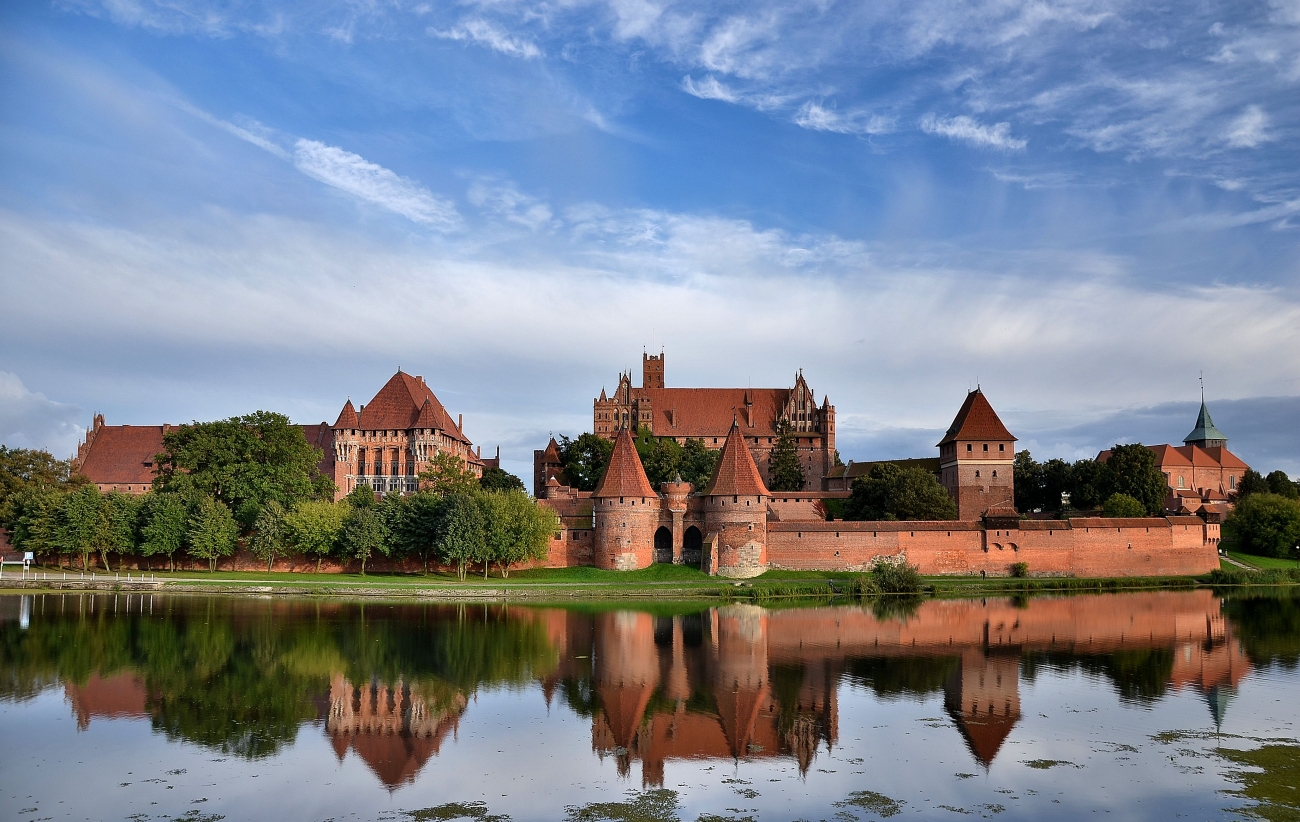
In 1309, the Grand Master Siegfried von Feuchtwangen moved the seat of the Teutonic Order from Venice to a fortress on the river Nogat, a hundred miles north of Thorn. The castle was called Marienburg — the Castle of Mary. It is, depending on how you measure these things, the largest brick castle in the world.
To stand in front of Marienburg, even today, is to understand something visceral about the Order's ambition. It was not just a fortress; it was the administrative capital of a sovereign country, the dormitory of an international military elite, the chapter house of a religious order, and the treasury of a trading state with branches from Bruges to Novgorod. The walls are not the romantic walls of a French chateau or an Italian hill-town. They are functional. They are huge. They look — and this is not an accident — like the walls of a state that intended to last forever.
"The Order's lands are governed in such peace and order, with such honesty in courts and such promptness in justice, that there is nowhere in Christendom to compare with them." — Wigand of Marburg, court herald, c. 1390
Wigand was a paid employee of the Order, so his account is partial. But other observers, who had no reason to flatter the Knights, said similar things. The Ordensstaat at its fourteenth-century peak was rich, orderly, technologically advanced, and shockingly well governed by the standards of the age. It minted its own currency. It maintained its own postal service. It had a written legal code. It collected reliable tax records. Its agricultural yields, on land that had been forest and bog a century earlier, were the envy of central Europe.
It was also, by the standards of any age, a peculiar society. There was no nobility in the medieval sense. There were no native princes. There were no inherited estates of the kind that dominated France or the Empire. There were knights — celibate, professional, foreign — and there were townsmen, and there were peasants. The knights were the state. When they died, the state replaced them, by election, from the next generation of Germans recruited for the purpose.
Tannenberg
And then, on the 15th of July 1410, the entire structure broke in a single afternoon.
The Order had spent the late fourteenth century in a long, low-grade war with the last pagan kingdom of Europe — Lithuania. When Lithuania converted to Christianity in 1386 (its Grand Duke, Jogaila, married the Queen of Poland and was baptised in the bargain), the Order's theological reason for war disappeared. The political reason did not. By 1409 a fresh war was on, this one with both Poland and the new Polish-Lithuanian dynasty united against the Knights.
The decisive battle was fought near two villages called Grunwald and Tannenberg, in the southern part of the Order's territory. The Polish-Lithuanian army under Jogaila — by then King Władysław II — was perhaps thirty thousand strong, perhaps more. The Order's army, under the Grand Master Ulrich von Jungingen, was smaller but better equipped. The Knights charged. They were absorbed. They were enveloped. They were destroyed. Of the Order's senior leadership, almost no one survived. The Grand Master was killed on the field. Two hundred and three knights-brothers fell with him.
The Order survived the battle militarily — its fortresses, including Marienburg, held — but it never recovered from the political defeat. The Prussian towns and the secular knights of the country had taken note of the new reality. Over the next fifty years the Order ruled an increasingly resentful population and a depleted treasury. In 1454 the Prussian Confederation, an alliance of towns and gentry from the country's western districts, revolted and offered itself to the King of Poland.
The Thirteen Years' War that followed ended in 1466 with the Second Peace of Thorn. By its terms the Order lost the entire western half of its country — including Marienburg itself, Thorn, Elbing, and the great port of Danzig — to the Polish Crown. This region became known as Royal Prussia, and remained a Polish territory for the next three centuries. What was left to the Order was the eastern half — Königsberg, Sambia, Warmia, the lower Memel — held now as a fief of the Polish king, who was the Order's overlord.
The Teutonic Order, founded in Acre in 1190 to fight Muslims, was now a vassal state of a Catholic king, ruling a population of German Catholic colonists, on the shore of the Baltic Sea, at the edge of a continent that was already, somewhere south of them, beginning to argue about a German monk called Luther.
The last Grand Master
In 1511 the Order elected, as its new Grand Master, a young Hohenzollern prince called Albert of Brandenburg-Ansbach. He was twenty-one. He spent the next decade attempting, with increasing desperation, to free the Order from its Polish overlordship and restore its sovereignty. He failed. The war he started in 1519 went badly. By 1521 the Order was bankrupt and Albert had no army worth the name.
He travelled south to consult an unlikely strategist. In Wittenberg, in 1523, he met with Martin Luther. The two men talked for several days. Luther's advice, in summary, was this: dissolve the Order, marry, take the country as your secular fief from Poland, and turn it Protestant. The pope no longer matters in your country. The future does not lie with celibate knights.
Albert took the advice. On the 8th of April 1525, in the marketplace of Kraków, he knelt before King Sigismund I of Poland and swore homage as the first Duke of Prussia. The Order was dissolved on his territory by his own decree. The Lutheran faith was proclaimed the state religion. The brick castles of the Knights became, almost overnight, the administrative seats of a hereditary German duchy.
It was the first time in European history that a Catholic religious order had been converted, wholesale, into a Protestant sovereign state. Three centuries of Teutonic crusading had ended in a single ceremony on a Polish market square. The country was now called the Duchy of Prussia. And it had a future, of which it knew nothing, to which we now turn.
End of Chapter II