The first thing to know about the Prussians is that they were not Germans. They did not speak a Germanic language. They did not worship a Christian god. They did not live in a kingdom, or even a country. They were a confederation of pagan tribes living along the southeastern shore of the Baltic, in a country of pine forests, peat bogs, slow rivers, and beaches where the storms washed up pieces of fossilised tree-resin worth, ounce for ounce, more than gold. The Romans called this resin succinum. We call it amber. It is what drew the first outsiders to the country that would, much later and through one of the stranger acts of cultural appropriation in European history, come to bear the Prussian name.
The people themselves were called something closer to Prūsai in their own tongue — an Indo-European language belonging to the Baltic family, closely related to Lithuanian and Latvian. Tacitus, writing in the year 98 of the common era, mentions them under a different name. He called them the Aestii, and he was impressed by them. They were industrious, he wrote, more so than any of their German neighbours. They gathered amber from the sea and shipped it south. They worshipped, he noted with some confusion, a mother of the gods.
For the next thousand years, almost nothing about them changed.
A country without a centre
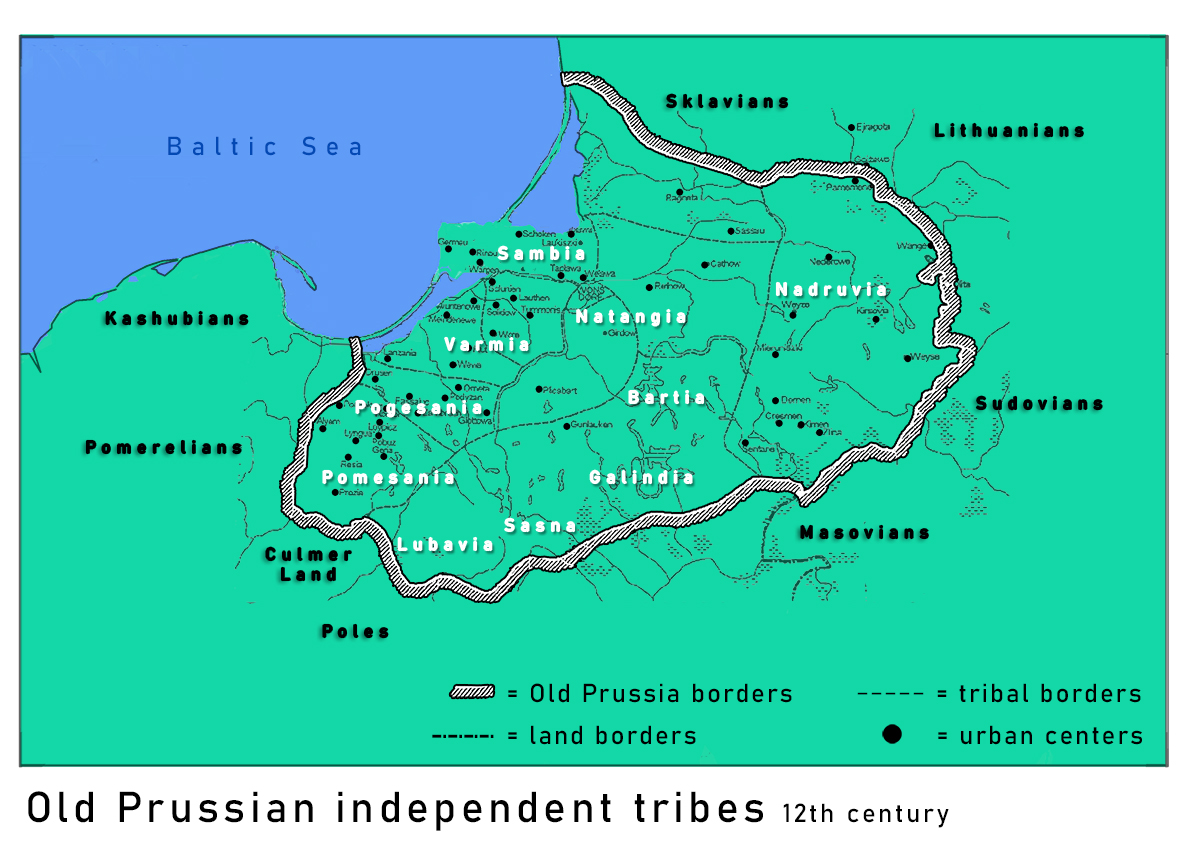
The land the Prussians lived in was not large by European standards — perhaps the size of modern Belgium. But it was divided into ten or eleven tribal regions, each politically independent, each loyal to its own chieftains. Their names survive today only as the names of obscure districts on old maps: the Sambians, who lived on the peninsula that holds the world's richest amber deposits; the Pomesanians and Pogesanians on the lower Vistula; the Warmians, whose region — Warmia — is still on the map of northern Poland; the Natangians, the Bartians, the Galindians, the Sudovians; and to the north, near the river Memel, the Nadruvians and Skalvians.
There was no Prussian king. There was no Prussian capital. There was no Prussian state, in any sense we would recognise. There was, instead, a shared language, a shared religion, and — at long intervals, in moments of common danger — the capacity to fight together.
The gods of the forest
What we know of Prussian religion comes mostly from their enemies, which is to say it should be treated with care. The thirteenth-century Polish chronicler Vincent of Kraków, the fourteenth-century Teutonic chronicler Peter of Dusburg, the sixteenth-century Lutheran historian Simon Grunau — none of them were neutral observers, and all of them wrote after the fact. What emerges through the filter is a pantheon resembling that of the Lithuanians and the Old Latvians, which makes sense, because the three peoples spoke closely related languages and lived on the same shore.
There was a sky god — Perkūnas, the thunderer, recognisable to anyone who knows the Slavic Perun or the Norse Thor. There was a god of the underworld, often called Patollos in the Latinised sources. There was a god of growth and the harvest, Potrimpos. There were sacred oak groves, attended by a priesthood that the chroniclers describe as organised and powerful. The most famous of these groves was at a place called Romove, somewhere in what is now the Kaliningrad Oblast — its exact location has been argued about for five hundred years and never settled. A chief priest, the krīve-krivaitis, was said to preside there over all the tribes, the closest thing the Prussians had to a national authority. Whether Romove was real, or whether the German chroniclers invented it to make their conversion campaigns look more glorious, is a question without a definitive answer.
"They worship the sun, the moon, the stars, thunder, birds, and four-footed beasts, even the toad. They have sacred forests, fields, and waters, in which they dare not chop wood, work the land, or fish." — Peter of Dusburg, Chronicle of the Prussian Land, c. 1326
The amber road
The reason the Prussians remained for so long outside the European story, and the reason they were eventually drawn — violently — into it, was the same reason: amber.
The southern shore of the Baltic, particularly the Sambian peninsula, sits over the world's largest deposit of high-quality amber, formed from the resin of pine forests that grew on the same coast forty-five million years ago. The Prussians knew the value of what washed up on their beaches. They had been trading it down a network of river routes since at least the Bronze Age. Roman senators wore Sambian amber. Mycenaean princes were buried with it. In return, the Prussians received iron, silver, glass beads, and — eventually — coins, which they rarely spent and often hoarded in pots in the floors of their wooden houses.
The amber kept them rich enough to defend themselves, but it also made them visible. By the eleventh century, the Christian kingdoms surrounding them — Poland, the Kievan Rus, the German bishoprics on the lower Elbe — had begun to take a strategic interest in their conversion. A Christian Prussia could be taxed and absorbed. A pagan Prussia could not.
The martyrs
In the year 997, a Bohemian monk named Adalbert, the former bishop of Prague, arrived on the Prussian coast carrying a wooden cross and a small group of companions. He was at this point a celebrated figure in the Christian world — a friend of the German emperor Otto III, an experienced missionary — and he had come to bring the Prussians to Christ. He met them, by the most likely account, in the woods of Sambia, near a sacred grove they expressly told him not to enter. He entered it. They killed him, probably with axes, on the 23rd of April. His body was bought back from his killers for its weight in gold, by Bolesław the Brave of Poland, and is now in the cathedral at Gniezno.

Twelve years later, in 1009, another missionary — Bruno of Querfurt — tried again, this time in the borderlands between Prussia and Yotvingia. He was also killed, along with eighteen companions, somewhere near the modern border of Lithuania and Belarus. The date of his death, the 9th of March, is the date on which historians conventionally place the first written use of the word Lithuania in a European source — it appears in the chronicle that records his murder.
The Prussians had now killed two of the most prominent missionaries of the early medieval church, and the church remembered. For two centuries after, intermittently, the Polish kings would lead expeditions into Prussian territory to punish them, to convert them, or simply to seize their cattle. The Prussians retaliated by raiding deep into Masovia and burning what they could.
An invitation that ended everything
By the early 1200s the rulers of the Polish duchy of Masovia, in particular Duke Konrad, were exhausted. The Prussian raids had become so destructive that whole districts of his lands lay abandoned. He had tried — and failed — to recruit a crusading order, the Knights of Dobrzyń, to protect his borders. They were not enough.
In 1226 he wrote to a different order, one that had been forced out of Hungary the previous year and was looking for a new mission. They were called the Order of the Hospital of Saint Mary of the Germans in Jerusalem. Most of Europe knew them by a shorter name. They were the Teutonic Knights, and they had been looking, for some time, for a country of their own.
The duke offered them the borderland of Chełmno — modern Kulm — as a base. The Knights, through their Grand Master Hermann von Salza, asked the Holy Roman Emperor Frederick II for a charter. The emperor obliged, in March of 1226, with a document known as the Golden Bull of Rimini, which gave the Teutonic Order title to any Prussian land it could conquer, in perpetuity, as a sovereign fief of the Empire. The pope confirmed it shortly afterwards.
The first Teutonic Knights crossed the Vistula in 1230. They were perhaps two dozen in number. They had with them several hundred crusading volunteers, a great many wagons, and a clear theological doctrine that violence against pagans was not murder.
What followed was the slowest, most thorough, and least-remembered conquest in European history. Over the next fifty-three years, the country the Prussians had lived in for at least a millennium ceased to belong to them. By 1300 the Prussian language was already in decline. By 1700 it was extinct — the last fluent speakers having died in the previous generation, in obscure villages on the Curonian Spit. By 1947, when the last vestige of the country was abolished by Allied decree, almost no one alive remembered that the people whose name the country bore had ever been a people at all.
The amber, of course, is still there. You can still buy it on the beach at Yantarny, west of Kaliningrad. The local children walk along the surf line after winter storms, picking it up. They will tell you, if you ask, that it has been done this way for a very long time.
End of Chapter I