Imperial Germany, in its first decade, was an experiment that no one had quite expected to work. Twenty-five separate states, four of them kingdoms in their own right, two of them grand duchies, the rest a scattering of duchies, principalities, and three free cities, had been welded together into a federal monarchy by a single chancellor whom they did not love. The new currency, the mark, had been introduced in 1873 — replacing thalers, gulden, kreuzers, schillings, and a dozen other regional issues. The new postal system, the new railway timetable, the new criminal code, the new commercial code, all entered force within five years of the proclamation at Versailles. Nothing like this consolidation had been attempted in Europe in the lifetime of anyone living. It worked because Prussia did most of the consolidating, and because Bismarck, having unified the country, devoted the next eighteen years to making the unification stick.

Bismarck's domestic struggles
The Iron Chancellor's foreign policy after 1871 was a model of restraint. He had got what he wanted. He spent the rest of his career trying to keep France isolated, Russia and Austria-Hungary at peace with each other, Britain unconcerned, and Germany itself in the middle of a stable alliance system. The five overlapping treaties he constructed — the Three Emperors' League, the Dual Alliance, the Triple Alliance, the Reinsurance Treaty with Russia, the secret Mediterranean Agreements — were a baroque masterpiece that only Bismarck could play. When he was dismissed in 1890, the system collapsed within four years.
His domestic policy was the opposite of restrained. He picked two of the biggest possible fights in a country he had just spent a decade building.
The first was the Kulturkampf — the cultural struggle — against the Catholic Church, which had emerged after 1871 as the largest organised opposition to Prussian dominance in the new Reich. A third of the new empire was Catholic; almost all of these Catholics lived in the formerly independent states of the south and west, in the Rhineland, in Polish-speaking Posen and Silesia. Bismarck, fearing a transnational Catholic political movement loyal to Rome rather than to Berlin, attacked. Between 1871 and 1878 he expelled the Jesuit order, brought all Catholic schools under state supervision, required state approval of every parish appointment, and imprisoned bishops who refused. The campaign was an unqualified failure. By 1878 the Catholic Centre Party was the second-largest faction in the Reichstag and Bismarck quietly retreated. The exception was Polish-speaking Posen, where the anti-Catholic measures merged with anti-Polish measures and remained in force for forty more years.
The second was his fight against the Social Democrats, who emerged as a serious political force after the founding of the SPD in 1875. Bismarck, an instinctive monarchist who regarded socialism as a foreign import, banned the party in 1878 under emergency laws passed after two assassination attempts on the emperor. The ban lasted twelve years. The party went underground, published in Switzerland, smuggled its papers across the border, and emerged from the ban in 1890 stronger, better organised, and more popular than it had been when banned. By 1912 it would be the largest single party in the Reichstag.
The first welfare state
The most striking thing Bismarck did, however — and the thing for which he is least famous in the English-speaking world — was to invent the modern welfare state. He did it partly out of conviction, partly out of cynical calculation, and entirely without anyone else in Europe having shown him how.
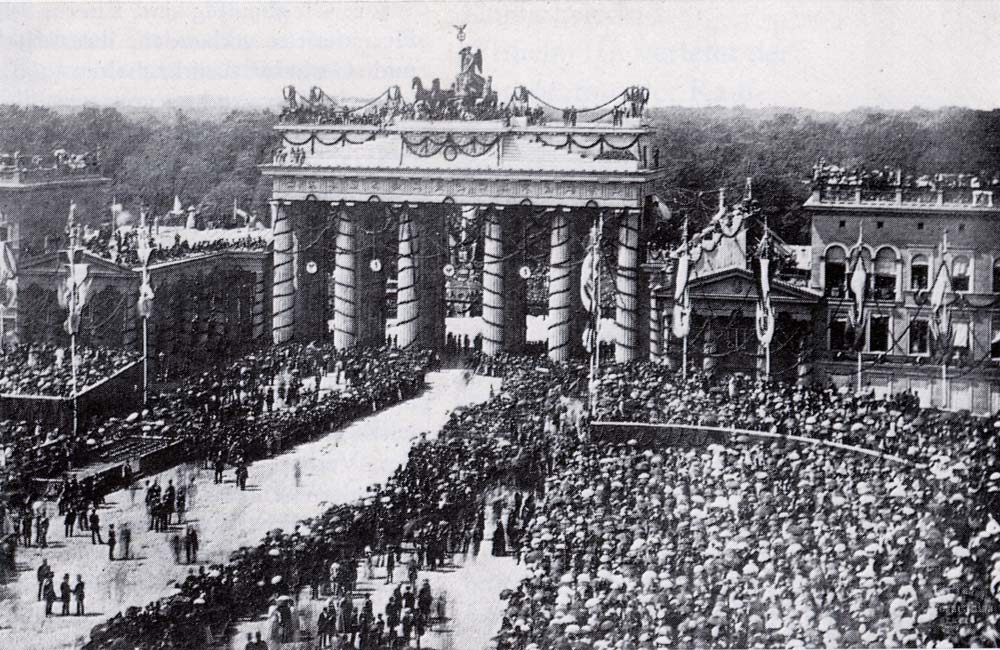
His logic was, at one level, transparent. The Social Democrats were promising the workers protection. If the state could promise the workers more protection sooner, the workers would have no reason to vote for the Social Democrats. The conviction beneath the calculation, however, was deeper. Bismarck, in his Junker bones, believed that an industrial society without state-provided social insurance would tear itself apart. He had grown up in an East-Elbian world in which the lord was responsible for the welfare of his peasants. He wanted, in a more limited form, to translate that responsibility upward to the level of the state.
The three great social insurance laws of the 1880s — Sickness Insurance in 1883, Accident Insurance in 1884, and Old Age and Disability Insurance in 1889 — were the first comprehensive social insurance scheme in the history of the world. They covered nearly all industrial workers. They were paid for jointly by employer and employee contributions, supplemented by the state. They provided cash benefits for illness, for injury at work, for disability, and for old age beginning at seventy. They were administered through local Krankenkassen — sickness funds — that still exist today, more than 140 years later, under nearly the same name. Every European welfare state of the twentieth century, and the American Social Security Act of 1935, was modelled, directly or indirectly, on the Bismarckian framework. The man who invented it was a reactionary Prussian Junker.
"The State must take the matter in hand, not as alms but as a right of the working man to security." — Bismarck, Reichstag, 17 November 1881
The Year of Three Emperors
1888 was a strange year for the dynasty. On the 9th of March, Wilhelm I died at the age of ninety. His son, the long-awaited liberal crown prince Frederick, was already terminally ill with throat cancer, contracted before his accession. He reigned for ninety-nine days, communicating with his ministers by handwritten notes — he had lost the use of his voice — and died on the 15th of June. His son Wilhelm II, twenty-nine years old, succeeded him. Frederick had been the great hope of the liberal current within the Hohenzollern family. He had been intelligent, internationally minded, married to Victoria of Britain, and committed to constitutional monarchy. He had been waiting twenty-seven years for the throne. He had it for fourteen weeks.
Wilhelm II was a different man entirely. He was charming in flashes, intelligent in patches, and emotionally extraordinarily unstable. He had a withered left arm from a difficult birth. He was the grandson of Queen Victoria of Britain. He admired and detested the British in equal measure. He had been educated by liberal tutors, around whom he had constructed in himself a deliberate parody of his grandfather's military style. He believed, with a conviction his ministers found genuinely alarming, in the divine right of Hohenzollern kings to rule by personal authority. He went through forty-six service uniforms before noon some mornings.
Within two years he had quarrelled with Bismarck. The pretext, in March 1890, was a domestic policy dispute. The substance was that there could not be both a Wilhelm and a Bismarck in the same country. Bismarck resigned, on the 18th of March 1890, after twenty-eight years in office, and retired to his Saxon estate at Friedrichsruh. He spent the next eight years writing memoirs designed, with patient cruelty, to embarrass his successors. He died in 1898.
The new course
The Wilhelmine era — from 1890 to 1914 — was a period of explosive German economic and demographic growth. The population rose from forty-nine million to sixty-eight million. Steel production tripled, then doubled again. Electrical engineering — Siemens, AEG — became a German industrial speciality. Chemistry — BASF, Bayer, Hoechst — became another. The dyestuffs industry alone employed more people in Germany than the entire chemical industry in France. The patent office in Berlin filed more applications, in 1900, than the entire combined output of Britain and France.
The educational system the Humboldts had built underpinned all of this. By 1900 Germany was producing more physics doctorates per year than every other country in Europe combined. By 1914 German chemists, in industrial laboratories funded by the state and the universities together, had earned the country a near-monopoly on synthetic dyestuffs and synthetic drugs. The Nobel Prizes — established in 1901 — went disproportionately to Germans in the early years: Röntgen, Behring, Fischer, Lenard, Baeyer, Bovet, Wien, Planck, Wallach, Otto Wallach, the Curies' German collaborators. The German chemists alone won eleven of the first twenty-six chemistry prizes.
But the political system did not keep pace. The Reichstag, elected by universal manhood suffrage, was a parliamentary debating chamber without real executive power; the Chancellor was responsible to the emperor, not to the parliamentary majority. The Prussian House of Representatives, more powerful than the Reichstag in many ways because it controlled the largest state in the country, was elected on the three-class franchise — a system that gave votes weighted by tax payment, with the result that the richest five per cent of voters elected a third of the seats and the poorest seventy per cent another third. The Social Democrats, despite being the largest party in the Reichstag from 1912, were entirely excluded from any executive office. The military, structured as a state-within-the-state, reported directly to the emperor and not to any civilian minister. The country, in other words, had become economically modern, scientifically modern, demographically modern, and constitutionally pre-modern, all at once.
The naval race and the end
The thing that did the most to unbalance Europe in this period was Wilhelm's decision, in 1898, to build a high-seas battle fleet. The plan, devised by Admiral Alfred von Tirpitz, was to construct a German fleet strong enough that the Royal Navy would not dare to fight it. The intended consequence was a British accommodation to German world ambitions. The actual consequence was a British rearmament programme, the construction of HMS Dreadnought in 1906, and an arms race that drove Britain into the arms of France and Russia. By 1907 the British had signed the Anglo-Russian entente, completing the encirclement that Bismarck had spent twenty years preventing. Wilhelm could not understand why his cousins in London had behaved like this. He blamed the Jews, the socialists, the Free Masons, and his uncle King Edward VII personally.
The countdown to 1914 was, in retrospect, audible from a long way off. The Bosnian crisis of 1908. The Moroccan crises of 1905 and 1911. The Balkan wars of 1912-13. Each one was contained, but the German military's appetite for a preventive war against Russia — before Russian rearmament caught up — was growing. In June 1914 an Austrian archduke was shot in Sarajevo by a Bosnian Serb nationalist. The Austrian government decided to use the assassination as a pretext for crushing Serbia. The Russians declared they would not stand by. The Germans gave Austria the famous "blank cheque" of support. Four weeks after the assassination, the General Staff in Berlin set in motion the Schlieffen Plan.
The plan was a Prussian military project. It had been refined since 1905 by a series of chiefs of the German General Staff — von Schlieffen, then the younger Moltke — operating on the assumption that, in a two-front war against France and Russia, Germany could defeat France in six weeks by passing through Belgium, before turning east to face the slow Russian mobilisation. The plan required the violation of Belgian neutrality. The violation of Belgian neutrality would, by the treaty of 1839, bring Britain into the war. The General Staff had known this for nine years. They considered it an acceptable cost.
It was not.
End of Chapter IX