The Heart — Berlin and Brandenburg
The political centre of Prussia from 1701 onward. The capital that became, in 1871, the capital of Germany. Today the most accessible region of the former kingdom — and the one in which the survivals are densest.
Berlin · Germany
The capital itself
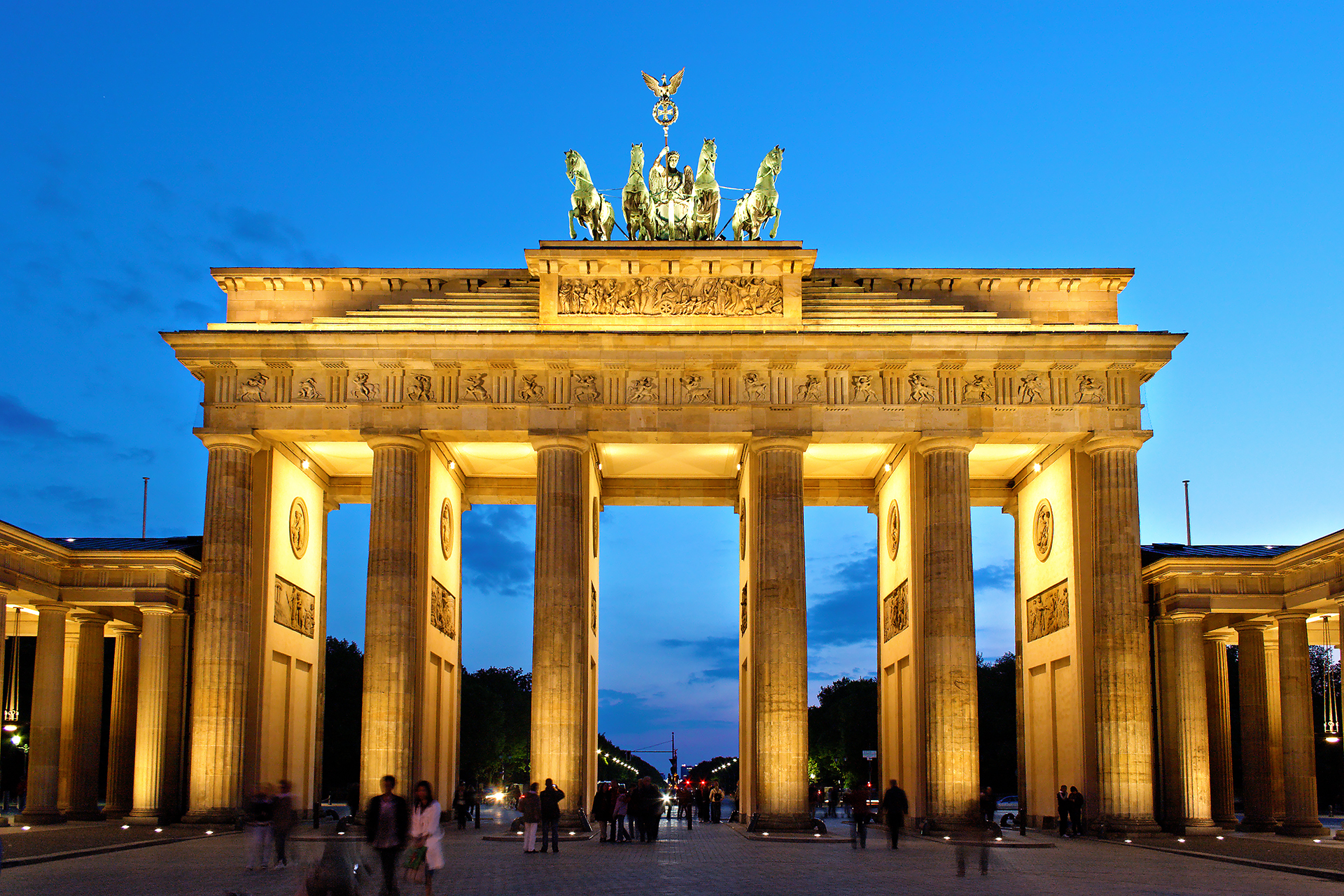
The largest collection of Prussian sites in the world. Begin at the Brandenburg Gate, finished in 1791, walk east down Unter den Linden, and you are walking the ceremonial axis of Prussian Berlin: the equestrian statue of Frederick the Great by Rauch (1851); the Bebelplatz with the Old Royal Library, the Catholic St Hedwig's Cathedral, the Humboldt-built University building; the Neue Wache (Schinkel, 1818) with the Käthe Kollwitz Mother with Dead Son as the federal memorial; the Zeughaus (the armoury, now the German Historical Museum, with the best single-narrative exhibition of German history anywhere); Schinkel's Altes Museum on the Lustgarten; the rebuilt Berlin Palace, opened as the Humboldt Forum in 2021, on the foundations of the Hohenzollern City Palace.
For the imperial period: the Reichstag, the Berlin Cathedral (the Hohenzollern parish church, with the dynastic crypt containing ninety-four sarcophagi), and Charlottenburg Palace with its mausoleum holding the embalmed Queen Luise.
Potsdam · Germany
The summer capital

Twenty-four kilometres south-west of Berlin. The Hohenzollern country town, the place where the dynasty preferred to live and work. Sanssouci itself — one-storey, ten rooms, fifteen-minute audio tour — is the smallest royal residence in Europe and the most affecting. Frederick the Great is buried on the terrace beside his dogs.
The surrounding park is enormous. The Neues Palais at the far end was built by Frederick after the Seven Years' War as a deliberate piece of architectural propaganda — see, he was saying to the Habsburgs, I am still rich. The Orangery Palace, the Roman Baths, the Chinese Teahouse, the Belvedere on the Klausberg, and the small private library that Frederick read in are all walkable in a long afternoon. The Cecilienhof, at the edge of the park, hosted the Potsdam Conference of 1945; the round table at which Truman, Attlee, and Stalin sat is preserved in situ.
Rheinsberg · Germany
Where Frederick was happy

Eighty kilometres north of Berlin, in the lake country of the Mark Brandenburg. The small water-castle of Rheinsberg was given to the young crown prince Frederick by his father in 1734 and was the only place, in the later king's own admission, where he had ever been truly happy. He spent four years here before his accession, playing the flute, reading philosophy, corresponding with Voltaire, and gathering around himself the small intellectual circle that would, in time, run his country. The palace is open, modest, and visited mostly by Germans. The lake is one of the loveliest in northern Brandenburg.
Küstrin · Poland (Kostrzyn nad Odrą)
Where Katte was beheaded

On the Polish-German border, where the Warta flows into the Oder. The eighteen-year-old crown prince was held here in the fortress in 1730 and made to watch from a window as his friend Hans Hermann von Katte was beheaded in the courtyard. The fortress is largely a ruin — destroyed in 1945, never rebuilt — and the old town within its walls is in part still a ruin, with the cobbled streets visible in the ground. It is one of the strangest and most evocative places in former Prussia. Easy day trip from Berlin by train (90 min).
The Old Duchy — East Prussia
The original Hohenzollern Prussia. The duchy of Albert. The province of the Junkers. Now divided between the Russian Kaliningrad Oblast in the north, the Polish voivodeships of Warmia-Masuria and Pomerania in the south, and a small piece of Lithuania around Klaipėda.
Kaliningrad · Russia (Königsberg)
The capital that was not rebuilt

The coronation city of Frederick I. The home of Immanuel Kant. The seat of the Albertina university. The largest German city east of the Vistula until 1945. Destroyed in British bombing in August 1944 and in Soviet siege in April 1945. The old town was demolished, not reconstructed; in its place there is a low concrete plaza and an unfinished Soviet-era ministry building called the House of Soviets, which has never been used. The cathedral on Kneiphof island, gutted in 1944, was reroofed in the 1990s and now contains an organ and Kant's tomb on its north exterior wall. There are a handful of restored Prussian-era buildings — the Brandenburg Gate of Königsberg, the King's Gate, several brick city gates, the fish market and harbour quarter, the small Friedrichsburg outwork. Almost nothing of the central old town survives.
The city is, however, still extraordinarily visitable in the way an archaeological site is visitable. Walk around the cathedral. Walk the surviving forts. Visit the Amber Museum in one of the surviving Prussian fortifications. Take the local commuter train to Svetlogorsk (Rauschen) on the Baltic coast — a small seaside resort that survived almost intact and that gives a hint of what an East Prussian town used to look like.
Note that as of 2026 travel to Kaliningrad from EU countries requires advance planning, valid Russian visa, and current advice from your foreign ministry; many overland routes are restricted. Consult the latest information before booking.
Malbork · Poland (Marienburg)
The largest brick castle in the world
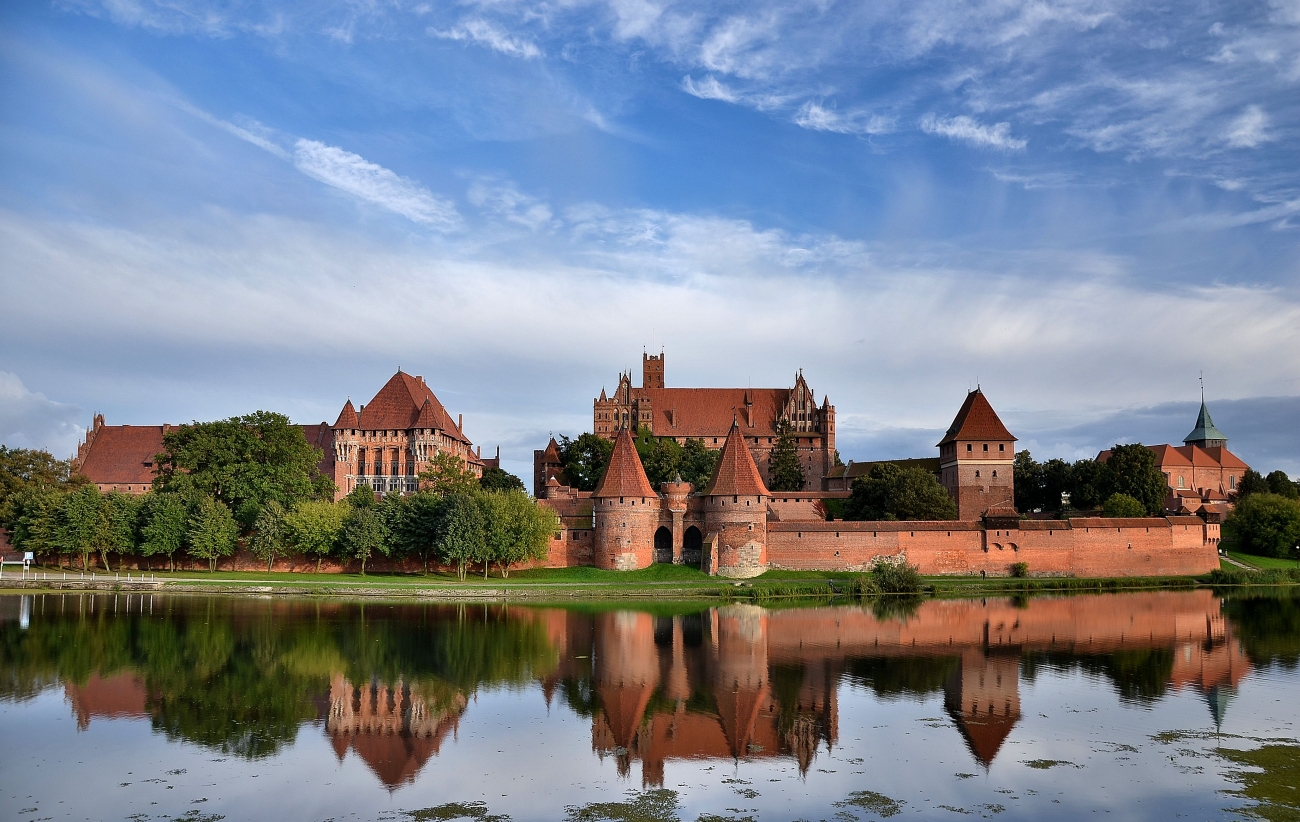
The seat of the Teutonic Order from 1309 to 1457. UNESCO World Heritage. Restored after war damage with extraordinary care. The High Castle, the Middle Castle, the Outer Castle, the Grand Master's residence, and the chapel of the Virgin (with its modern statue replacing the famous medieval one destroyed in 1945) are all accessible. The site is enormous; allow at least three hours. The audio guide is excellent. The town outside the walls is unremarkable. The bridge over the Nogat, with the castle rising on the far bank in the late afternoon, is one of the great views in northern Europe.
Gdańsk · Poland (Danzig)
The Hanseatic port
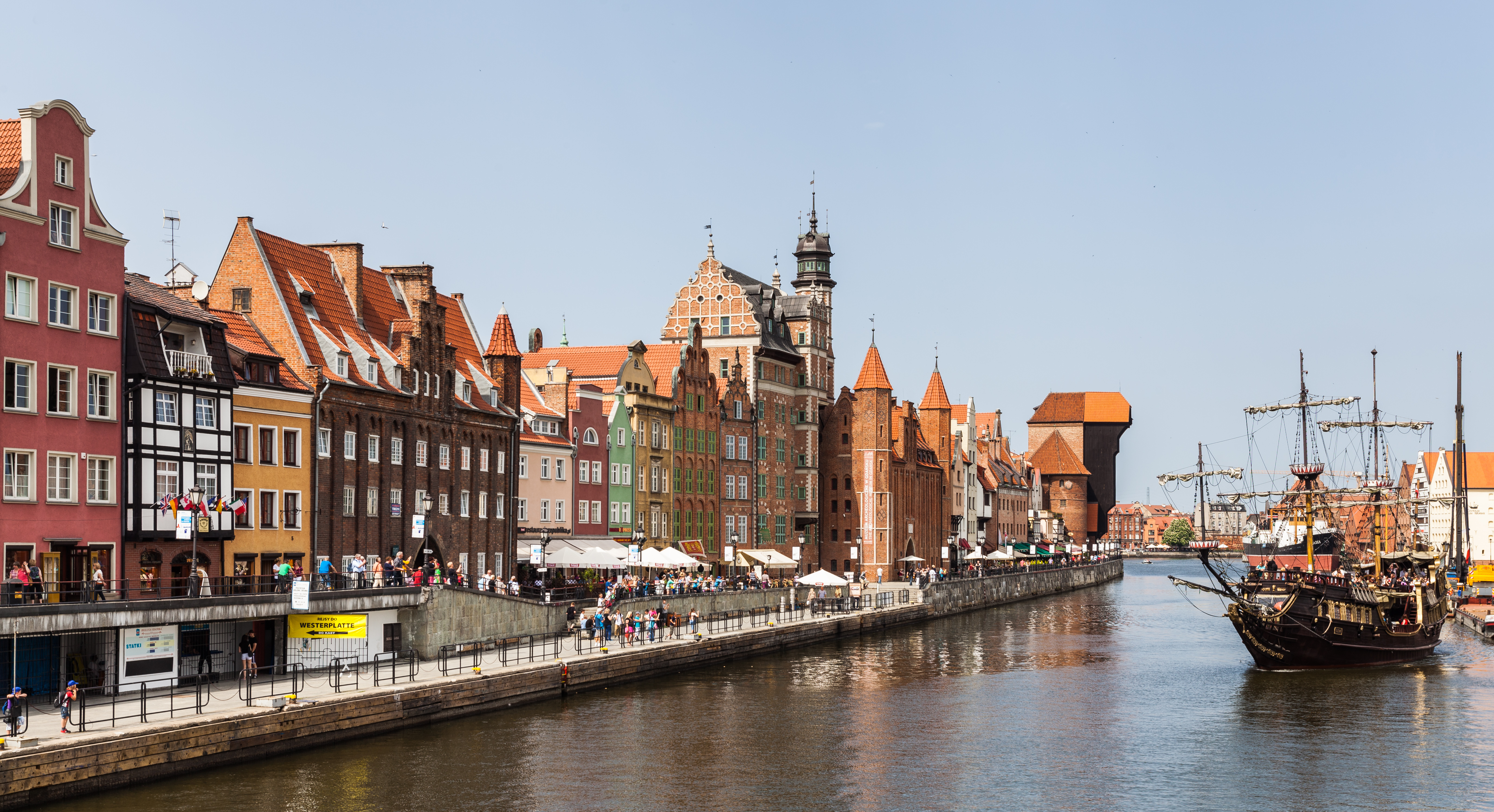
The largest of the former Royal Prussian cities. A Polish city in two periods, a Prussian city in one (1793-1919), a Free City under the League of Nations between the wars, and a Polish city again. The old town was destroyed by the Soviets in March 1945 and meticulously rebuilt in the 1950s and 1960s — not in concrete but in a careful approximation of the pre-war Hanseatic and Prussian streetscape. The Long Market, the Green Gate, the Crane on the Motława, the Mariacka church (the largest brick church in the world), and St Bridget's where the Solidarity movement was nurtured in 1980-81 are all walkable in a day.
Toruń · Poland (Thorn)
The first Teutonic foundation

The first town founded by the Teutonic Order, in 1231. A medieval Hanseatic city of red brick, with a complete defensive wall, a leaning tower, and the house in which Nicolaus Copernicus was born in 1473 (he attended the Old Town parish school and is now the principal local industry). Toruń survived the Second World War almost intact — it was bypassed by the Soviet offensive — and is the most complete medieval brick-Gothic town in northern Europe. UNESCO World Heritage. Three hours by direct train from Warsaw.
Olsztyn · Poland (Allenstein)
The capital of Warmia

The largest town in the Polish part of former East Prussia. A castle of the Warmian bishops, in which Copernicus served as administrator from 1516 to 1521, sits at the centre of an attractively restored old town. The surrounding lake district of Masuria is full of small Prussian-era villages, Wilhelmine spa towns, the Wolf's Lair (Hitler's wartime headquarters at Gierłoż, where the bomb of 20 July 1944 was placed and failed), and the Battle of Tannenberg sites — both 1410 and 1914.
Frombork · Poland (Frauenburg)
Copernicus's cathedral

A small cathedral town on the Vistula Lagoon. Copernicus was a canon here for thirty-six years and wrote De revolutionibus orbium coelestium in a tower-room you can climb. He is buried under the cathedral floor (the grave was rediscovered and confirmed by DNA testing in 2008 and reburied with state honours in 2010). The cathedral is one of the great brick Gothic monuments of the Baltic.
Klaipėda · Lithuania (Memel)
The northern edge

The last Prussian town, on the river Memel, ceded to Lithuania in 1923 and again in 1945. A small surviving Prussian old town of half-timbered warehouses around the river. The Curonian Spit, accessible by ferry, is one of the most extraordinary landscapes of the southern Baltic — a hundred-kilometre-long sand peninsula with shifting dunes, fishing villages, the small German-era resort of Nida, and Thomas Mann's summer house from the 1930s, preserved as a museum.
Silesia — The Conquered Province
Taken from Austria by Frederick the Great in 1740-42 and held until 1945. The richest province of the kingdom; the source of Prussian coal and steel; the home of Hauptmann and Hesse. Now almost entirely in Poland, with a small piece in the Czech Republic.
Wrocław · Poland (Breslau)
The Silesian capital
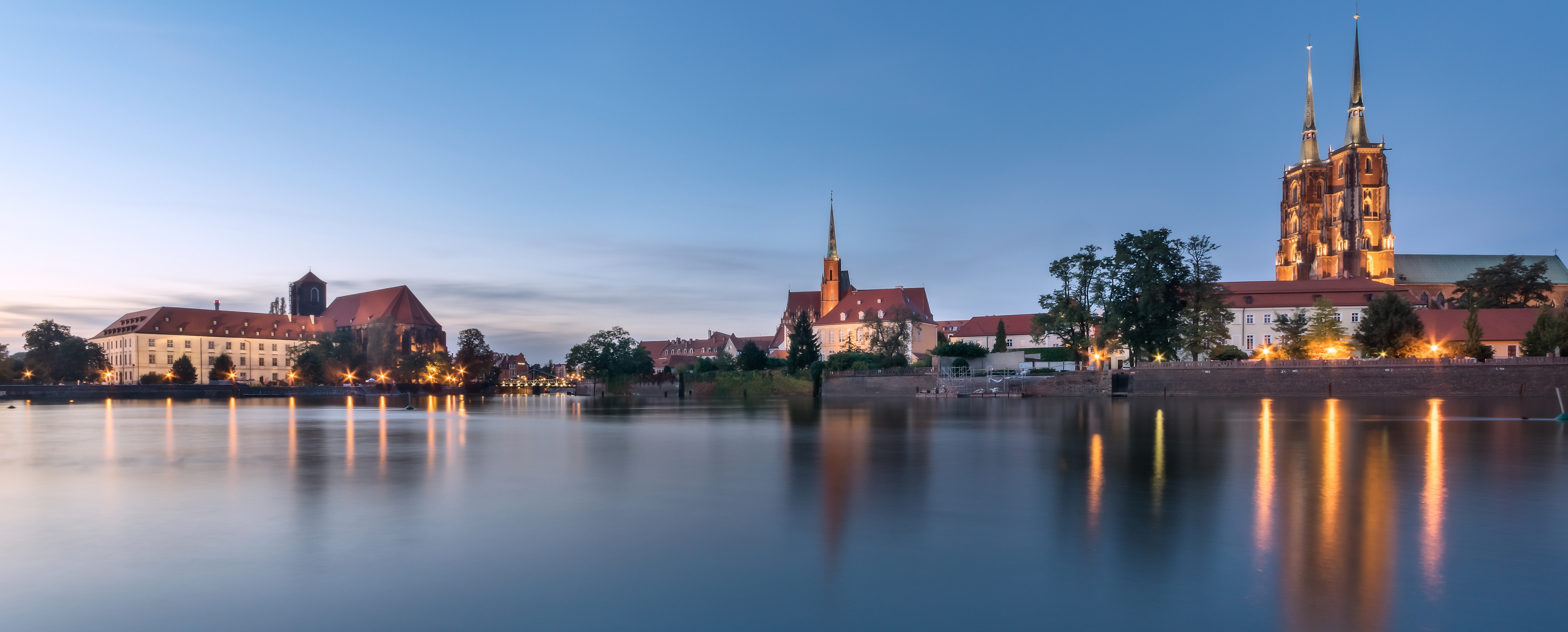
The fourth-largest city of the German Empire in 1914. Heavily damaged in the three-month siege of 1945 — at the end of which it surrendered to the Red Army on the 6th of May, two days before the wider German surrender — and rebuilt in the post-war period as a Polish city. Twelve islands, more bridges than Venice, a magnificent Gothic Town Hall on the Market Square, the Centennial Hall of 1913 by Max Berg (a Modernist landmark of reinforced concrete, UNESCO listed), and a large university quarter on the river.
Świdnica · Poland (Schweidnitz)
A wooden Lutheran cathedral

One of three Silesian "Churches of Peace" built in the 1650s as a concession to Lutherans in Habsburg Silesia: timber and clay, no stone, no tower, no street frontage allowed by the treaty. The Świdnica church is the largest surviving wooden religious building in Europe and the Lutheran response to the absurdity of its conditions: every square inch of the interior is painted, sculpted, or gilded. UNESCO listed since 2001.
Książ · Poland (Fürstenstein)
The vast Silesian castle

The third-largest castle in Poland, owned by the von Hochberg family from the sixteenth century to 1941. Confiscated by the SS during the war for a secret project to construct an underground complex called Riese — Giant — beneath the castle and the surrounding mountains. The tunnels are still there, partially open to the public, dripping and unfinished. The castle itself is a magnificent Baroque and neo-Renaissance pile in mature parkland.
The Reformation Sites
The places where the duchy made itself Protestant — and where Luther's correspondence with Albert of Hohenzollern is preserved.
Wittenberg · Germany
Where Luther advised the convert

The small Saxon town in which Martin Luther taught, preached, and lived for thirty-five years. Albert of Hohenzollern came here in 1523 to consult him about the dissolution of the Teutonic Order. The Castle Church door on which the 95 Theses were said to have been nailed (it is a replacement; the original was burned in 1760) faces a small market square. Luther's house, now a museum, is around the corner. The grave of Luther himself is in the floor of the Castle Church beneath the pulpit.
Kraków · Poland
Where the duchy was born
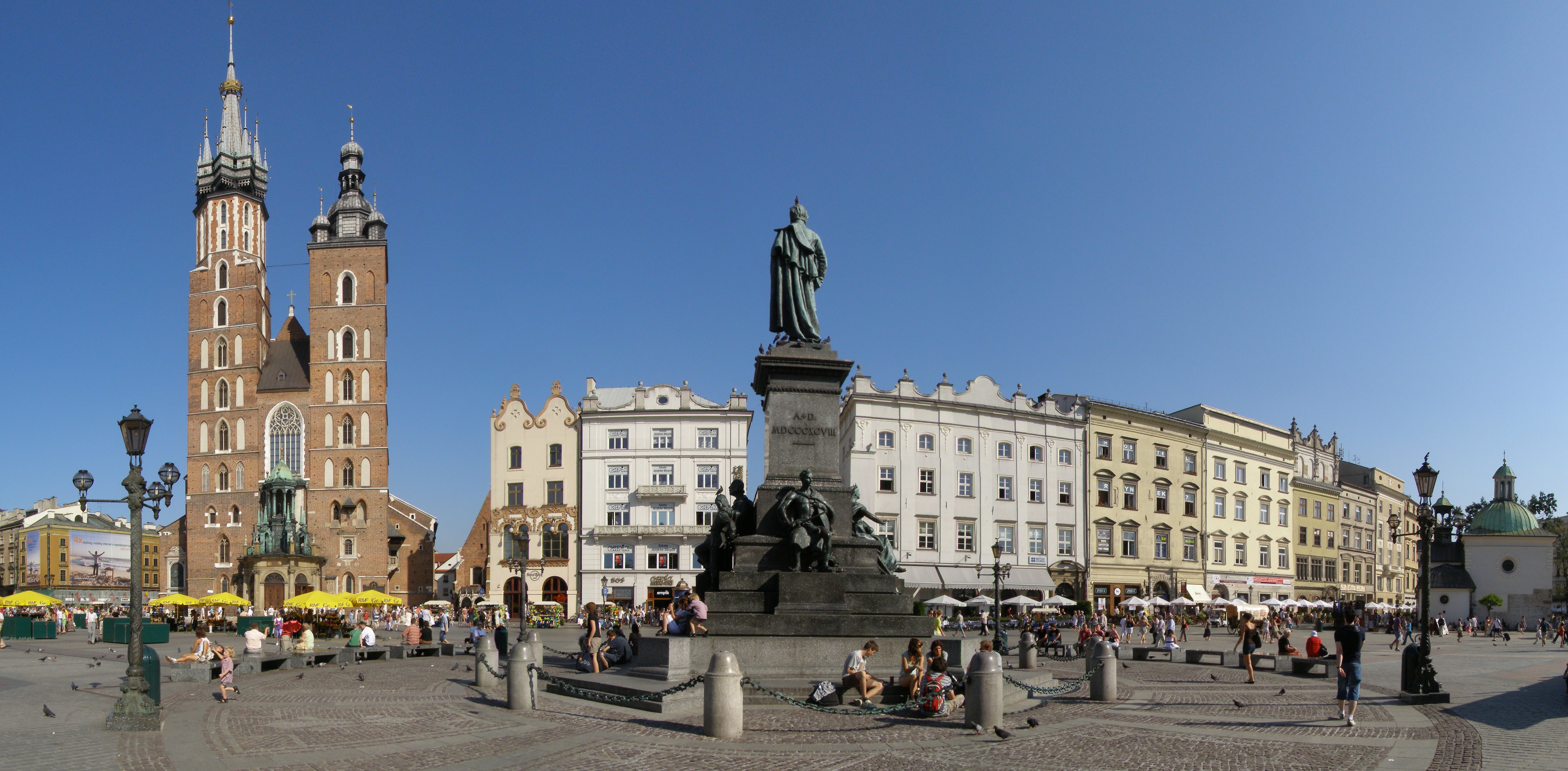
The Polish royal capital, and the city in which Albert of Hohenzollern knelt before Sigismund I on the 10th of April 1525 and was invested as the first Duke of Prussia. The market square — Europe's largest — and Wawel Castle above it are still the same buildings. The Sigismund Chapel, in Wawel Cathedral, contains the king's tomb; the Royal Apartments are a museum. The Renaissance courtyards of Wawel are where the Polish-Prussian relationship was conducted for almost a century afterwards.
The Western Provinces — Rhineland and Westphalia
The territories awarded to Prussia by the Congress of Vienna in 1815 and never quite at home in the kingdom. Catholic, French in legal culture, more economically developed than Brandenburg, and now part of the most populous of the modern German states.
Cologne · Germany (Köln)
The Catholic capital of Prussia

The largest Rhineland city. Awarded to Prussia in 1815 and the source of fifty years of Catholic-Protestant friction within the kingdom. Cologne Cathedral, begun in the thirteenth century and abandoned in 1473, was completed only in 1880 — under Prussian funding, with the foundation stone of the resumed construction laid by King Frederick William IV in 1842 in a deliberate gesture of Catholic-Protestant reconciliation. The cathedral is the principal Prussian-era monument in western Germany.
Koblenz · Germany
The fortress at the Rhine bend

Where the Mosel meets the Rhine. Heavily fortified by the Prussians after 1815 with one of the largest fortress complexes in Europe — Ehrenbreitstein, on the bluff above the river, is the second-largest preserved fortress in Europe after Gibraltar, accessible by cable car. The Deutsches Eck, the wedge of land at the confluence, has the colossal Wilhelm I equestrian monument — destroyed in 1945, rebuilt in 1993.
Battlefields and Memorials
Jena and Auerstedt · Germany
14 October 1806

Two villages in Thuringia, twenty miles apart, on each of which a battle was fought on the same morning. The Prussian army was destroyed in both. A small museum at Cospeda, above Jena, with a Napoleonic-period diorama and a viewing platform looking out over the fields where the French right wing crossed in the dawn fog.
Leipzig · Germany
The Battle of the Nations · 1813

The largest battle in European history before the First World War. Half a million troops on the four-day field; ninety thousand casualties. The Völkerschlachtdenkmal, the Monument to the Battle of the Nations, was completed in 1913 — a ninety-one-metre granite stupa-shaped megalith that may be the strangest piece of European national architecture of the early twentieth century. Climb the stairs inside for a view across the old field.
Hradec Králové · Czech Republic (Königgrätz)
3 July 1866

The battle that won the Austro-Prussian War in seven weeks. The battlefield, twelve kilometres north-west of the city of Hradec Králové, has a small museum at Chlum and a series of monuments scattered across the fields where the Austrian centre broke under the Prussian needle-gun fire. The town itself is a quietly beautiful Bohemian provincial capital with two cathedrals and excellent beer.
Sedan · France
2 September 1870

A small town on the Meuse in the Ardennes. The French army under Napoleon III was encircled here in a single afternoon by two German armies under Moltke. The emperor surrendered the following morning. The Bazeilles museum, in a village immediately south of the battlefield, has the best small Franco-Prussian War collection in either country.
The Family — Hohenzollern places outside Brandenburg
Hechingen · Germany
Burg Hohenzollern

The ancestral seat of the dynasty, in Swabia, on a steep hill above the town of Hechingen. The present castle is a Neo-Gothic reconstruction of the 1850s, built by Frederick William IV in conscious imitation of the medieval original. It houses the Prussian crown (since 1953) and the coffins of Frederick the Great and his father Frederick William I (between 1953 and 1991, when Frederick was reinterred at Sanssouci).
Doorn · Netherlands
Where the last Kaiser is buried

A small chateau in the central Netherlands. Wilhelm II lived here from 1920 until his death in 1941. The house is preserved largely as he left it — his desks, his books, his collection of snuff-boxes, the saddle on which he ate his breakfast — and is open to visitors. A small mausoleum in the garden contains his coffin. Visitors are sparse, and most are Dutch schoolchildren.
The Small Things
Yantarny · Russia (Palmnicken)
The amber coast

A small village on the Sambian peninsula. The largest deposit of amber in the world, mined commercially here since the nineteenth century. The beach is open. After winter storms, the local people still walk along the surf line with buckets, picking up pieces of fossil resin. The amber mine, on the cliff above the beach, is partly open to visitors.
Friedrichsruh · Germany
Bismarck's last estate

Twenty kilometres east of Hamburg, in the Sachsenwald forest. The estate to which Bismarck retired after his dismissal in 1890, and on which he spent the last eight years of his life writing his memoirs. The mausoleum, simple and granite, contains his coffin and that of his wife Johanna. The forest is enormous and quiet. The small museum, in the former railway station, has his desk.
End of the travel guide