The country that ceased to exist in 1795 was, by an enormous margin, the most consequential European state of the eighteenth century to be erased. It was not merely a polity but a society — Polish-speaking and Catholic in its western lands, Ruthenian-speaking and Orthodox/Greek Catholic in its eastern lands, German-Jewish-Polish in its cities, with a noble class numbering perhaps a million and a peasant class of perhaps ten million — and the project of reconstituting it occupied the next 123 years of central European politics. The Commonwealth's afterlife is therefore one of the richest in modern European history: half a dozen named territorial reconstructions (some legal, some unrecognised), four major risings, one full restoration in 1918, a second extinction in 1939–45, a partial restoration as a Soviet satellite in 1945, and a final restoration of full sovereignty in 1989–91 across the territories that had once been the Commonwealth.
The Duchy of Warsaw, 1807–1815
The first named successor state was the Napoleonic Duchy of Warsaw, established by Napoleon at Tilsit in 1807 from territory taken from Prussia in the partitions. The duchy covered about 155,000 km² (about a quarter of the original Commonwealth area) with a population of about 2.6 million; it was constitutionally a Napoleonic satellite, with a Saxon-Wettin duke (Frederick Augustus I of Saxony, hereditary), a French-style civil code, and a constitution that abolished serfdom while leaving the peasantry without land. It contributed an army of roughly 100,000 men to Napoleon's later campaigns, of which perhaps 70,000 died in the 1812 Russian campaign. After Napoleon's fall in 1815, the duchy was dismantled at the Congress of Vienna; most of its territory became "Congress Poland" — a constitutionally autonomous Russian-administered kingdom — while the Poznań region went back to Prussia and Kraków became a tiny independent city-republic until 1846.
The risings — 1830, 1846, 1863
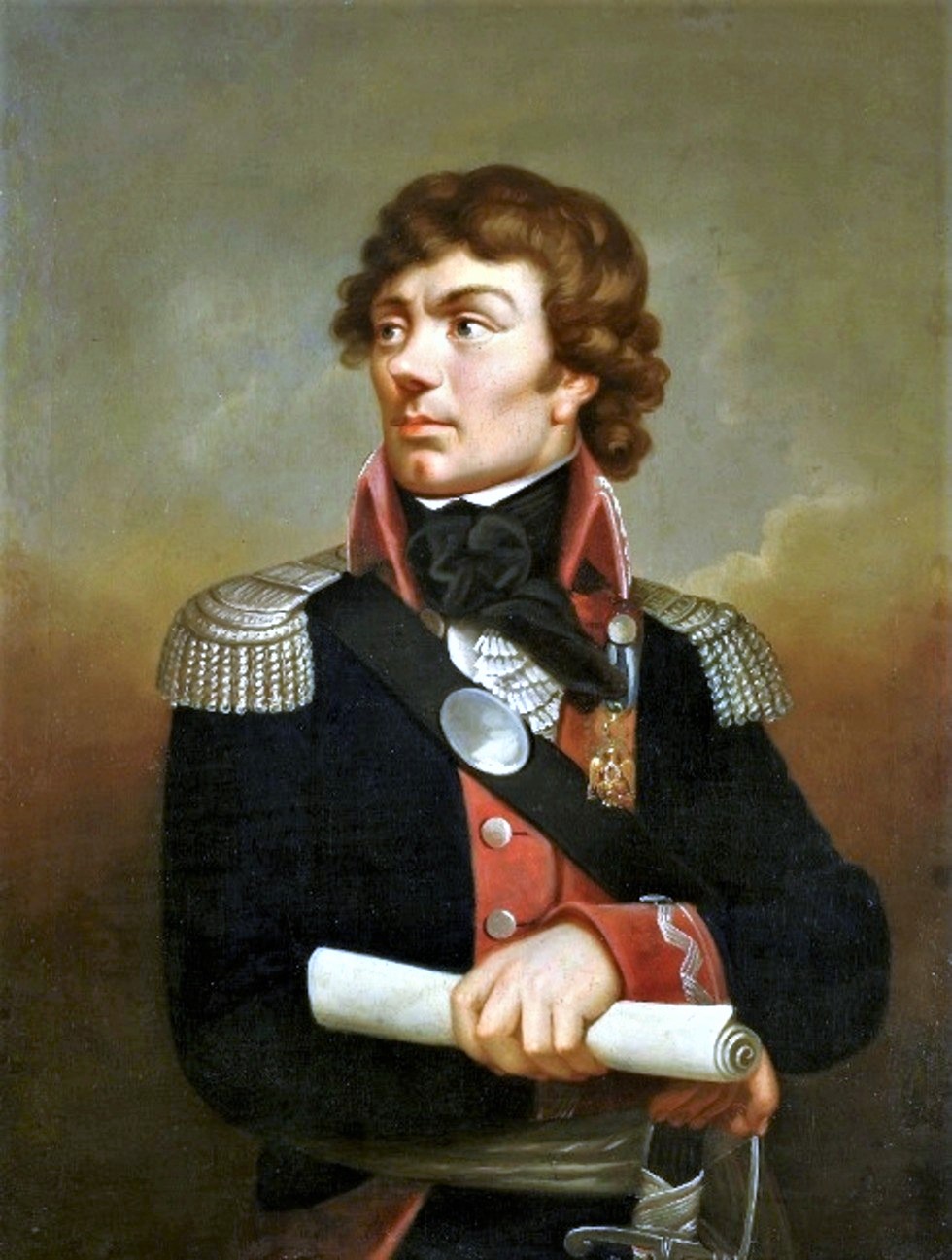
Three major uprisings against the partitioning powers — and many smaller ones — marked the long nineteenth century. The November Uprising of 1830–31 against Russia in Congress Poland mobilised about 150,000 troops, fought a competent eleven-month war (engagements at Stoczek, Grochów, Ostrołęka), and was defeated militarily by the Russian field army; the punitive aftermath abolished Congress Poland's constitution and brought Russian-style governance to the territory. The Kraków Uprising of February 1846 was a brief abortive rising suppressed by Austrian troops; the city-republic was abolished and incorporated into Austrian Galicia. The January Uprising of 1863–64 against Russia mobilised about 30,000 partisans (smaller because the social base had shrunk after the 1830 reforms and the 1864 Russian emancipation of serfs aimed at separating peasants from the noble-led national movement), fought a fifteen-month guerrilla war, and was defeated by the substantially larger Russian field force.
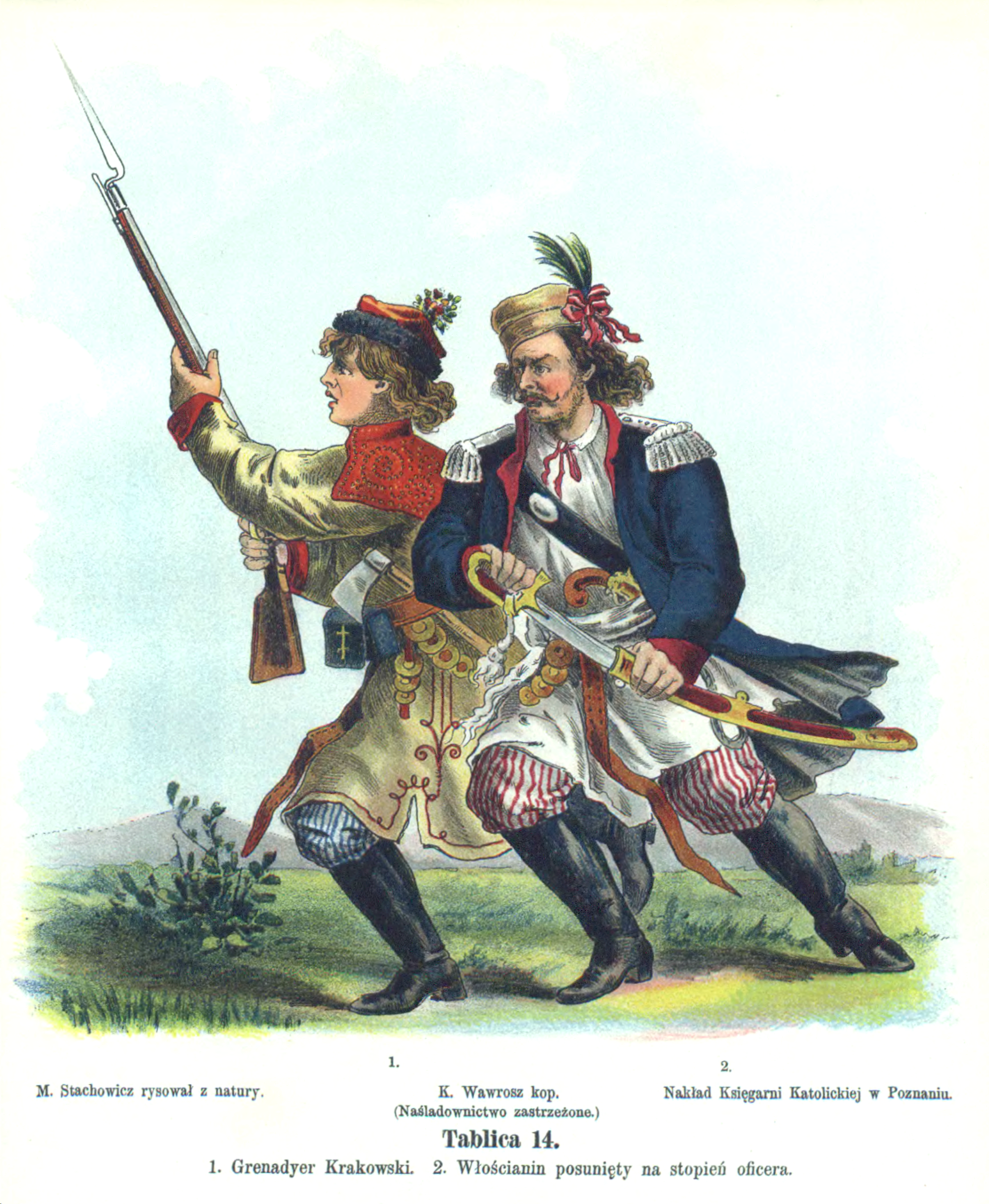
The cumulative effect of the failed risings was to transfer Polish national activity, by the late nineteenth century, from military to cultural-economic channels. "Organic work" — the building of Polish cooperatives, savings banks, agricultural schools, scientific societies and literary journals — became the dominant Polish national strategy, particularly in Prussian-ruled Greater Poland and in Habsburg-ruled Galicia (where the relatively liberal Habsburg constitution after 1867 allowed substantial Polish autonomy). Galicia developed, between 1867 and 1914, into the substantial autonomous Polish province (with a Polish-language Sejm at Lwów, a Polish-language educational system, and the only substantially Polish-administered region in any partitioning empire).
The Second Polish Republic, 1918–1939
The collapse of all three partitioning empires between 1917 and 1918 — Russian (February-October 1917), Austro-Hungarian (October 1918), German (November 1918) — produced, for the first time in 123 years, the opportunity for an independent Polish state. The new Republic was proclaimed on the 11th of November 1918, with Józef Piłsudski as head of state; its borders were settled by a combination of armed conflict (the Polish-Soviet War of 1919–21, the Wielkopolska Uprising of 1918–19, the three Silesian uprisings of 1919–21, the seizure of Vilnius from Lithuania in 1920) and international treaty (Versailles 1919, Riga 1921, Bydgoszcz 1922). The resulting state covered about 389,000 km² — much less than the historical Commonwealth, but more than the Duchy of Warsaw — with a population of about 27 million.
The Second Republic was a constitutional democracy on paper, an authoritarian quasi-presidential regime in practice after Piłsudski's coup of May 1926. Its economic situation was difficult (postwar reconstruction, the 1929 depression, the heavy industrial base of Silesia and the agricultural base of the eastern voivodeships were poorly integrated). Its minorities were complex: Ukrainians and Belarusians were the largest, particularly in the eastern voivodeships (the Kresy); Jews were a substantial urban minority (about 10% of the population). The Republic survived twenty years and four months before being destroyed by the joint German and Soviet invasions of September 1939 — the pattern of the 1795 partition repeated almost exactly 144 years later, with substantially the same consequences.
The Polish People's Republic and after
The third Polish state — the Polish People's Republic (1944–89) — was a Soviet satellite established in Yalta on territory shifted substantially westward from the prewar borders (the eastern Kresy were ceded to the Soviet Union and incorporated into Ukrainian, Belarusian and Lithuanian SSRs; the German Recovered Territories of Pomerania, Silesia and Lower Silesia were transferred to Polish administration with the expulsion of their German populations, in the largest single forced population transfer in modern European history, covering about 8 million people).
The People's Republic governed for forty-five years. It was a one-party Communist state with periodic crises (1956 in Poznań, 1968 student protests, 1970 Gdańsk worker uprising, 1976 Radom and Ursus, 1980–81 Solidarity, 1980s martial law). It nonetheless preserved Polish language, Polish national identity, Polish Catholic religious practice, and substantial elements of the cultural-historical sense of continuity with the Commonwealth. The Solidarity-led negotiations of 1989, the Round Table Agreement, and the partially free elections of June 1989 produced the modern Third Republic, which has now governed for thirty-six years — already longer than the entire interwar Republic.
What survives
The Commonwealth's territory is today divided between five states: Poland (the bulk of the central and western lands), Lithuania, Belarus, Ukraine, and a small slice of Latvia (the Latgale-Inflanty region). The Commonwealth's national languages — Polish, Lithuanian, Belarusian, Ukrainian — are all now state languages in their respective successor countries; Ruthenian, the historical chancellery language, survives only as the academic ancestor of modern Belarusian and Ukrainian. The Commonwealth's confessional landscape persists in modified form: Catholic in Poland and Lithuania (where the Greek Catholic Church also survives in Ukraine), Orthodox in Belarus and most of Ukraine, with Protestant minorities in Royal Prussia (modern northern Poland) and Jewish communities almost entirely destroyed by the Holocaust. The Commonwealth's institutions are gone — the elective monarchy, the Sejm of the szlachta, the magnate fiefs, the liberum veto, the noble election field at Wola — but the constitutional ideas they articulated (religious toleration, the rule of law, the right of resistance to a king who breaches his oath) have substantial echoes in the constitutions of modern Poland and Lithuania.
The 3 May Constitution is observed as a national holiday in Poland and (informally) in Lithuania, on the 3rd of May each year. The Union of Lublin is observed as a regional holiday in Lithuania. Sobieski's relief of Vienna is observed in Polish Catholic liturgy on the 12th of September. The Polish-Lithuanian Commonwealth ended in 1795. The political imagination that produced it did not.
End of Chapter X · End of the Book