No European state had ever before been dismembered by treaty by its neighbours while remaining at peace with them. The Partitions of Poland — 1772, 1793 and 1795 — were therefore an innovation. They established a principle of great-power diplomacy that would have substantial consequences for the next two centuries: that a sovereign state's territory could be reassigned by external agreement when its internal arrangements were inconvenient to its neighbours. The principle was condemned at the time by, among others, Edmund Burke, by the British prime minister William Pitt the Younger, by the French Encyclopedists, and by Thomas Jefferson; it was nonetheless executed three times, by three powers acting in coordinated bad faith, and the European international order absorbed it without serious resistance. Poland-Lithuania became the largest single act of state dissolution by foreign agreement in modern history.
The First Partition — August 1772
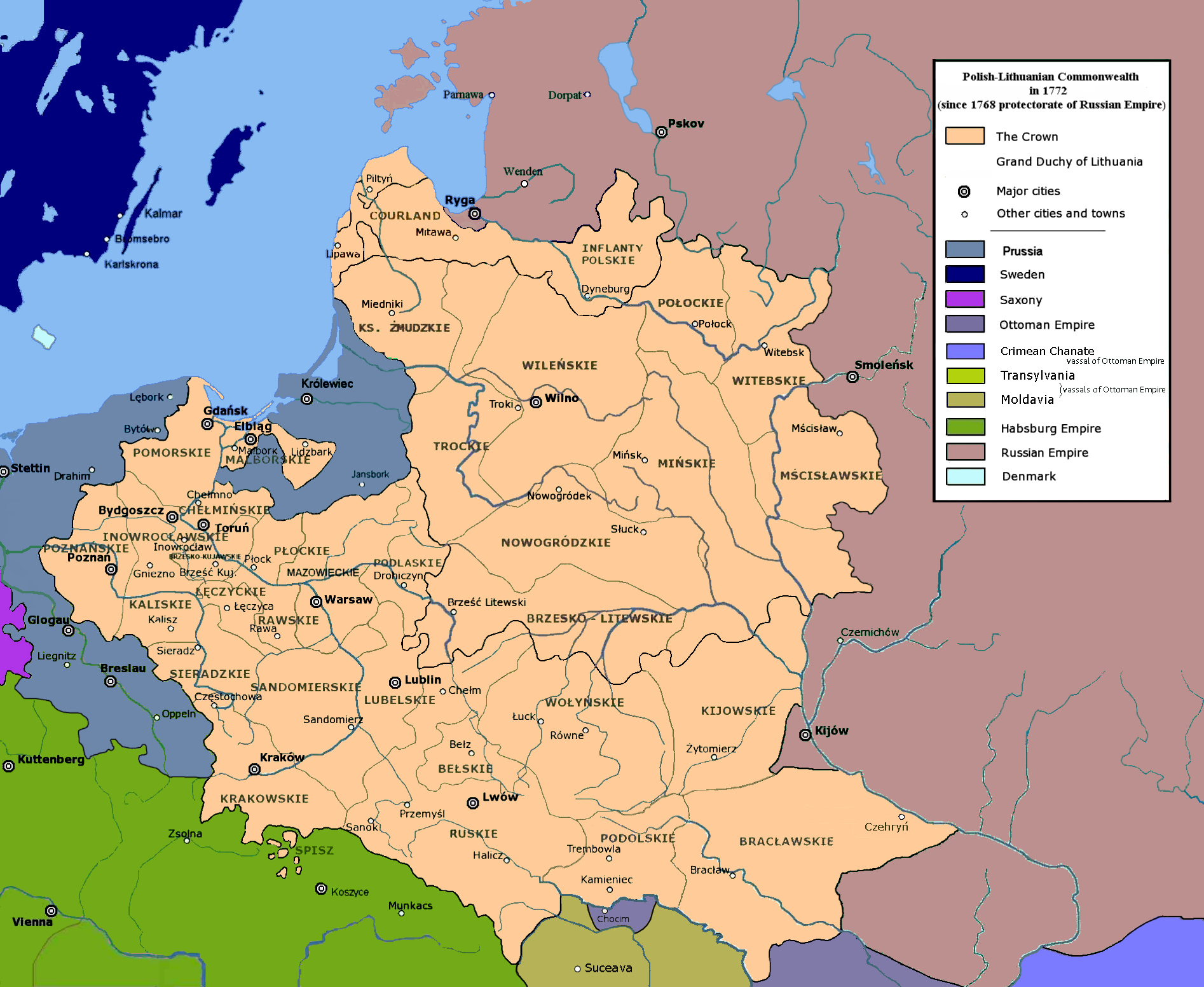
The First Partition was provoked, on the surface, by the disorders of the Bar Confederation and the Russo-Turkish War of 1768–74. Russia, while at war with the Ottomans, was unwilling to allow Frederick the Great's Prussia to gain compensation at Russian expense; Frederick suggested, instead, that Prussia might be compensated by territory taken from Poland, with Russia and Austria taking their own shares. The arrangement was agreed in principle by January 1772, ratified in August at a treaty between the three powers at St Petersburg, and forced on the Polish Sejm in 1773 by Russian military pressure. The territories assigned were: to Russia, the Belarusian voivodeships east of the Dvina-Dnieper line (about 92,000 km², 1.3 million inhabitants); to Prussia, Royal Prussia (the Vistula lowlands, Warmia, the Netze district, but not the cities of Danzig and Toruń) — about 36,000 km², 600,000 inhabitants; to Austria, Galicia (the lands south of the upper Vistula, including Kraków's southern hinterland but not Kraków itself, plus the salt-mining region around Wieliczka) — about 83,000 km², 2.6 million inhabitants. The Commonwealth lost about 211,000 km² and roughly 4.5 million inhabitants in the First Partition.

The Second Partition — January 1793
The Second Partition followed Catherine's successful invasion of 1792 (after the 3 May Constitution) and the establishment of the Targowica Confederation. The 1792 invasion gave Russia control of the central Polish administration; Prussia, having declined to defend the Commonwealth, demanded compensation for its restraint. The settlement was negotiated between Russia and Prussia, without Austrian participation, and ratified by the bullied Grodno Sejm of June–November 1793 — the last Sejm of the Commonwealth, held under Russian troops, with deputies confined to the chamber until they assented. Russia took the central Belarusian and Ukrainian lands (about 250,000 km²); Prussia took Greater Poland, with Poznań and Gniezno, plus Danzig and Toruń (about 58,000 km²). The Commonwealth lost a further 308,000 km² — more than the First Partition — and was reduced to about a third of its original area. The Grodno Sejm formally renounced the 3 May Constitution and substantially returned the Commonwealth to its pre-1764 constitutional structure.
The Kościuszko Uprising — 1794

The reaction to the Second Partition was the only sustained armed resistance the Commonwealth would mount in defence of its sovereignty. On the 24th of March 1794, Tadeusz Kościuszko — a Polish general who had served as a colonel of engineers in the American Revolutionary War under Washington and had returned to Poland in 1784 — proclaimed in the main square of Kraków a general uprising against the Russian and Prussian occupations. He was named commander-in-chief with dictatorial powers. The army he raised — initially about four thousand regulars and ten thousand peasant volunteers armed with scythes (the so-called kosynierzy) — defeated a Russian field force at the Battle of Racławice on the 4th of April. The victory triggered urban uprisings in Warsaw (17 April, in which the Polish forces drove the Russian garrison out of the city) and Vilnius (23 April, with the same result in Lithuania).
The uprising lasted six months. Kościuszko's strategic position was hopeless: the Russian army had, by midsummer, mustered some 80,000 troops; the Prussians added 50,000 more; the Austrians (who had stayed out of the Second Partition but joined the suppression) contributed perhaps 20,000. Kościuszko had perhaps 50,000 men and very limited artillery. He fought a series of holding actions through the summer (Szczekociny, June; Maciejowice, October) but was defeated and captured at Maciejowice on the 10th of October. He was wounded, captured, and transported to St Petersburg, where he was held in the Peter and Paul Fortress until Catherine the Great's death in 1796 allowed Paul I to release him. The capital, Warsaw, was stormed by the Russian army under Suvorov on the 4th of November, with about 20,000 civilian deaths in the suburb of Praga on the right bank of the Vistula. The uprising ended.
The Third Partition — October 1795
The Third Partition was decided by the three powers after the suppression of the Kościuszko Uprising. Its purpose was the complete extinction of the Polish-Lithuanian state. The remaining territory — about 215,000 km² with roughly 3.5 million inhabitants — was divided: Russia took the eastern Belarusian and most of the remaining Ukrainian and Lithuanian lands (about 120,000 km²); Prussia took Mazovia (with Warsaw itself) and parts of central Poland (about 55,000 km²); Austria took the southern and western lands including Kraków and Lublin (about 47,000 km²). The treaty was signed in October 1795; the formal abdication of King Stanisław August Poniatowski followed on the 25th of November 1795 (American Thanksgiving Day, which is coincidence but striking: Poniatowski's abdication act was signed on a day that the United States — a country he had supported in its own foreign policy through the 1770s — was nominally giving thanks for its own continued existence).
Poniatowski lived in St Petersburg under Russian house arrest until his death in February 1798. He was buried first in St Petersburg, then in 1938 returned to a church in Volhynia, then in 1995 transferred to Warsaw, where his remains are now in St John's Cathedral.
The act of extinction
The three partitioning powers, in a separate convention of January 1797, agreed never again to use the words "Polish kingdom" or "Polish nation" in their diplomatic correspondence. The state, in their language, had never existed. The convention has no legal force in international law today, but its symbolic significance is large: the Commonwealth was the first European state in modern history to be dismembered to the point of being denied even retrospective recognition. Russia's argument — that the partitions were not a conquest but a reorganisation of disorderly territory — was eventually repeated, with the same word ("Reorganisation"), in the 1939 Soviet-German partition of Poland. The pattern, in other words, was repeated. The lessons drawn from the 1795 act of extinction would shape Polish national consciousness for the next 220 years.
The country no longer existed as a state. It existed, however, as a project. The next chapter follows that project: from the Napoleonic Duchy of Warsaw to the nineteenth-century uprisings, the Second Polish Republic of 1918–39, the Polish People's Republic, and the contemporary state of modern Poland and Lithuania.
End of Chapter IX