The election of Augustus II (the Strong) in June 1697, and of his son Augustus III in 1733, gave the Commonwealth two consecutive German kings from the House of Wettin, electors of Saxony. Between them they reigned for sixty-six years — most of the eighteenth century before Poniatowski. They were not, by any standard, the worst monarchs the country had ever had. They were also not, by any standard, the best. They were the kings who presided over the slow conversion of Poland-Lithuania from a sovereign great power into a Russian protectorate. They did so substantially by signing whatever they were asked to sign.
Augustus II — the Strong
Augustus II Wettin of Saxony was thirty-seven years old at his election, conventionally educated, fluent in five languages, an enthusiastic baroque patron, and physically formidable enough that contemporary court chroniclers called him Sasen-Stark, "Saxon-strong" — he could, according to documented court games, bend horseshoes with his hands and break twenty-cm-thick gambling cards in half. He was also a Lutheran, which by the Henrician Articles he was required to renounce before coronation, which he did. The political deal that put him on the throne was made with Russia: Tsar Peter the Great preferred him to the French candidate, the prince de Conti, and made the Polish electors aware of this preference through diplomatic channels and the well-placed bribes that had become standard practice at Polish royal elections.
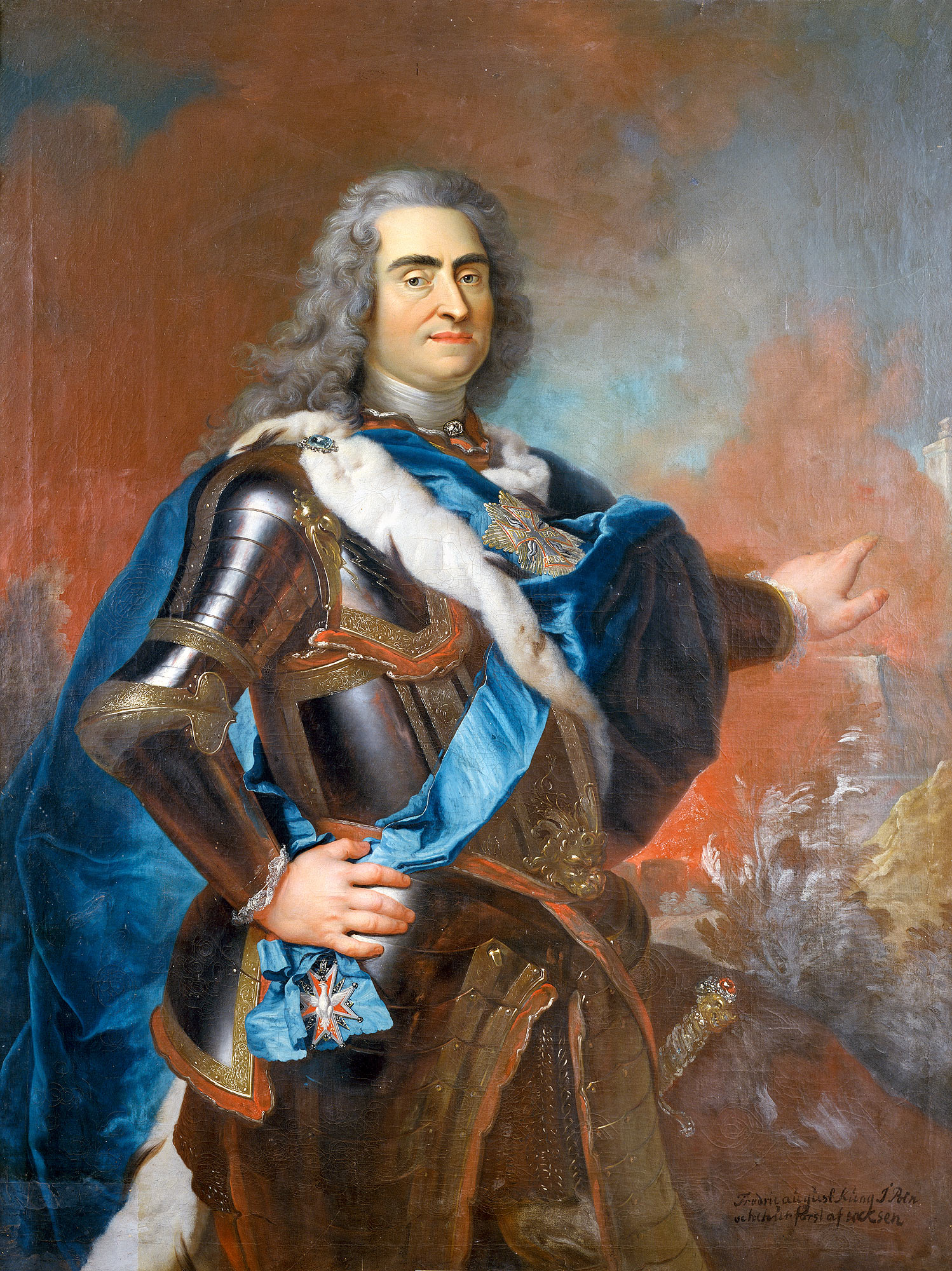
Augustus's foreign policy was substantially personal. His principal ambition was to recover the Swedish-held Baltic provinces of Livonia and Estonia for his Saxon dynasty (and, ideally, to convert the elective Polish crown into a hereditary one for his descendants). To achieve this he committed the Commonwealth to the Great Northern War (1700–21) on the Russian side against Sweden. The decision was constitutionally questionable — the king was technically the elector of Saxony when he signed the alliance — but the war was fought substantially on Polish-Lithuanian territory. Charles XII of Sweden invaded in 1702, occupied Warsaw, deposed Augustus by sponsoring a counter-king (Stanisław Leszczyński, elected 1704 under Swedish bayonets), and chased Augustus to Saxony. Augustus recovered the throne in 1709 after Peter the Great defeated Charles at Poltava; by that point the Commonwealth had been used as a battleground by all three armies and had suffered grievously.
The principal political legacy of Augustus II was the Silent Sejm of 1717 — a session of the Polish Sejm convened under Russian military escort, allowed to sit only for one day, and required to ratify a Russian-drafted compromise that ended a Polish noble revolt against Augustus. The Silent Sejm capped the Polish army at 24,000 men (it had been considerably larger in the seventeenth century), formally accepted Russian guarantees of the constitution, and effectively converted Russia from a sometime-ally into the standing protector of the Polish constitutional system. The Commonwealth, from 1717 onward, was a state whose constitutional structure was guaranteed by a foreign power. The guarantee was a constraint, not a protection.
Augustus III — the Quiet
Augustus II died in February 1733. The ensuing royal election produced one of the most contested in Polish history. The szlachta majority elected Stanisław Leszczyński (Louis XV of France's father-in-law, and the candidate previously imposed by Charles XII in 1704). Russia and Austria preferred Augustus II's son, the Saxon electoral prince Augustus III. The two empires invaded. The War of the Polish Succession (1733–38) ended with Leszczyński in French exile (he eventually became Duke of Lorraine) and Augustus III on the Polish throne with about a fifth of the szlachta's electoral support.
Augustus III reigned for thirty years (1733–63) and is conventionally regarded by Polish historians as the most ineffectual monarch the Commonwealth ever had. He spent something like two-thirds of his reign in Dresden, his Saxon capital, rather than in Warsaw. He visited Poland only occasionally. He spoke Polish poorly. He left the country's affairs substantially in the hands of his prime minister Heinrich Brühl, a Saxon courtier who used the position to enrich himself rather than to govern. During Augustus's reign, of the thirteen ordinary Sejms convened, twelve were broken by liberum veto before they could enact any legislation. The Commonwealth, during these decades, was substantially ungoverned at the centre — its administration ran on regional sejmiki, magnate jurisdictions, and the inertia of inherited custom.

Why the Saxon period mattered
The Saxon decades were not a period of total stagnation. The cultural achievements of the period were substantial: the baroque architecture of Warsaw under the Saxons (the Saxon Garden, the Mariwill, the rebuilt Royal Castle), the foundation of public libraries (the Załuski Library opened in 1747, the first public library in Europe with sixty thousand volumes by mid-century, of which the bulk was later seized by Catherine the Great), the establishment of the first regular Polish-language newspaper (the Kurier Polski, 1729). The Polish szlachta culture of the period — its sarmatian costume, its honour code, its court ceremonial, its baroque Catholicism — reached a peak of internal coherence that has been the object of Polish nostalgia ever since (Henryk Sienkiewicz's nineteenth-century trilogy of historical novels is set substantially in this period).

What was missing was effective state action. The army was small and unpaid; the treasury was empty; the taxation system was unenforced; the courts were corrupt; the church was untaxed; the magnate fiefs were exempt from the few statutes that did exist. Foreign powers — particularly Russia, but increasingly Prussia and Austria — exercised effective veto over Polish policy by means of bribed deputies, sponsored sejmik factions, and (when necessary) regular troops on Polish territory. The Russian ambassador in Warsaw, by the 1750s, exercised more practical influence over Polish governance than the Polish king did.
This state of affairs was widely understood within the Polish elite, and a reform movement gathered slowly through the Saxon decades. Stanisław Konarski, a Piarist priest, founded the Collegium Nobilium in 1740 — a school for sons of noble families that combined Enlightenment political thought with practical training in Polish constitutional law. The Czartoryski family — the magnates of the "Familia" faction — drafted a programme of constitutional reforms (the abolition of the liberum veto, the strengthening of the executive, the regularisation of taxation) that they hoped to enact through a future Czartoryski-friendly election. When Augustus III died in 1763, the conditions for the next election were already substantially being negotiated. The result, after substantial Russian sponsorship, was the election of Stanisław August Poniatowski, a Czartoryski nephew and a former lover of Catherine the Great. He would prove to be a much more capable and reform-minded monarch than the Saxons. He would also be the Commonwealth's last.
End of Chapter VII