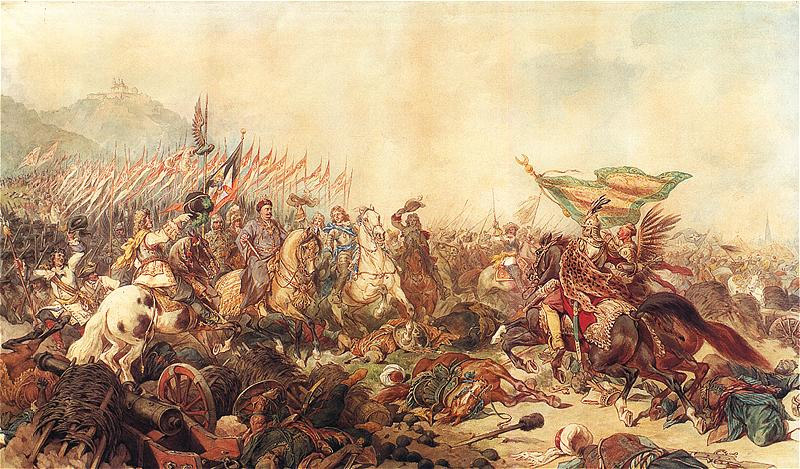
On the early afternoon of the 12th of September 1683, a Polish-led relief force broke an Ottoman siege of Vienna that had begun on the 14th of July. The battle was decided by the largest single cavalry charge in early modern European history: between fifteen and eighteen thousand horsemen — three thousand of them Polish winged hussars, the rest a mixed force of Polish, Saxon, Bavarian and Austrian cavalry — descended the Kahlenberg ridge north-west of the city in a sequence of squadron waves over roughly two hours, broke the Ottoman left and centre, drove the kapıkulu cavalry from the field, and forced Kara Mustafa Pasha to abandon his camp, his army's heavy artillery, and a quantity of personal possessions that, when sorted afterwards, included tents, prayer rugs, ostrich feathers, an emerald the size of a hen's egg, and the coffee beans that — by tradition — gave Vienna its first cup of coffee. The Ottoman field army, which had besieged the city for two months and had been within perhaps a week of taking it, withdrew. The siege was over. So, in retrospect, was the long Ottoman threat to central Europe.
Jan III Sobieski
The Polish commander was King Jan III Sobieski, elected to the throne in 1674 after a long career as the Crown grand hetman. He was, by the standards of his century, an unusually well-prepared monarch: educated in classical and modern languages (he read seven), trained in the cavalry tactics that he would later use to break the Ottoman line at Khotyn (1673) and Vienna, married to a strong-willed French wife (Maria Casimira d'Arquien) whose political instincts substantially shaped his reign, and personally devout in the Catholic-baroque mode of the Counter-Reformation. He came to the throne in the aftermath of the Cossack and Ottoman wars of the 1660s and early 1670s — wars in which the Commonwealth had lost the Ukrainian fortress of Kamianets-Podilskyi (1672) and the Podolian-Ruthenian lands to the Ottomans by the humiliating Treaty of Buchach. Sobieski's first major military success as king was the recovery of most of these lands through the 1670s campaigns.
By 1683 the Habsburg Emperor Leopold I was facing the largest Ottoman expedition since the sixteenth century. Kara Mustafa Pasha, the grand vizier and brother-in-law of the sultan, had crossed the Hungarian plain with an army of perhaps 150,000 men. The siege of Vienna opened on the 14th of July. The garrison — under Count Ernst Rüdiger von Starhemberg — was about 15,000 strong. The walls had been strengthened in the 1660s after the previous Ottoman threat, but the Ottoman engineers were proficient: by mid-August they had pushed parallel trenches to within fifty metres of the walls, had detonated mines under several of the bastions, and had reduced the garrison's effective strength to about 5,000. Leopold and his court had fled the city. Sobieski's army was the only field force in central Europe that could plausibly intervene in time.
The relief force
Sobieski crossed the Danube north of the city on the 8th of September with about 27,000 Polish troops, joining a German imperial force of about 47,000 under Charles V of Lorraine. The combined relief army — the Holy League — climbed the Wienerwald ridge by night through the 11th and assembled on the Kahlenberg by dawn on the 12th. The position was tactically extraordinary: the Christians held the high ground; the Ottomans were committed to a siege that left their field force facing the wrong direction; and a single concentrated cavalry attack down the slope could potentially cut the Ottoman line in two. The risk was that the assembling allies were short of ammunition and bread, and that another day's delay would force them to retreat for resupply, by which time Vienna would have fallen.
The battle began at dawn with an infantry advance down the right side of the ridge against the Ottoman left. By midday the infantry had made enough ground to expose the Ottoman flank to cavalry. Sobieski ordered the charge in the early afternoon. The winged hussars — the heavy lance-and-sabre cavalry whose distinctive feathered "wings" on their saddle-backs were either psychological intimidation, sound-masking against the enemy's javelin throwers, or (most likely) heraldic display — led the assault. The charge was sustained for roughly two hours, in waves, with the supporting infantry advancing behind. By 6 p.m. the Ottoman army was in retreat. Kara Mustafa fled south to Belgrade, where he was executed on the sultan's orders by silken bowstring on Christmas Day 1683.
Sobieski entered Vienna that evening. He wrote to his wife Maria Casimira the same night, in Polish, a letter that survives in the Polish state archive: "Bóg i Pan nasz na wieki błogosławiony dał zwycięstwo i sławę narodowi naszemu, o jakiej wieki przeszłe nigdy nie słyszały" — "God and our Lord, blessed for ever, has given a victory and glory to our nation such as past ages have never heard of". The phrasing is exact: the victory is the nation's, not the king's; the glory is collective.

What came of it
The strategic consequence of Vienna was substantial. The Ottoman army never again threatened a central European capital. The wars that followed — the Great Turkish War of 1683–99 — recovered all of Hungary for the Habsburgs, ended the Ottoman presence north of the Sava, and were settled at the Treaty of Karlowitz in 1699. The Polish Commonwealth recovered Podolia (and the fortress of Kamianets-Podilskyi) by the same treaty. The Ottoman Empire entered, slowly, the long structural decline that would eventually produce the late-nineteenth-century "sick man of Europe" trope.
The political consequence inside the Commonwealth was less satisfactory. Sobieski had hoped to use the victory to leverage constitutional reforms — strengthening the executive, reducing the liberum veto, regularising the army's financing — and to install his son Jakub on the throne after him. The first goal was blocked by the magnate-dominated Sejm; the second by the magnate-dominated election. When Sobieski died in 1696 the country elected, in his place, the Saxon elector Augustus II — a candidate funded by Russian bribes and backed by the threat of Russian intervention if the Sejm refused. The substantial reform window that the Vienna victory might have opened was closed.
The hussars
The winged hussars deserve a paragraph of their own because they have become, in Polish national memory, the iconic image of the Commonwealth at its peak. Their distinctive equipment — the wood-and-feather "wings" mounted on the back of the saddle, the long hollow lance (up to 5.5 metres, longer than the contemporary western European cavalry standard), the eagle-feather standards on the company commanders' lances — was unique to the Polish (and to a lesser extent Lithuanian) heavy cavalry of the late sixteenth and seventeenth centuries. They were a noble-aristocratic arm: a hussar company was recruited by, and named for, a magnate sponsor; the troopers were lesser szlachta with their own horses and personal arms; the cost of equipping a hussar (perhaps 2,000 zł in the 1670s, equivalent to a small estate's annual income) was substantial. They were, at their peak, the most effective shock cavalry in Europe — successful at Kircholm 1605, Kłuszyn 1610, Chocim 1621, Khotyn 1673, and Vienna 1683 — and they were obsolete within fifty years of their last great victory, as infantry firepower and field artillery rendered shock cavalry tactically marginal. The last formal hussar charge was at Klissów in 1702, a defeat. The unit was finally disbanded in 1775. Their image, however, survived as a permanent national emblem; modern Polish ceremonial cavalry and many regimental insignia still reference them.

The reign of Sobieski ended in 1696. The Commonwealth entered its long eighteenth century, and the next chapter is the story of the foreign-influenced Saxon period that consumed it.
End of Chapter VI