Sigismund II Augustus died on the 7th of July 1572 without an heir. The Jagiellonian dynasty, which had held both crowns continuously since 1386, was over. The Sejm was confronted with a question no previous European parliament had quite faced before: how does an electoral monarchy that has, in practice, always elected the same family, conduct an election when the family no longer exists? The answer they worked out, between 1572 and 1573, was the system known to subsequent historians as elective monarchy. It would govern the choice of every Polish-Lithuanian king for the next two hundred and twenty-two years, until the final extinction of the state in 1795. It produced, in its complete operation, eleven monarchs from seven different dynasties, of whom only one was Polish by birth.
The procedure
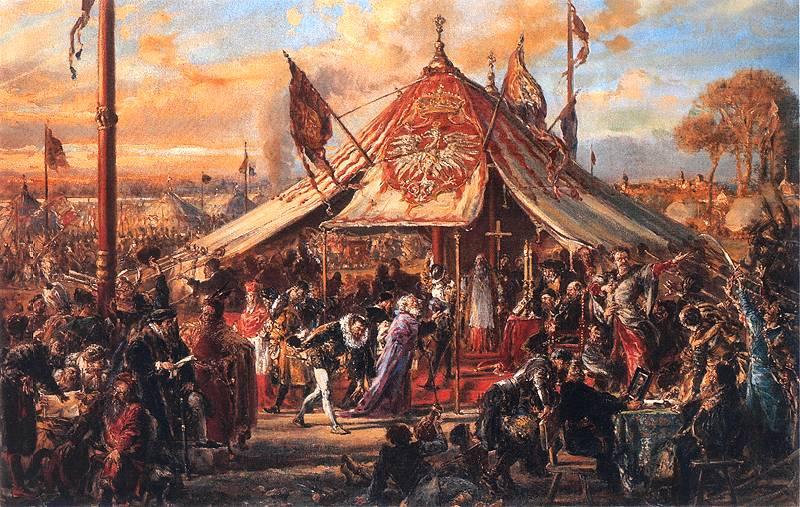
The election procedure as it crystallised in the 1573 act of the Convocation Sejm worked as follows. Upon the death of a king, an Interrex — by tradition the primate of the Polish Catholic Church — took over the formal functions of head of state for the duration of the interregnum. The Sejm convened first as a Convocation Sejm, which discussed candidates, set rules, and adjourned. It then reconvened, a few months later, as the Election Sejm, on an open field outside Warsaw called the pole elekcyjne — initially at Kamion in 1573, later (from 1575 onward) at Wola, on the western edge of the city. The participants were not only the nobility's elected deputies. By the 1573 act, the election was a viritim election — every adult male of the noble class had the right to attend in person, cast a vote, and address the assembly. This produced electoral gatherings of, at peak, perhaps a hundred thousand armed men on horseback, camped in a vast circle on the Wola plain.
The candidates — chosen from the European princely houses of the period — sent ambassadors to present their case. The ambassadors negotiated with the assembled szlachta and offered written commitments. Each successful candidate was required to sign two documents before being crowned: the Henrician Articles (the constitutional provisions binding every Polish king, drafted in 1573 and unchangeable thereafter); and the pacta conventa (the personal commitments of this particular candidate to this particular Sejm, freely negotiated, but binding for life). Failure to honour the documents triggered the constitutional right of the szlachta to renounce their obedience — the de non praestanda oboedientia clause, the most extreme expression of contractual monarchy in early modern Europe.
The Henrician Articles
The articles were named after the first elected king, Henry of Valois, the third son of Catherine de' Medici, elected in 1573 at twenty-two. Henry signed them. Henry then served as king for four months. Upon learning, in June 1574, that his elder brother Charles IX of France had died and that the French throne was now vacant for him as Henry III, he gathered a small entourage and rode out of Wawel Castle by night, abandoning his Polish-Lithuanian subjects without warning, never to return. The Sejm formally deposed him a year later and held a new election.
The articles he had signed, however, remained the constitutional anchor for the next two centuries. Their twenty-one clauses bound every subsequent king to (1) call the Sejm at least every two years, (2) wage no offensive war without the Sejm's consent, (3) raise no general tax without the Sejm's consent, (4) appoint no senator without the Sejm's consent, (5) marry no woman without the Sejm's consent, (6) confirm all noble privileges including the right of habeas corpus (neminem captivabimus nisi iure victum), (7) maintain religious toleration as laid down in the Warsaw Confederation of 1573, and (8) accept that the szlachta could lawfully resist a king who violated these terms. The Henrician Articles were, in effect, the first formal constitutional code of any European elective monarchy.
Stephen Báthory and the Vasa kings
The second elected king, the Transylvanian prince Stephen Báthory (reigned 1576–1586), is conventionally regarded as the most able sovereign the Commonwealth ever had. He was a competent military commander (his Livonian War campaigns against Ivan the Terrible recovered Polotsk and Velikie Luki and forced Ivan to a humiliating peace at Yam-Zapolsky in 1582); he reformed the army by establishing the standing infantry of the piechota wybraniecka drawn from royal estates; he founded the academy at Vilnius in 1579 (now Vilnius University, the oldest in eastern Europe); and he died, by report of natural causes, in 1586 at age 54 without obvious successors among his Hungarian relatives.
The third election, in 1587, returned the Jagiellonian descendants through the female line: Sigismund III Vasa, son of King John III of Sweden and Catherine Jagiellon. Sigismund III reigned for forty-five years (1587–1632). His was the longest reign of any Polish king. He was a deeply Catholic, deeply Spanish-influenced ruler whose principal political objective was to recover his hereditary Swedish throne (he held it briefly, 1592–99, and lost it permanently to his uncle Charles IX in 1599; this would launch the long Polish-Swedish wars that culminated in the 1655 Deluge). He moved the royal residence from Kraków to Warsaw in 1596, formally completing the shift of the political centre eastward that the Union of Lublin had begun.


What the system produced
The elective monarchy delivered, over its two centuries, a kind of monarch unique in European history: a constitutional foreign professional, periodically rotated, never permitted to consolidate dynastic power, always personally obliged to a written pact with the assembled nobility. The advantages were substantial. The Commonwealth never had a Cromwell-Charles-I crisis; it never had a Henri-IV-of-France assassination; it never had a Habsburg succession-war crisis. The disadvantages were equally substantial. The interregna averaged about ten months and produced repeated brief constitutional crises. The candidates' pacta conventa often committed them to foreign-policy preferences that did not align with the Commonwealth's actual interests (Sigismund III's Swedish entanglements, the Wettin Saxons' Saxon entanglements). Foreign powers learned how to manipulate the elections, paying bribes, sending troops to encamp on the election field, or simply funding rival candidates: by the eighteenth century, Russia, Austria, France and Prussia routinely treated the Polish royal election as an arena of their own great-power competition.
None of this was anticipated in 1573. The Henrician Articles were a piece of unprecedented constitutional creativity, written by men who had every reason to believe they had solved the problem of arbitrary monarchy. They had — and in doing so, they had bequeathed to their descendants a system that, when subjected to outside pressure, would prove difficult to defend.
End of Chapter II