Nader Shah Afshar (1688-1747) is, after Cyrus the Great and Shah Abbas, the third military figure of pre-modern Iranian history. He was a Turkmen tribesman from the Afshar branch of the Qizilbash, born in Khurasan, who began his career as a brigand and rose, in the chaos following the Afghan sack of Isfahan in 1722, to make himself successively the protector of the Safavid pretender, the regent of his own puppet shah, and finally — at a tribal assembly on the Mughan steppe in 1736 — the new king of Iran in his own name. In the eleven years of his personal reign, he reconquered every territory the Safavids had lost, briefly extended Iranian authority further east than any Iranian state had reached since the Achaemenids, and made himself into a figure whom contemporary European observers compared, without irony, to Alexander.

The military campaigns are the easiest part of the story to summarise. In 1729-1730 Nader expelled the Hotaki Afghans from Isfahan and the central plateau. In 1730-1735 he fought the Ottomans on the western frontier, recovering Tabriz, Hamadan, and the entire territory lost in the long Safavid decline. In 1737-1738 he turned east and reconquered Kandahar from the rebel branch of the Afghan ruling family. In 1738-1739, in an unprovoked invasion that has no parallel in Iranian military history before or since, he crossed the Khyber Pass into Mughal India, defeated the Mughal army of Muhammad Shah at the battle of Karnal in February 1739, took Delhi without further resistance, and after a misunderstanding between his troops and the city population that escalated into a riot, ordered a general massacre that killed an estimated thirty thousand civilians in a single day. He left Delhi after fifty-seven days, carrying away the entire Mughal imperial treasury — including the Peacock Throne of Shah Jahan, the Koh-i-Noor diamond, the Darya-ye Noor diamond, and (by some accounts) the equivalent in modern terms of roughly ninety billion dollars in gold, silver, and gems. He exempted Iran from taxation for three years on the proceeds.

The collapse
The wealth from Delhi did not stabilise the regime. Nader was, by temperament, a man whose authority rested on personal military victory; in peacetime he found it hard to govern. His health deteriorated. He grew suspicious of his eldest son Reza Qoli, blinded him in 1742 on suspicion of conspiracy, and immediately regretted the act. He executed senior officers on increasingly slight pretexts. In June 1747, at a camp in Khurasan, a group of his own commanders entered his tent at night and assassinated him to forestall their own predicted executions. He was fifty-nine.
The Afshar empire he had built collapsed within months. His nephew Adil Shah held the throne briefly. The army dispersed along tribal lines. The Afghan provinces declared independence under Ahmad Shah Durrani — a former Afshar general — who took most of Nader's eastern conquests with him; the modern country of Afghanistan dates effectively from this moment. The Indian conquests, briefly held, reverted to the Mughals. The Caucasian provinces were lost to the local Georgian and Armenian princes. Iran itself fragmented into competing regional powers.
Karim Khan Zand
The decade after Nader's death produced two competing dynasties. The Qajars, a Turkmen tribe based at Astarabad on the south-eastern Caspian, made themselves masters of the northern plateau. The Zands, a Lur tribe from the Zagros mountains, controlled the southern half of the country from Shiraz. The first round of the contest, between 1750 and 1779, was won by the Zand leader Karim Khan, an unusually mild and capable man who took the title Vakil ar-Ra'aya ("Advocate of the People") rather than shah, ruled from Shiraz, restored a measure of administrative competence and economic recovery, and is, in Iranian memory, the most admired figure of the eighteenth century.
Karim Khan's reign (1751-1779) is the small, civilised interval between the wars of Nader Shah and the long, often violent reign of the Qajar dynasty that succeeded him. Shiraz under Karim Khan acquired its present urban core, including the bazaar of the Vakil and the citadel that bears his name. The Zand court patronised the late stages of the so-called Isfahan school of miniature painting and the great Persian-language poet Hatef Esfahani. Karim Khan died of natural causes in 1779 — itself a noteworthy event in eighteenth-century Iranian royal biography — and the dynasty fragmented immediately. The Qajar leader Agha Muhammad Khan, who had been held hostage at the Zand court for sixteen years and had developed there a comprehensive and patient personal hatred of his captors, escaped, returned to Astarabad, raised his tribe, and reconquered the country province by province between 1779 and 1796.
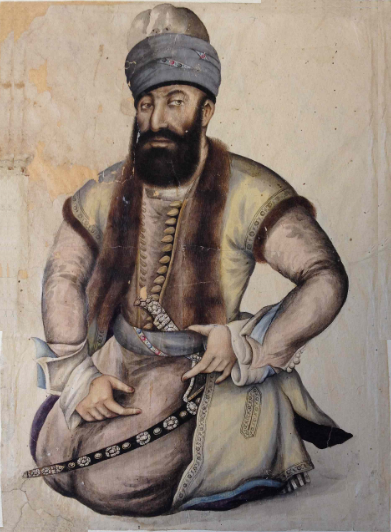

The brutality of Agha Muhammad Khan
Agha Muhammad Khan Qajar (1742-1797), the founder of the Qajar dynasty, was — by all accounts including those of his own court historians — one of the cruellest rulers in Iranian history. As a child he had been castrated by his father's enemies; he carried the resentment for the rest of his life. He sacked the city of Kerman in 1794 in punishment for its support of the Zands and ordered the entire male population blinded; one of the contemporary accounts records the eyeballs being delivered to his pavilion in baskets. He had the corpse of Karim Khan disinterred from Shiraz and reburied under his palace doorstep in Tehran, so that he might walk over the bones of his old enemy every morning.
His political achievements were nevertheless real. He reunified Iran in its modern boundaries, expelled the Russians from Tbilisi (which he sacked in 1795), moved the capital from Shiraz to the small town of Tehran (which would grow over the next two centuries from perhaps 15,000 inhabitants to the present nine million), and was crowned shah in March 1796 at the Mughan steppe, on the same site where Nader Shah had been crowned sixty years before. He was assassinated by two of his own servants — whom he had threatened with execution and who pre-empted him — in June 1797 at Shusha in Karabakh, during a campaign to recover Iran's Caucasian provinces from a now-resurgent Russia. He was sixty-five.
His nephew and adopted son Fath Ali Shah took the throne. The Qajar dynasty would rule Iran for another 128 years, against a background of mounting external pressure from Russia and Britain that would, by the end of the nineteenth century, reduce the country to something close to a joint protectorate. That story is the next chapter.
"The kingdom was an inheritance Nader Shah won by the sword and lost by the same sword turned upon his own children." — Mirza Mahdi Khan Astarabadi, court historian, 1750s
End of Chapter VII