The world's first empire of intercontinental scale was put together by a man whose grandfather had been a tribal chieftain. Cyrus II of Anshan — Cyrus the Great, in the Greek convention that English has inherited — was born sometime around 600 BC into the Achaemenid family of Persis, a southern province of the Iranian plateau. The Persians were at that time vassals of the Medes, a related Iranian people whose king Astyages held court at Ecbatana. Cyrus rebelled in 553 BC, defeated his grandfather Astyages in three years of campaigning, took the Median capital, and made himself king of both peoples. He then went on, in the space of two decades, to subdue Lydia in Anatolia (capturing Croesus in 547 BC), Babylon (taking the city without a battle in 539 BC), and the eastern Iranian provinces as far as the Jaxartes river. By the time he died, around 530 BC, in a campaign against the Massagetae beyond the Oxus, his empire stretched from the Aegean coast of Asia Minor to the western edge of India. It was the largest political entity the world had yet seen.
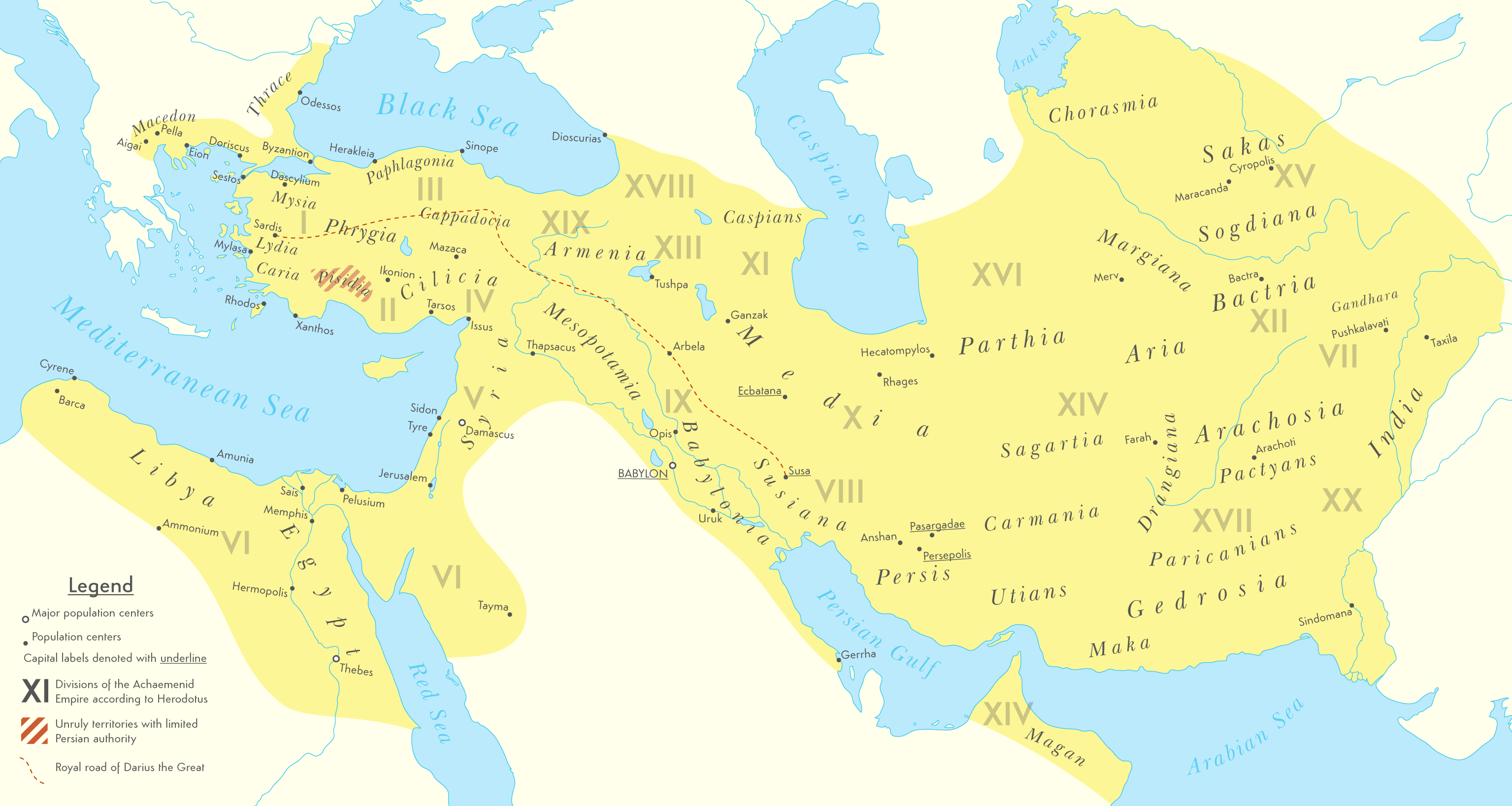
The empire he assembled remained intact for two more centuries, and grew. His son Cambyses II conquered Egypt in 525 BC. His successor Darius I — a distant cousin who took the throne by force in 522 BC after a year of dynastic chaos — extended the empire to the Indus, the Danube, and the Caucasus, and put in place the administrative machinery that would let it run. Darius's son Xerxes I led the invasion of Greece in 480 BC that produced Thermopylae and Salamis (and ultimately, a Persian withdrawal). His descendants ruled for another century and a half. The dynasty ended only when Alexander III of Macedon defeated Darius III at Gaugamela in 331 BC, and Darius was murdered the next year by his own satrap of Bactria. The Achaemenid Empire had lasted 220 years.
The Cyrus Cylinder
The single most famous document of Achaemenid Persia is a small clay cylinder, inscribed in Akkadian cuneiform, that Cyrus deposited under the walls of Babylon when he entered the city in October 539 BC. It is on display today in the British Museum. The text is, in form, a standard piece of ancient Near Eastern royal propaganda — Cyrus tells his new Babylonian subjects that the Babylonian god Marduk chose him to replace the unpopular last king Nabonidus, and that he has restored the proper worship of all the gods. But its substantive content is remarkable. Cyrus declares that the populations deported by the Babylonians to their own city — including, by inference, the Jews of the Babylonian Captivity — are free to return to their homelands and to rebuild their own temples. The Hebrew Bible's books of Ezra and Isaiah remember Cyrus by name as the foreign king who ended the Exile. He is the only non-Jew in the Hebrew scriptures to be called "the anointed of the Lord."
The cylinder has been called, in modern times, the world's first human rights document. This is an overstatement. It is not a general declaration of principles; it is a specific royal order for a specific city. But its underlying policy was real and consistent. Achaemenid governance, from Cyrus through Darius, was based on the principle that conquered peoples should be permitted to keep their gods, their languages, their priests, and (where possible) their local rulers, provided they paid their taxes and provided their soldiers. This was a sharp departure from the practice of the Assyrian and Babylonian empires that had preceded it, which had relied on deportation, massacre, and the suppression of local cults. The Achaemenid alternative was both more humane and more efficient. It allowed the empire to absorb peoples it could not have governed by force alone.

The administrative machinery
Darius I — who took the throne in 522 BC after killing the pretender Gaumata and his fellow conspirators, an episode he recorded on the great trilingual inscription at Bisotun — was the empire's true organiser. He divided the realm into twenty (later more) provinces called satrapies, each under a royal governor (a satrap) appointed from Persepolis. The satrap collected the local taxes and provided the local military forces, but was watched by an independent military commander and by a roving inspector — the so-called King's Eye — who reported directly to the court. Tax was paid in standard precious-metal weights. A standard coinage — the gold daric and the silver siglos — was minted. A network of royal roads, the most famous of which ran from Sardis on the Aegean to Susa in southwestern Iran, was kept up with a postal relay system that Herodotus described in terms that the United States Postal Service later borrowed for its motto: neither snow nor rain nor heat nor gloom of night.
The administrative documents that survive — chiefly the Persepolis Fortification Tablets, ten thousand small clay tablets unearthed at Persepolis in the 1930s — show a state of bureaucratic competence that has few parallels until the nineteenth century. Workers were paid in standardised rations of grain, wine, and beer. Women received maternity pay. Foreign craftsmen — Egyptians, Lydians, Greeks, Bactrians — were paid at higher rates than locals, presumably to attract them. The accounts are in Elamite, the indigenous language of the southern Iranian plateau, written in cuneiform. The court used Old Persian for monumental inscriptions and Aramaic for chancellery purposes. The empire was, from its administrative beginnings, multilingual and multi-ethnic on principle.
Persepolis
Darius's ceremonial capital was Persepolis — Pārsa in Old Persian, "the city of the Persians" — built from 518 BC on a terrace at the foot of the Kuh-e Rahmat in southern Iran. It was not the empire's administrative capital; that was Susa, with Babylon and Ecbatana also serving as royal residences according to the season. Persepolis was the ceremonial seat, where the kings received the tribute of the satrapies at the New Year festival (Nowruz, still celebrated on the 21st of March across the Iranian cultural world). The reliefs on the Apadana stairway — preserved in extraordinary condition — show delegations from twenty-three peoples bringing gifts: Medes bring horses, Babylonians bring bulls, Lydians bring rings, Indians bring gold dust, Ethiopians bring an okapi. The carving is shallow, precise, and serial, and the figures wear their own national dress. The point of the panel is the empire's self-image: many peoples, one king.

Persepolis was burned in May 330 BC by the army of Alexander the Great, several months after his victory at Gaugamela and his pursuit of the fleeing Darius III. The destruction was either an accident of a drunken banquet (so Plutarch and Diodorus) or a deliberate act of revenge for the burning of Athens by Xerxes 150 years before (so most modern historians). Either way the buildings collapsed, and the city was abandoned. The ruins, exposed for two and a half millennia, survived because the local stone is hard, the climate is dry, and the site is too remote to have been quarried for re-use. They are the best-preserved monumental architecture of pre-Islamic Iran, and the most-visited archaeological site in the country.
The Greek wars
The Achaemenid wars with the Greek city-states — the Ionian Revolt of 499-493 BC, Darius's invasion of 490 BC ending at Marathon, Xerxes's invasion of 480-479 BC at Thermopylae, Salamis, and Plataea — loom large in Western memory because the Greeks won them and wrote the histories. They do not loom large in Iranian memory at all. Greece, from a Persepolis perspective, was a small and unprofitable theatre on the empire's far western edge; the Greek city-states were, from a Persian perspective, vassals who had failed to pay their tribute and required correcting. The fact that the correction failed was a tactical inconvenience, not a strategic catastrophe. The empire continued to fight on the Aegean coast for the next 150 years, generally with great success, and was a continuous patron of one Greek faction against another. The Persian Wars are a Greek tragedy that the Persians did not realise they were starring in.
"The Persians had reached an agreement among themselves that they would not laugh at any custom that was not their own." — Herodotus, Histories, I.135
The end of the dynasty
The Achaemenid Empire was destroyed by a combination of internal succession crises and the unexpected arrival, in 334 BC, of the army of Alexander III of Macedon. The succession crises were repeated and bloody: of the ten kings who reigned between Cyrus and Darius III, four were murdered, two were probably murdered, and one was deposed. The throne was usually contested by adult sons and brothers, and the harem of any Achaemenid king contained the women and children of several potential claimants. By the time Darius III came to power in 336 BC, the central authority was in poor health.
Alexander's three years of campaigning in 334-331 BC are covered in the next chapter. What matters for this one is that Darius III was the last Achaemenid king. When he was murdered by his own satrap Bessus in the eastern provinces in July 330 BC, the dynasty ended. The empire he had ruled passed first to Alexander and then, after Alexander's death in 323 BC, to a Greek-speaking successor kingdom centred on the same satrapies, under a new royal family that had nothing in common with the old one except the territory.
The Achaemenid name went into eclipse for a thousand years. It would be revived as a self-conscious model by the Sasanian dynasty (Chapter III), reused as a political symbol by the Pahlavi dynasty in 1971 (Chapter IX), and remembered by the Iranian national imagination ever since.
End of Chapter I