The Arab conquest of Iran was, militarily, a swift catastrophe for the Sasanian state. From the fall of Ctesiphon in 637 to the death of Yazdegerd III in 651, the central authority collapsed, the army dispersed, and the territories of the empire were absorbed, province by province, into the new caliphate of Medina, then Damascus, then Baghdad. Local resistance was real and prolonged — the Caspian provinces of Tabaristan and Gilan held out for two centuries — but the imperial state ended in 651 and never reassembled in the Sasanian form. The conquest itself, then, was rapid. What followed it was slower and more interesting.

The Arab armies that took the empire were small — perhaps thirty to forty thousand fighters in total across the entire eastern campaign — and they had no administrative apparatus of their own with which to govern a state of twenty million people. They therefore did what most successful conquerors of that scale do: they kept the existing apparatus and ran the empire through it. Sasanian provincial governors who would convert (or in some cases simply pay tribute) were left in place. The land-tax registers were taken over. The mint masters of Persepolis, Ctesiphon, and Estakhr went on striking coins in the Sasanian style for thirty years — with the head of the late Sasanian king replaced, slowly, by an Arabic formula. The Pahlavi language continued to be used in administration as late as the eighth century. The conquerors lived in a small number of newly founded garrison cities — Kufa, Basra, Wasit — and left the country, in everyday terms, to itself.
The Islamisation of Iran
Conversion to Islam, against this background, was slow. Modern estimates suggest that the population of Iran did not become majority-Muslim until about 850 AD — two centuries after the conquest — and was not predominantly Muslim until perhaps 900. The Zoroastrian communities did not disappear, but were progressively reduced by emigration (to India, where they became the Parsis), by economic and legal pressure (the jizya, the poll tax on non-Muslims, was a permanent disincentive to remaining outside the faith), and by the slow loss of the priestly classes who maintained the liturgical knowledge. By 1000 AD, Zoroastrians were a small minority. Today there are perhaps 25,000 in Iran (concentrated in Yazd), 50,000 Parsis in India, and an active diaspora elsewhere. They are the survivors of a religion that was, for four centuries, the official creed of the Sasanian state.
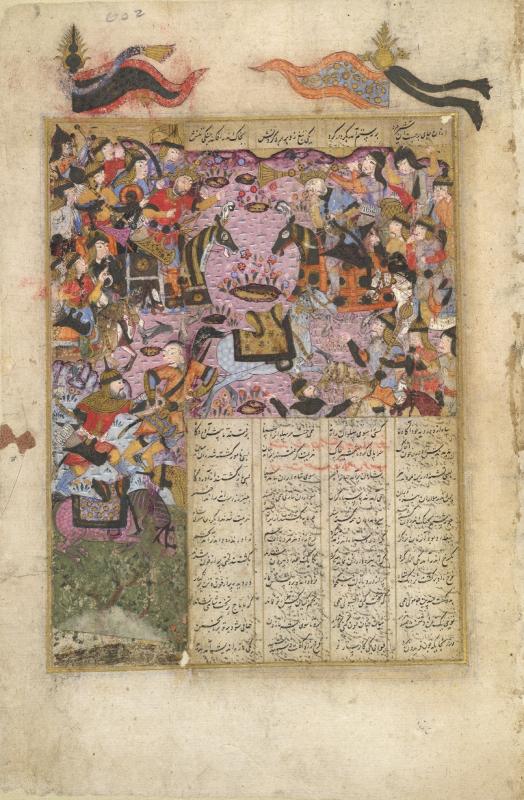
The Arabic language replaced Middle Persian as the language of high culture, but did not replace Persian as a spoken language. Iran did not become Arabic-speaking in the way that Syria, Iraq, and Egypt did. New Persian — written in the Arabic script with the addition of four extra letters, and with a substantial Arabic vocabulary in religious and abstract subjects — emerged in the ninth and tenth centuries as the everyday and then the literary language of the country. By 1000 AD, when Ferdowsi completed the Shahnameh (the Book of Kings, a 50,000-couplet epic of pre-Islamic Iranian legendary history), New Persian was a mature literary language, with a self-conscious resistance to Arabic borrowing in its high registers. Persian, not Arabic, would become the language of culture and administration of every Iranian state from the tenth century to today.
The Abbasid Caliphate and the Persian bureaucracy
The Umayyad Caliphate (661–750), based in Damascus, was an Arab state in which Iranian converts to Islam were second-class subjects (the mawali) who paid heavier taxes and held no senior positions. The Abbasid revolution of 750 — a movement that began in the eastern Iranian province of Khurasan under a propagandist named Abu Muslim — overthrew the Umayyads and brought to power a new dynasty that styled itself the family of the Prophet's uncle Abbas. The Abbasid capital moved east from Damascus to the newly founded Baghdad (762 AD), on the Tigris near the old Sasanian capital of Ctesiphon. The administrative model adopted there was the Sasanian one. The court ceremonial was the Sasanian one. The vizierial system, the postal service, the land-tax registers, the army organisation — all were essentially continuations of Sasanian practice, run by Iranian bureaucratic families like the Barmakids of Balkh, who held the vizierate for two generations.
The result was a caliphate that, in formal religious terms, was Arab and Muslim, but in administrative substance was Iranian and Persianate. Translators at the Abbasid court — the so-called House of Wisdom, sponsored by Caliph al-Ma'mun in the 820s — produced Arabic versions of Greek philosophical, medical, and astronomical texts, working largely from the Syriac translations that had survived from the Sasanian academy of Gondishapur. Avicenna (Ibn Sina, 980–1037), Al-Biruni (973–1048), Al-Khwarizmi (the mathematician whose name gave us "algorithm" and whose book gave us "algebra," c. 780–c. 850), and Al-Razi (the physician, 854–925) all worked in Arabic, but were Iranians, born in Iranian cities, trained by Iranian teachers. The Islamic Golden Age that ran from about 800 to about 1100 was, in personnel and intellectual substance, very largely a Persian achievement under an Arab linguistic cover.
The independent Iranian dynasties
From the mid-ninth century, the Abbasid caliphs lost effective control of their eastern provinces. A succession of independent Iranian dynasties emerged in the lands that had been the Sasanian heartland: the Tahirids (821–873) and Saffarids (861–1003) in Khurasan, the Samanids (819–999) in Transoxiana, the Buyids (934–1062) in western Iran and Iraq, the Ziyarids (931–1090) on the Caspian. These dynasties paid formal allegiance to the caliph in Baghdad, sent him a token tribute, and otherwise governed themselves. The Buyids were Shi'a; in 945, the Buyid amir Mu'izz al-Dawla took Baghdad itself and reduced the Sunni Abbasid caliph to a figurehead under Buyid protection. The political centre of the Islamic world, after three centuries, had moved back to the Iranian plateau.
It was in this period, and especially under the patronage of the Samanid court at Bukhara (in modern Uzbekistan), that New Persian literature began. The first major Persian poet, Rudaki (858–941), was a Samanid court poet. The historian Bal'ami translated al-Tabari's Arabic universal history into Persian for the Samanid amir Mansur I. The Shahnameh of Ferdowsi was begun under the Samanids and completed, after their fall, under their Ghaznavid successors. By the year 1000, the Iranian plateau had its own state, its own language, its own literature, its own school of mathematics and medicine, its own school of theology, and — crucially — a sense of cultural distinctness from the Arab Islamic world that has persisted in some form ever since.
"I have suffered much in these thirty years; I have brought the Persians alive by this language of mine." — Ferdowsi, Shahnameh, on completing the epic c. 1010 AD
The Turkic invasion
The independence of the Iranian dynasties ended with the arrival of the Turks. The Seljuk Turks — Oghuz nomads from the Central Asian steppe, recently converted to Sunni Islam — entered Khurasan from the north in the 1030s, defeated the Ghaznavid empire at Dandanaqan in 1040, and over the next thirty years overran the entire Iranian plateau, Iraq, and most of Anatolia. The Persian-speaking literary and bureaucratic class survived intact and was inherited by the new Turkic ruling dynasty. But the political character of the Iranian world changed: from this point until the early twentieth century, Iran was ruled mostly by Turkic or Turkic-Mongol dynasties, with Persian-speaking civil servants administering the state for them. The model — Turkic sword, Persian pen — would last almost a thousand years. The Seljuks are the subject of the next chapter.
End of Chapter IV