Alexander III of Macedon crossed the Hellespont in the spring of 334 BC, at the head of an army of about forty thousand Greeks and Macedonians, intending to do what no Greek state had succeeded in doing for two centuries: to free the Greek cities of Asia Minor from Persian rule. In the event he did considerably more than that. He defeated the Persian provincial forces at the Granicus in May 334 BC, took Sardis, marched south through the Anatolian and Syrian coast, defeated the imperial army of Darius III at Issus in November 333 BC, captured Tyre after a seven-month siege in 332 BC, accepted the surrender of Egypt later that year, and crossed the Euphrates and the Tigris into the heart of the empire in 331 BC. On the 1st of October 331 BC, on the plain of Gaugamela in northern Iraq, he destroyed the imperial Persian army for the second time. Darius fled. The road to Babylon, Susa, and Persepolis was open.
Alexander entered Babylon as the new Great King, was acclaimed by the Persian aristocracy that had not died at Gaugamela, and took up the Achaemenid royal titles. He spent the winter of 331-330 BC at Persepolis, where the palace complex was burned (see Chapter I). He pursued the fleeing Darius into eastern Iran. Darius was murdered by his own satrap of Bactria in July 330 BC, and Alexander captured the satrap and had him executed. By 327 BC Alexander had subdued Bactria and Sogdiana — modern Afghanistan, Uzbekistan, and Tajikistan — and married the Sogdian noblewoman Roxana. In 326 BC he crossed the Hindu Kush into the Punjab. His exhausted troops mutinied on the Beas river, refusing to march further east. He turned back. He died in Babylon on the 11th of June 323 BC, aged thirty-two, of an illness whose nature is still debated. He had been Great King of Persia for seven years.
The Seleucid kingdom
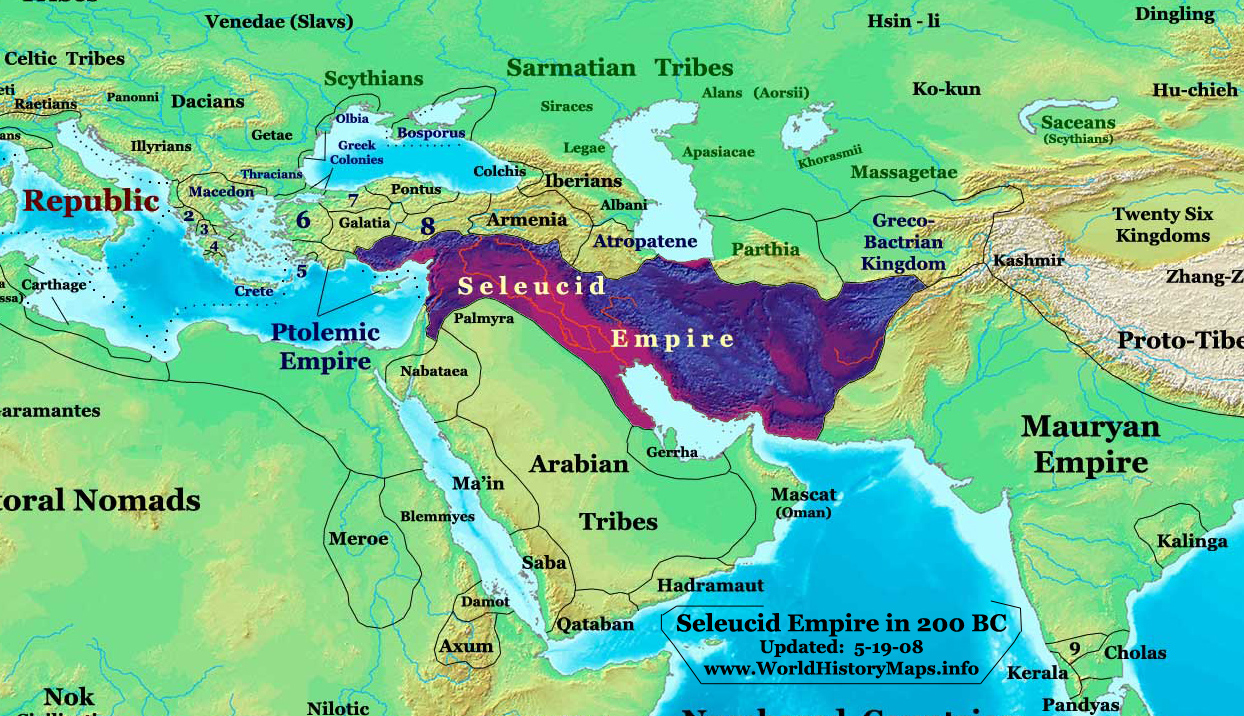
Alexander's empire was divided among his generals within twenty-five years of his death — the so-called Wars of the Diadochi, the Successors. The largest of the successor kingdoms, comprising most of the old Achaemenid heartland, fell to Seleucus I Nicator, a Macedonian cavalry officer who had served under Alexander. The Seleucid kingdom at its height ran from western Anatolia to the Indus, with two capitals: Antioch on the Mediterranean, and Seleucia-on-the-Tigris in southern Iraq. It was a Greek-Macedonian ruling class superimposed on the population, infrastructure, and administrative practice of the Achaemenids. Seleucus and his descendants kept the satrapy system, kept the royal road network, kept the multilingual chancellery, kept the policy of religious tolerance, and added a layer of Hellenistic cities — Greek-style poleis with theatres, gymnasia, agoras, and Greek civic constitutions — across the empire. Some of these cities — Antioch, Apamea, Seleucia, Ecbatana — became important. Most withered. The Iranian plateau itself was not, in any deep way, Hellenised. It remained Persian-speaking, Zoroastrian, and culturally continuous with the Achaemenid past.
The Seleucid kingdom held together for about a century. It began to disintegrate from the eastern end: Bactria broke away in around 250 BC under a Greco-Bactrian dynasty that would, in the second century BC, briefly rule parts of northern India. Parthia, the satrapy south-east of the Caspian Sea, was overrun in the same decade by Iranian-speaking nomads from the steppe — the Parni — under a chieftain called Arsaces. The Arsacid dynasty he founded would, over the next century, expel the Seleucids from the entire eastern half of the old Achaemenid empire and would reign as kings of Persia for nearly five hundred years. The Seleucid kingdom was reduced to Syria. The last Seleucid king, Antiochus XIII, was killed by Pompey the Great in 64 BC, when the Romans took Syria and reduced what remained to a Roman province.
The Parthian recovery
The Parthian — or Arsacid — empire that took the place of the Seleucids in Iran has been treated by classical Western historians as a kind of placeholder between Achaemenids and Sasanians, a barbarian interlude in which not much happened. This is wrong. The Parthians ruled for 471 years (247 BC – 224 AD); the dynasty was longer-lived than any other Iranian state before the modern period. They restored the Persian-speaking aristocracy to power, they re-established the Iranian style of royal court, they continued and extended the Silk Road trade with China (a Han Chinese embassy reached the Parthian court in 121 BC), and they fought the Romans to a standstill for three centuries on the Euphrates frontier.
The Parthian state was looser than the Achaemenid had been. The king of kings ruled a federation of vassal kingdoms — Armenia, Adiabene, Characene, Persis itself — each with its own dynasty under Arsacid suzerainty. The military backbone was the heavy cavalry of the Iranian aristocracy: the cataphracts, fully armoured horse and rider, fighting with the long lance, alongside mounted archers who used the bow at the gallop. The Roman legions were largely infantry. The military mismatch was decisive at Carrhae on the 9th of June 53 BC, when the Roman triumvir Marcus Licinius Crassus, attempting an unprovoked invasion of Parthia, was destroyed by a Parthian army a third the size of his own. Crassus was killed. Twenty thousand Roman legionaries died. Ten thousand were taken prisoner and resettled, according to one Chinese source, in a town in the eastern Iranian provinces. The seven captured legionary eagles were returned to Rome thirty-three years later as part of a diplomatic settlement under Augustus. The Romans never tried to take Mesopotamia again — they tried four further times, by four different emperors, all of them ending in defeat or stalemate.


"He who covets another's, loses his own." — Parthian proverb, recorded by Tacitus on the failure of Crassus
Ctesiphon
The Parthian and later Sasanian capital was Ctesiphon, on the east bank of the Tigris about thirty-five kilometres south of modern Baghdad. The two cities — Ctesiphon and the older Greek foundation of Seleucia, on the opposite bank — formed a single conurbation that ancient sources call the largest city in the world at the start of the first millennium AD. Modern archaeological estimates put its population, at peak, at about half a million people. The site is partly preserved today: the great arched iwan of the royal audience hall, the Taq-e Kasra, built by the Sasanians in the sixth century and at the time the largest brick vault in the world, still stands in the Iraqi desert outside Baghdad. It is one of the few above-ground remains of pre-Islamic Iranian monumental architecture, and it is mostly visited by Iranian pilgrims who consider it a national monument that happens to be in Iraq.
The slow decline
The Parthian state grew weaker through the second century AD under combined pressure from Rome, from the eastern nomads (Kushans, Sakas), and from internal dynastic conflict. The Romans took Ctesiphon three times — under Trajan in 116 AD, under Lucius Verus in 165 AD, and under Septimius Severus in 198 AD — and on each occasion withdrew, unable to hold the territory but inflicting serious damage. The plague that the army of Lucius Verus brought back from Ctesiphon in 165 AD — the so-called Antonine Plague — killed an estimated five million people across the Roman world over the next fifteen years, and is generally considered one of the proximate causes of the Roman empire's third-century crisis.
The end came not from Rome but from inside. In around 220 AD, a regional king in Persis itself — Ardashir of the Sasanian family, descended from the priestly aristocracy of the old Achaemenid heartland — rebelled against his Parthian suzerain. He defeated the last Parthian king Artabanus IV at the battle of Hormozdgan in 224 AD, killed him, and was crowned king of kings at Ctesiphon two years later. The Arsacid dynasty was over. A new and self-consciously Persian regime was about to take its place.
End of Chapter II